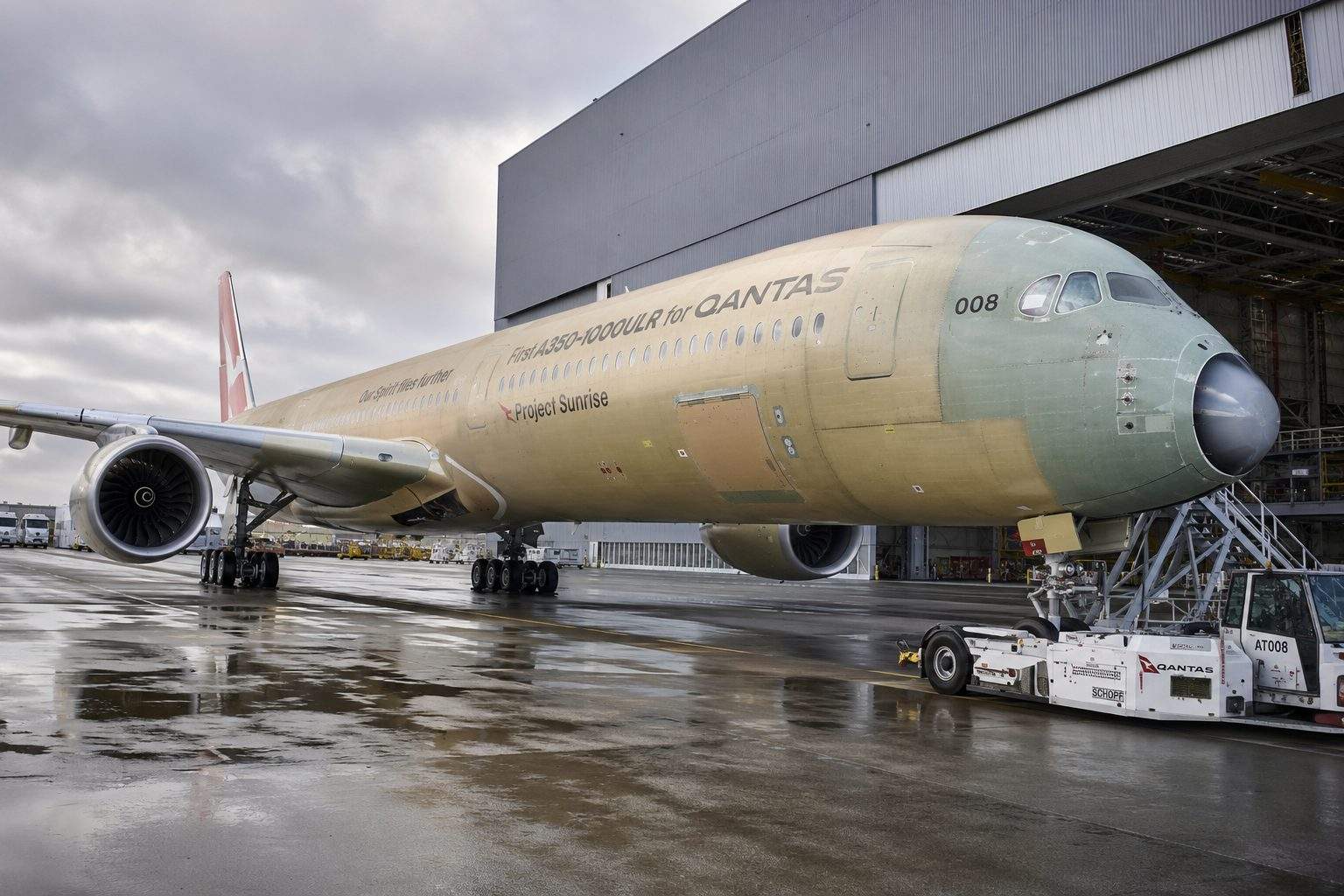

Qantas (ASX:QAN) Project Sunrise Test Flight Meets Range Target, Premium Fare Strategy Highlighted

Qantas (ASX:QAN) Project Sunrise Test Flight Meets Range Target, Premium Fare Strategy Highlighted

SYDNEY, July 30, 2026, 20:04 AEST

  • Airbus operated its A350-1000ULR for 24 hours and 24 minutes, covering 23,075 kilometres.
  • The jet, configured with 238 seats, dedicates 41.2% of its total capacity to premium class cabins.
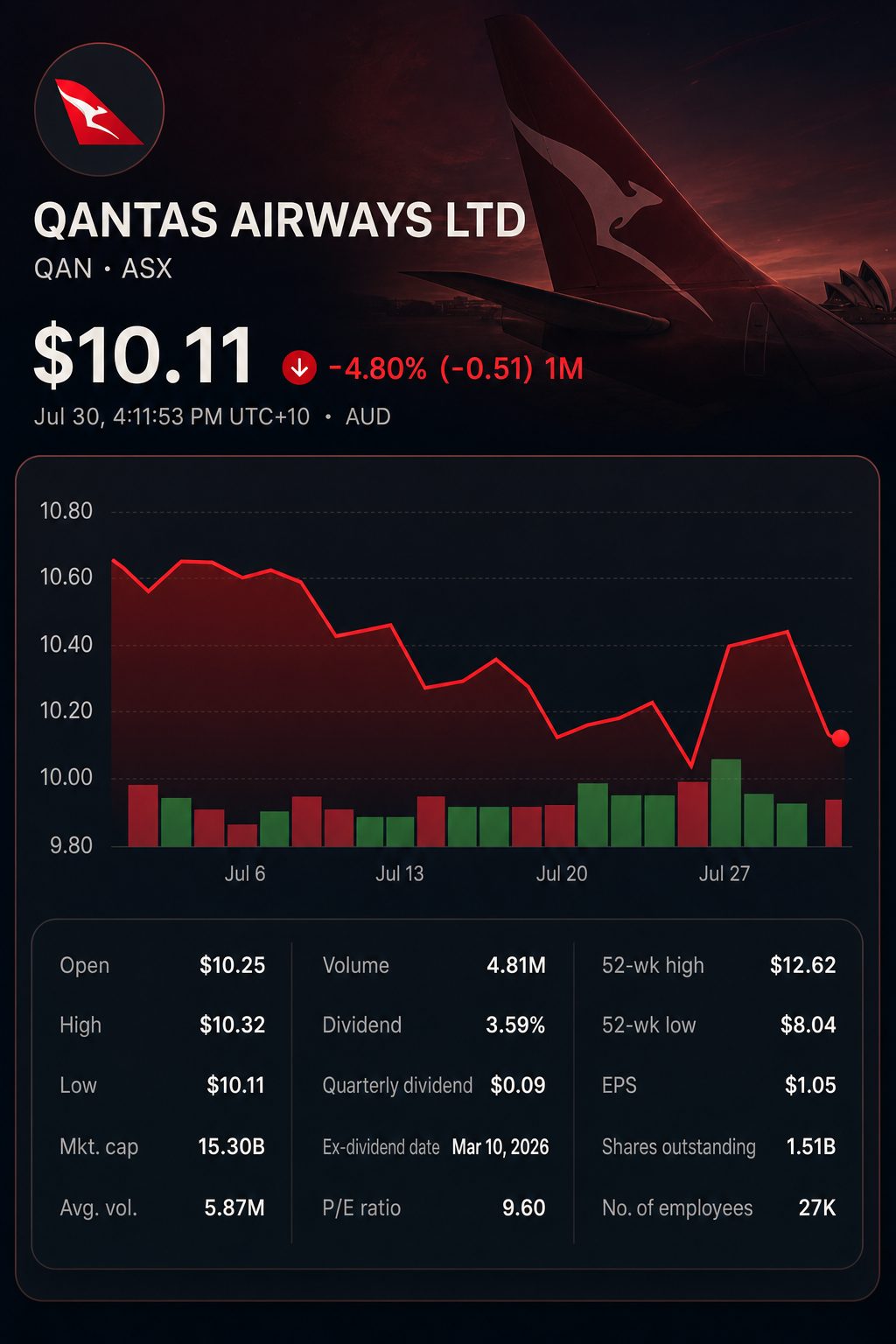
  • Qantas ended Thursday at A$10.11, falling 3.0%.

Qantas overcame a key endurance test for Project Sunrise. The flight addressed an engineering issue but left commercial uncertainties unresolved.
Stock chart for ASX:QAN

The business model relies on charging higher prices for time savings. Project Sunrise seats just two additional passengers compared to Qantas’s 787-9 but includes 28 extra premium seats.

Premium seats increase by 40%, as overall seat count climbs 0.8%. Economy seating drops 15.7%. The cabin, rather than the headline figure, is key to the investment argument.

The Australian cash market was shut at the dateline. Qantas finished at A$10.11, dropping 3.0%. The S&P/ASX 200 fell 0.78% to 8,967.70.

Based on closing-price data, Qantas trailed in every comparison period. Performance in the most recent full week also remained subdued.

Market periodQantasASX 200Qantas relative
Thursday, July 30-3.0%-0.78%-2.2 percentage points
Week ended July 24-2.4%-0.3%-2.1 percentage points
July 24 to July 30+1.2%+2.2%-1.0 percentage point

The tape does not clarify investors’ reasons for selling. It also indicates that resilience by itself has not led to any lasting rerating.

Airbus operated the A350-1000ULR on a nonstop flight from Melbourne to Toulouse, remaining in the air for 24 hours and 24 minutes. The achievement surpassed Boeing ’s distance record from 2005 by 6.8%.

Flight benchmarkTimeDistanceComparison
A350-1000ULR development flight, 202624h 24m23,075 kmSets new endurance record
Planned Project Sunrise customer mission21h 40mTest exceeded by 164 minutes
Boeing 777-200LR flight, 200522h 42m21,601.7 kmHeld previous distance record

However, this stage involved development testing, not certification. Airbus conducted evaluations of fuel management, cabin environment, and crew rest systems. Test pilot Xavier Pepin explained that the tank was completely filled “to validate all necessary parameters during the mission.” Airbus

Qantas’s cabin configuration uses range capability to drive revenue. Unlike high-capacity models, its A350 features a far larger proportion of premium seating compared to Qantas’s other long-haul aircraft.

Qantas aircraftTotal seatsPremium seatsPremium shareEconomy seats
Project Sunrise A350-1000ULR2389841.2%140
787-92367029.7%166
A38048514429.7%341

Business and premium economy together, counted first.

Current network data underlines the approach. On Qantas’s 787-9 routes, premium revenue per available seat kilometre (RASK) surpassed economy by 9%. The airline also reports that Perth-London attracts fares about 20% above one-stop competitors.

Aviation analyst John Strickland put it directly: “What they are selling is time.” Qantas needs to ensure it sells a sufficient amount. Reuters

Qantas is aiming for over A$400 million in yearly EBIT after the full fleet of 12 aircraft becomes operational. Management projects this figure to make up more than two-thirds of Qantas International EBIT for FY25.

Economic indicatorFigureClassification
H1 FY26 Premium RASK uplift9%Reported actual
Perth-London route fare premiumAbout 20%Management benchmark
Qantas International EBIT for FY25A$596 millionReported actual
Annual EBIT for Project Sunrise full fleetMore than A$400 millionManagement estimate
Sunrise EBIT goal against FY25 international EBITMore than 67%Calculated comparison

The scale is bold. If premium demand is soft, returns could erode rapidly. Additional fuel use and reduced seat density mean fewer economy travellers to share costs.

Delivery of the first aircraft is expected in April 2027. Tickets are set to go on sale in February. Subject to necessary certification and approvals, daily flights between Sydney and London are scheduled to commence in October 2027.

Chief Executive Vanessa Hudson said, “Today, we’re taking out the last one,” as she addressed the end of the Kangaroo Route’s final stopover. Qantas anticipates the direct flight will reduce travel time by up to four hours. Qantas Newsroom

Qantas does not have an earnings release set for next week. The company’s preliminary FY26 results are expected on August 27. In the short term, focus moves to testing, pricing, and operational expenses.

Week-ahead itemTimingInvestor read-through
International Red Tail Sale concludesAugust 4, 23:59 AESTCurrent fare dynamics
A350 evaluation and certification processesOngoingTimeline for delivery and entry to service
Qantas FY26 resultsAugust 27Upcoming earnings event

Commercial and operational risks remain. Qantas’s premium fares may fall short of targets. Certification or delivery setbacks could push back the expected 2027 start. Rising fuel prices, closed airspace, and passenger fatigue could lower the appeal of the time advantage.

The test provided an answer on the range issue. Investors remain to be convinced that 98 premium seats will sell at premium pricing.

TS2 TECH • EXTENDED COVERAGE

Further analysis

How are airline shares performing ahead of the U.S. market open today?
Ahead of Thursday’s U.S. open, airline stocks posted another widespread decline. The JETS ETF traded at $30.97, down around 2.8% from its last close. Delta was quoted at $86.25 and United at $119.42, each falling nearly 3.5%. American was priced at $14.84, and Southwest slipped 4.2% to $44.38. The moves reflected sector-wide pressure.
Is there an overall decline in passenger demand, or is it simply moving across different regions?
Global passenger demand dropped 1.7% in June from a year earlier. Capacity was down 1.3%, pushing the industry load factor to 84.2%. Domestic demand decreased 3.0%, with the United States reporting a 1.2% decline. Middle Eastern airlines saw the sharpest fall, as total demand dropped 13.9%. European traffic rose 0.8%, and African demand increased 3.8%. Demand shows continued weakness.
To what extent are rising fuel costs eroding airline earnings?
IATA forecasts global airlines will post earnings of just $23 billion in 2026, about half its previous industry estimate of $41 billion. The net margin outlook has dropped to 2.0%, down from 3.9%. Fuel spend could climb to $350 billion, compared to $252 billion last year. Jet fuel prices are projected to average $152 a barrel in 2026. IATA says the margin for error is slim.
Which major U.S. airline is presently offering the most robust published outlook?
United’s full-year adjusted EPS outlook leads at $9 to $11. Delta’s guidance remains at $6.50 to $7.50 in adjusted EPS, with $3 billion to $4 billion projected free cash flow. The EPS numbers aren’t directly comparable because the companies have different share counts. Delta projects a third-quarter operating margin of 11% to 13%. United forecasts it will offset 80% to 90% of third-quarter fuel inflation. Both airlines’ guidance substantially surpasses American’s breakeven midpoint.
What factors are contributing to American Airlines holding greater downside risk compared to its rivals?
American reported a 16.3% increase in second-quarter revenue, reaching a record $16.7 billion. Despite this, GAAP net income for the quarter totaled just $71 million. Fuel costs rose by more than $2.2 billion, up 83% from a year earlier. Management forecasts that adjusted 2026 EPS will range from a $0.65 loss to a $0.65 profit, with the midpoint at zero. A further rise in fuel prices could quickly eliminate this slim margin. AAL shares trade at $14.84, with negative trailing earnings.
Have increased ticket prices managed to balance out the fuel cost impact for the industry?
So far, only a partial offset. American recouped close to half of its Q2 fuel cost increase with higher ticket prices. United similarly recovered around half, as passenger yields advanced 12% from a year earlier. United forecasts a recovery of between 80% and 90% in Q3, targeting full recovery in Q4. Frontier posted a 28% jump in revenue per available seat mile, with capacity up 8%. IATA projects a 7% global rise in passenger ticket yields in 2026. Rising fare prices offer some relief, but fuel prices change more rapidly.
Do Air France-KLM's latest results offer a boost to the European outlook?
Air France-KLM posted adjusted operating profit of €484 million for the second quarter, surpassing analyst forecasts of €327 million, though the result decreased from €736 million posted a year ago. Revenue climbed 9.9% to €9.28 billion, as 28.3 million passengers flew with the airline. The company lowered its 2026 capacity growth outlook to 2%-3%. Shares were up roughly 1.4% after the results were announced.
Based on current P/E ratios, which airline share appears most undervalued?
United is valued at roughly 11.2 times trailing earnings, while Delta trades at about 14.3 times. Southwest’s multiple stands at approximately 28.1 times after reducing its 2026 earnings guidance. American, Frontier, and JetBlue report negative trailing earnings, so P/E ratios are not applicable for comparison. These metrics give United an advantage at present. However, trailing multiples can shift sharply with changes in fuel exposure, so lower valuations carry risks. Bargain stocks may drop further.
What is the latest, most credible outlook for airline stocks in the upcoming quarter?
A typical scenario suggests steady revenue increases but thinner profit margins. IATA maintains its forecast of 5.1 billion passengers with an 84.0% load factor. Delta projects mid-teens revenue growth for the third quarter, despite only slight growth in capacity. American predicts its third-quarter revenue will rise 16% to 19% from a year earlier. A positive outcome would depend on lower oil prices and consistent Middle Eastern airspace. Risks tilt bearish if fuel prices rise again or demand weakens further. The spread of possible futures remains considerable.
Iwona Majkowska

Iwona Majkowska is a financial markets journalist at TS2.tech. She covers stocks, artificial intelligence and technology, with a focus on the stories moving U.S. and global markets. Before turning to financial journalism, she worked in equity research and financial analysis. She is a graduate of the Warsaw School of Economics. Follow Iwona Majkowska on Google News.

US Stock Market Today Updates

AI PORTFOLIO

Top Stock Picks

Today’s highest-ranked model selections.

#1 Strong buy

Alphabet

NASDAQ:GOOGL 92/100 • ★★★★½
#2 Strong buy

Taiwan Semiconductor Manufacturing

NYSE:TSM 89/100 • ★★★★½
#3 Buy

S&P Global

NYSE:SPGI 88/100 • ★★★★
#4 Buy

Amazon

NASDAQ:AMZN 86/100 • ★★★★
#5 Buy on weakness

Microsoft

NASDAQ:MSFT 84/100 • ★★★★
View full portfolio
Editorial model selection. Not personalised advice.
MARKET CALENDAR

Key Events Today

The catalysts most likely to move markets.

#1

Flash U.S. PMIs

The 9:45 AM ET pair has the strongest broad-market potential today because growth surprises can quickly reprice Treasury yields, the dollar and rate expectations.

#2

BJ's Wholesale Club

Results can influence consumer and retail sentiment, particularly around value-seeking behavior, traffic and gross margins.

#3

Ubiquiti

Its results are relevant for communications equipment and networking demand, with earnings sensitivity to margins and product mix.

View full calendar
Times and estimates may change. Verify before trading.
Microsoft (NASDAQ:MSFT) shares surge close to 9% after easing of AI order backlog tempers spending worries
Previous Story

Microsoft (NASDAQ:MSFT) shares surge close to 9% after easing of AI order backlog tempers spending worries

Buybacks Shift UK Dividend Stock Income Rankings
Next Story

Buybacks Shift UK Dividend Stock Income Rankings