Published December 5, 2025
NASA is closing out 2025 with a flood of major developments: its next flagship space telescope is now fully assembled, scientists are warning that satellite swarms could seriously damage future space astronomy, an interstellar comet is under intense scrutiny, and new results are reshaping our understanding of asteroids, supernovae, Earth’s weather and even aircraft safety.
Here’s a detailed roundup of the key NASA stories making headlines as of December 5, 2025, curated for readers of Google News and Discover.
Roman Space Telescope: NASA’s Next Flagship Is Fully Assembled
NASA has confirmed that construction of the Nancy Grace Roman Space Telescope is complete, marking one of the most important milestones in space astronomy since the James Webb Space Telescope. NASA
On November 25, 2025, engineers at NASA’s Goddard Space Flight Center in Maryland mechanically joined the observatory’s two major sections—its inner core (telescope, instruments and spacecraft bus) and the outer structure that includes its protective sunshield. With that integration, Roman is now a single, fully assembled observatory. NASA
Key points about Roman’s status and mission:
- Launch timeline: The mission is officially slated to launch no later than May 2027, but the team says they’re on track for a possible launch as early as fall 2026, pending final tests and readiness reviews. NASA
- Recent testing: Earlier this fall, Roman’s inner core completed an intensive 65‑day thermal vacuum campaign, proving it can operate in the extreme cold and vacuum of space. The outer structure also passed acoustic and vibration tests that simulate the violence of launch. NASA
- Science goals: Roman is designed to:
- Map the universe to probe the nature of dark energy.
- Conduct massive exoplanet surveys using microlensing.
- Produce ultra‑wide, Hubble‑quality images to study galaxy evolution, dark matter and stellar populations. NASA
Roman’s combination of a wide field of view and sharp Hubble‑like resolution will make it a central NASA observatory for the 2030s—if, that is, the sky itself remains dark enough. That brings us to one of today’s most worrying NASA‑related headlines.
Satellite Megaconstellations: NASA‑Led Study Warns of Severe Threat to Space Telescopes
A new NASA‑led study published in Nature has sparked global concern by quantifying how satellite megaconstellationscould contaminate images from space telescopes like Hubble and Roman later this decade. Nature+1
Researchers modeled the effect of up to 560,000 low‑Earth‑orbit satellites—a rough total based on current and proposed constellations from multiple operators—and found:
- By the mid‑2030s, roughly one‑third to 40% of Hubble Space Telescope images could contain satellite streaks if current deployment plans proceed. Moneycontrol+1
- For future wide‑field missions, the picture is even more alarming:
- A planned NASA mission (SPHEREx) could see streaks in ~96% of images in worst‑case scenarios. Nature+1
- China’s Xuntian space telescope, with its large field of view, could have dozens of satellites in a single exposure. Moneycontrol
The study, led by NASA Ames researcher Alejandro Borlaff, frames satellite light pollution as a “very severe threat” to space‑based astronomy, not just to ground‑based observatories. ScienceAlert
Mitigation options under discussion include:
- Tighter international coordination on orbital altitudes and satellite brightness.
- Software pipelines to automatically detect and remove satellite trails, though this costs observing time and can compromise data. Science
The findings are particularly relevant for NASA missions like Hubble, Roman, SPHEREx and future survey telescopes, and they add new urgency to global space‑traffic policy debates.
Interstellar Comet 3I/ATLAS: Hubble, Psyche and Others Chase a Visitor from Another Star
Comet 3I/ATLAS is only the third known interstellar object to pass through our solar system, and NASA is throwing multiple tools at it.
Hubble revisits 3I/ATLAS
On November 30, 2025, the Hubble Space Telescope reobserved 3I/ATLAS with its Wide Field Camera 3. At that time the comet was about 178 million miles (286 million kilometers) from Earth. To keep the comet centered, Hubble tracked its motion, causing background stars to appear as blue‑white streaks across the image. NASA Science+1
These new data will help refine the comet’s activity, coma structure and composition as it swings through the inner solar system.
NASA’s Psyche mission joins the campaign
NASA’s Psyche spacecraft, en route to study a metal‑rich asteroid, also turned its multispectral imager toward 3I/ATLAS in September 2025. Over eight hours, Psyche gathered a sequence of images when the comet was about 33 million miles (53 million kilometers) from the spacecraft. NASA Science
Those measurements:
- Provide an independent check on 3I/ATLAS’s orbit and velocity.
- Help scientists understand how the comet’s coma and jets evolve at different distances from the Sun. NASA Science
What we’re learning so far
Ground‑based observations reported this week suggest 3I/ATLAS may be venting material from “ice volcanoes” (cryovolcanoes) as it warms—jets of gas and dust likely driven by carbon dioxide and other volatile ices. Live Science
NASA still classifies 3I/ATLAS as a natural comet from another planetary system, offering a rare peek at primordial material formed around a distant star. NASA Science+1
For skywatchers, NASA’s December “What’s Up” bulletin notes that 3I/ATLAS will reach its closest approach to Earth around December 19, 2025, though it will remain a telescopic object rather than a naked‑eye spectacle. NASA Science+1
Artemis: From Media Invites for Artemis II to New Science for Artemis IV
NASA’s Artemis program—aimed at returning humans to the Moon and building a long‑term presence—is also in the news.
Artemis II: First crewed lunar flyby of the campaign
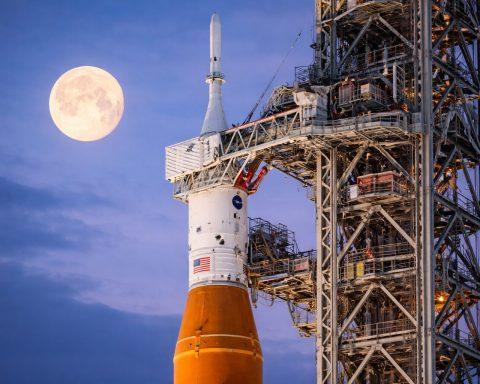
NASA has opened media accreditation for the launch of Artemis II, the first crewed flight of the Space Launch System (SLS) rocket and Orion spacecraft. NASA
- Artemis II is targeted for early 2026 and will send:
- Reid Wiseman,
- Victor Glover,
- Christina Koch, and
- Jeremy Hansen (Canadian Space Agency)
on an approximately 10‑day journey around the Moon and back. NASA
The mission will test Orion’s life‑support systems and operations with crew before NASA attempts a lunar landing on Artemis III.
Artemis IV: New lunar surface instruments
In deep‑space science planning, NASA has selected two new instruments to fly on the Artemis IV mission, expanding the suite of experiments that will operate on the lunar surface later this decade. NASA Science
The selected payloads will target:
- Detailed measurements of the lunar environment and surface composition.
- Data to support long‑term human operations and resource utilization at the Moon’s south polar region.
Building the lunar infrastructure: Lunar freezer system
NASA has also awarded a contract to develop a Lunar Freezer System, specialized cryogenic hardware designed to store and transport extremely cold samples returned from the Moon under Artemis. NASA
Together, these steps show that NASA is trying to lock in not just crewed flights, but also the scientific and logistical backbone that will make sustained lunar exploration possible.
Humans in Orbit: Jonny Kim’s Science Push and an ISS Crew Transition
On the International Space Station (ISS), astronaut Jonny Kim is wrapping up an extraordinarily busy research tour as NASA prepares for a crew handover.
Jonny Kim’s research campaign
In a recent feature, NASA highlighted Kim’s wide‑ranging portfolio of experiments aboard the ISS, which span: NASA
- Medical checks in microgravity to understand how spaceflight changes the human body.
- Plant growth studies under low‑light conditions, aimed at future space agriculture.
- Experiments that encode data into DNA, exploring ultra‑dense information storage techniques.
- Remote robotics demonstrations, where astronauts control robots that could work on the Moon or Mars.
- Investigations into bone‑loss countermeasures, advanced manufacturing and nutrient delivery systems.
These studies are part of a broader push to use the ISS as a testbed for Mars‑class missions, where crews will need robust medical, food, and automation systems far from Earth.
Upcoming return to Earth
A separate media advisory lays out NASA’s coverage plan for Kim’s return to Earth aboard Soyuz MS‑27 with Roscosmos cosmonauts Sergey Ryzhikov and Alexey Zubritsky. NASA
Key timeline (all Eastern Time, subject to change):
- Dec 7 – Change‑of‑command ceremony as Expedition 73 hands off to Expedition 74. NASA
- Dec 8 – Farewell activities, hatch closure and undocking from the ISS. NASA
- Just after midnight on Dec 9 – Planned landing on the Kazakh steppe. NASA
By mission’s end, Kim and his crewmates will have spent about 245 days in space, orbiting Earth nearly 4,000 times and traveling roughly 104 million miles. NASA
New arrivals and a new chief astronaut
- NASA astronaut Chris Williams and two Roscosmos crewmates recently arrived at the ISS aboard Soyuz MS‑28, temporarily boosting the station’s population to 10 people. NASA
- On the ground, NASA has named veteran astronaut Scott Tingle as the new chief of the Astronaut Office, a role that includes helping assign crews to upcoming Artemis missions. NASA
NASA has also been marking 25 years of continuous human presence aboard the ISS this fall, reflecting on how the station has become both a science laboratory and a proving ground for deep‑space exploration. NASA Science
Asteroids and Planetary Defense: Bennu’s Chemistry and the Latest NEO Numbers
Bennu samples reveal sugars, “gum” and stardust
NASA’s OSIRIS‑REx mission continues to pay off. Fresh analysis of the returned samples from asteroid Bennu, published in Nature Geoscience and Nature Astronomy, reveals: NASA
- Sugars essential for biology, supporting the idea that asteroids may have delivered some of life’s building blocks to early Earth.
- A previously unseen “gum‑like” organic material, an unusual sticky matrix that binds grains in the sample.
- An unexpectedly high abundance of dust from ancient supernovae, suggesting Bennu preserves debris from stellar explosions predating our solar system.
These findings reinforce the view that small bodies like Bennu are time capsules from the dawn of the solar system—as well as potential contributors to life’s ingredients on planets.
Near‑Earth asteroid statistics for December 2025
NASA’s Planetary Defense Coordination Office released its monthly update on near‑Earth asteroids (NEAs), summarizing the state of the asteroid catalog as of December 3, 2025: NASA Science
- Over 39,000 NEAs of all sizes have been discovered.
- About 870+ are at least 1 kilometer wide; NASA estimates only a few dozen such large objects remain undiscovered.
- More than 11,000 NEAs larger than 140 meters are known, with an estimated tens of thousands still out there.
- In the last 30 days, a dozen known asteroids have passed closer to Earth than the Moon, and more than 500 millionobservations of near‑Earth objects have been submitted to the Minor Planet Center.
The takeaway: we’ve found the vast majority of the planet‑killer‑scale asteroids, but there’s still substantial work to do in cataloging smaller objects that could pose regional‑scale hazards.
Mars and Its Analogs: Electric Dust Devils and Desert Drones
NASA’s Mars exploration program also generated headlines this week.
Perseverance detects electric sparks in Martian dust devils
Using instruments aboard the Perseverance rover in Jezero Crater, NASA scientists have finally confirmed that electrical discharges can occur inside Martian dust devils and storms—something long suspected but never directly seen. NASA
Perseverance recorded:
- Radio and acoustic signatures consistent with electric sparks and shock waves inside swirling dust columns.
- Visual evidence of multiple dust devils captured by rover cameras.
Understanding these discharges is important because they can affect:
- The charging and erosion of dust grains.
- Potential electrical hazards to future surface habitats, spacesuits and electronics.
Testing future Mars drones and robot scouts in Death Valley
To prepare for a new generation of aerial scouts and robotic field assistants on Mars, NASA’s Jet Propulsion Laboratory has been testing drones and four‑legged robots in the Dumont Dunes area of California’s Mojave Desert. NASA
As described in NASA’s report: NASA
- Research drones are flown over sand dunes to stress‑test navigation software that will one day guide rotorcraft in thin Martian air.
- Dog‑like robots are used to practice autonomous traverses over rough terrain, scouting routes and hazards that could be too risky for crewed vehicles.
These field tests build on the success of the Ingenuity helicopter and point toward a future where swarms of semi‑autonomous drones and robots scout ahead for human explorers.
Earth Under Watch: Rare Cyclone in Sumatra, Explosive Volcano in Ethiopia and an Ozone‑Hole Update
NASA’s Earth‑observing fleet continues to capture dramatic and scientifically important events on our home planet.
Cyclone Senyar swamps Sumatra
Today’s Image of the Day from NASA’s Earth Observatory focuses on Cyclone Senyar, a rare tropical cyclone that formed in the Strait of Malacca, an area usually too close to the equator for storms to spin up. NASA Science
Satellite imagery from Landsat 9 and rainfall estimates from the Global Precipitation Measurement (GPM) mission show:
- Senyar dropped nearly 400 millimeters (~16 inches) of rain over parts of northern Sumatra in late November.
- Widespread flooding near Lhoksukon and along the coastal plain, with muddy water pouring into the Strait of Malacca. NASA Science
The event underscores how unusual storm tracks—and more extreme precipitation—can have outsized impacts in vulnerable regions.
Hayli Gubbi’s explosive first impression
A separate Earth Observatory feature highlights the first documented eruption of Ethiopia’s Hayli Gubbi volcano. NASA Science
Satellite observations show:
- A towering plume of ash and gas stretching across the Red Sea, captured in mid‑November.
- Changes to the volcanic landscape between images taken on November 15 and 23, 2025.
The data help volcanologists understand how newly active systems behave and how far ash can travel, which is critical for aviation safety and regional air‑quality forecasts.
2025 ozone hole: small but still significant
NASA’s Earth Science Division also reports that the 2025 Antarctic ozone hole ranks as the fifth smallest since 1992, according to joint NASA‑NOAA analyses. NASA Science
This is cautiously good news:
- The trend is consistent with gradual recovery thanks to the Montreal Protocol, which phased out many ozone‑depleting chemicals.
- Year‑to‑year variability driven by stratospheric weather means the hole still fluctuates, so continued monitoring is essential.
High‑Energy Universe: XRISM Finds Chlorine and Potassium in a Supernova Remnant
In high‑energy astrophysics, a NASA–JAXA collaboration has delivered a striking result.
The XRISM (X‑ray Imaging and Spectroscopy Mission) spacecraft has made the first clear X‑ray detection of chlorine and potassium in the supernova remnant Cassiopeia A (Cas A), about 11,000 light‑years away. NASA Science
Using XRISM’s ultra‑precise Resolve spectrometer, scientists found:
- Strong signatures of chlorine and potassium in different regions of the expanding debris cloud.
- Abundances much higher than expected from previous models, suggesting the star’s interior and the explosion were more complex than thought. NASA Science
These elements matter because:
- Stars and supernovae produce nearly all elements heavier than helium.
- Potassium, for example, is critical for the function of human cells and muscles, so tracing its cosmic origin links stellar deaths directly to planetary habitability and life. NASA Science
The results, published in Nature Astronomy, highlight XRISM’s ability to dissect the chemical fingerprints of exploded stars.
Aeronautics: New NASA Software Tackles Dangerous Aircraft Icing
NASA isn’t only looking up; it’s also working to make flying on Earth safer.
A new software toolkit called Glenn Icing Computational Environment (GlennICE) is being rolled out to researchers and industry as NASA’s latest standard for modeling ice buildup on aircraft. NASA
Key features, according to NASA’s Glenn Research Center: NASA
- GlennICE simulates how supercooled water droplets in clouds freeze onto wings, rotors and other surfaces.
- It builds on decades of NASA icing codes but is more flexible, faster to set up and able to handle unconventional designs—from advanced air‑mobility drones to open‑rotor engines and supersonic concepts.
- The software has been validated against experiments in NASA’s Icing Research Tunnel and is already being adopted by dozens of industry partners.
By improving designers’ ability to predict and prevent ice accumulation, NASA aims to reduce icing‑related risks for both current and future aircraft.
What to Watch Next from NASA
Looking ahead over the next couple of weeks, here are key NASA‑related milestones to keep on your radar:
- December 7–9: ISS change‑of‑command and the return of Jonny Kim and his Soyuz crewmates, with full coverage on NASA+ and NASA’s YouTube channel. NASA
- December 7: A pretty Moon–Jupiter conjunction, highlighted in NASA’s December skywatching guide. NASA Science+1
- December 13–14: Peak of the Geminid meteor shower, one of the year’s most reliable meteor displays. NASA Science+1
- December 19: Interstellar comet 3I/ATLAS reaches its closest approach to Earth, still mainly a target for telescopes but a scientific bonanza. Gulf News+1
- Ongoing: Final integration and test campaigns for the Roman Space Telescope and continued discussion of how to protect it—and other observatories—from the growing cloud of satellites in low‑Earth orbit. NASA+2Nature+2
NASA’s portfolio right now stretches from deep‑space observatories and interstellar visitors to ice on airplane wings and floods in Sumatra—a reminder that the agency’s mandate truly runs from the edge of the universe back down to the runway.