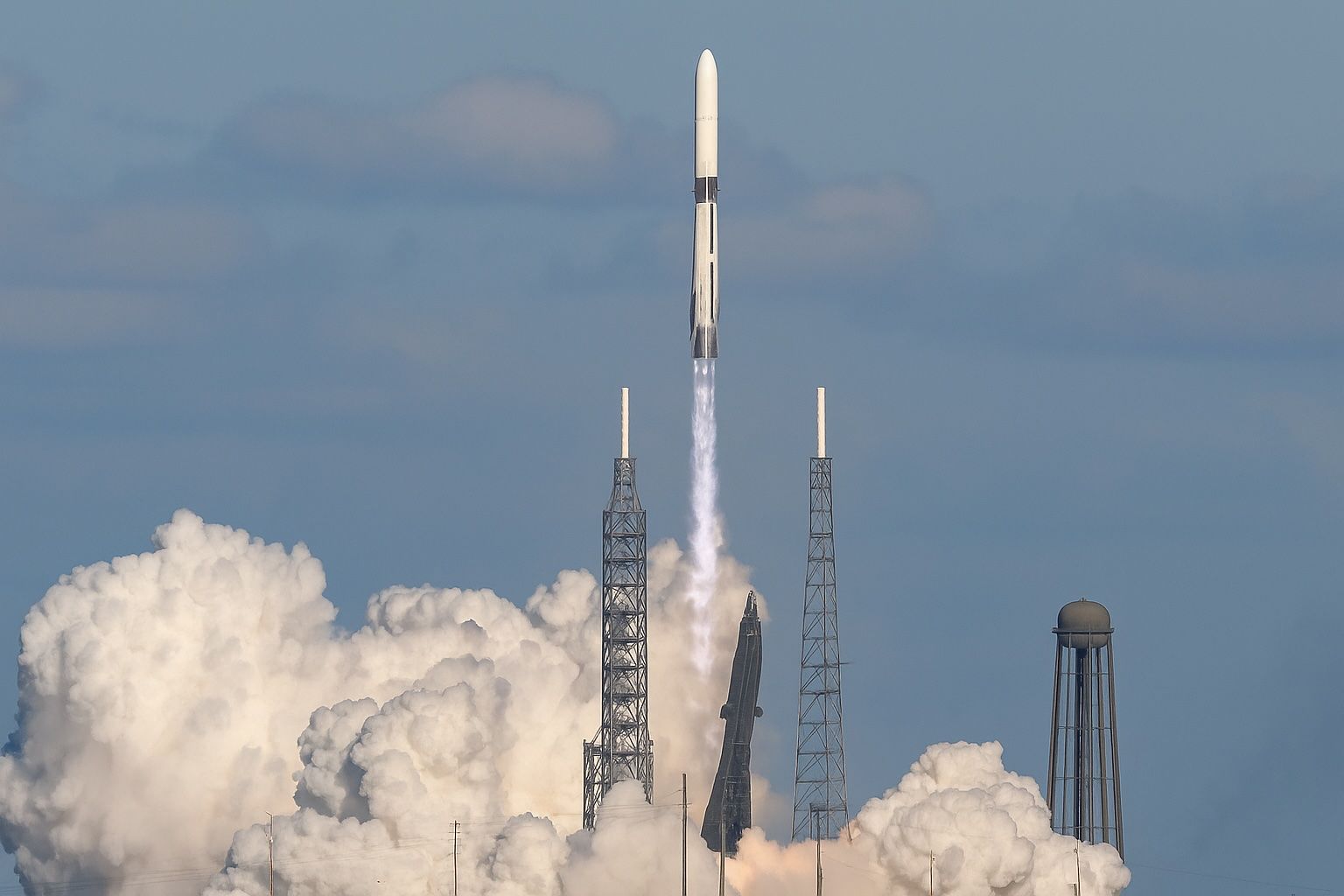

CAPE CANAVERAL, Fla. — November 13, 2025. Blue Origin’s heavy‑lift New Glenn rocket roared off Space Launch Complex 36 at 3:55 p.m. EST, sending NASA’s twin ESCAPADE spacecraft on the first leg of a long cruise to Mars—and then stuck the vehicle’s first-ever booster landing at sea. The on‑time liftoff followed a string of weather and space‑weather delays earlier in the week.
Minutes after stage separation, the 320‑foot‑class launcher’s first stage—nicknamed “Never Tell Me the Odds”—descended to a pinpoint touchdown on Blue Origin’s autonomous landing ship Jacklyn in the Atlantic. The recovery marks a pivotal reuse milestone for New Glenn on its second orbital mission, a leap forward after January’s debut flight reached orbit but lost the booster during descent. Reuters+2Blue Origin+2
NASA later confirmed spacecraft deployment: the two ESCAPADE probes separated from New Glenn’s upper stage to begin a precisely choreographed “Earth‑proximity” phase before heading to Mars. (Spaceflight Now reported deployment about 33 minutes after liftoff.) The twin craft are designed to work in tandem once at the Red Planet. NASA Science+1
What flew—and why it matters
ESCAPADE—short for Escape and Plasma Acceleration and Dynamics Explorers—is a two‑satellite heliophysics mission that will map how the solar wind interacts with Mars’ patchy magnetic field, an enduring mystery tied to the planet’s atmospheric loss. The duo, informally nicknamed Blue and Gold, were built by Rocket Lab with key instruments led by the University of California, Berkeley.
The flight profile and timeline
Because Earth and Mars aren’t ideally aligned this season, ESCAPADE will loiter for roughly a year in a wide “kidney‑bean” orbit looping out near L2 (about a million miles from Earth). In fall 2026, the pair will perform an Earth‑gravity assist to set up their Mars transfer, aiming to arrive in 2027 and begin an ~11‑month campaign in synchronized, elliptical orbits around the planet. NASA Science+2NASA Science+2
How New Glenn performed
New Glenn uses seven BE‑4 methane/oxygen engines on its first stage and two BE‑3U hydrogen upper‑stage engines. Today’s ascent progressed as planned; after main‑engine cutoff and fairing separation, the upper stage delivered ESCAPADE to its target orbit while the booster executed entry, re‑entry and landing burns to reach Jacklyn several hundred miles downrange. Blue Origin’s profile notes compliance with NASA Orbital Debris Mitigation Standard Practices via safing of the upper stage.
Secondary payload and contract context
Alongside ESCAPADE, New Glenn carried a Viasat in‑space communications demonstration mounted to the upper stage—a subtle but notable tech test for commercial relay concepts. The mission was booked under NASA’s VADR (Venture‑class Acquisition of Dedicated and Rideshare) contracting framework, which lowers cost by tailoring mission‑assurance levels for risk‑tolerant science payloads.
A launch week shaped by space weather
This attempt followed scrubs for cloud cover and for a strong geomagnetic storm that bathed skies in aurora and raised risk to avionics. Conditions improved today, clearing the path for launch within the afternoon window from Florida’s Space Coast.
Industry significance
The successful sea landing puts Blue Origin’s flagship rocket on firmer footing as a reusable competitor in the large‑payload market. NASA’s Mars‑bound payloads also mark New Glenn’s first mission for a paying science customer, and the achievement drew congratulatory notes from across the sector, including rivals.
What’s next for ESCAPADE
After commissioning and navigation checkouts in the coming days, the spacecraft will settle into their extended Earth‑proximity orbit while teams refine the trajectory for next year’s gravity assist. On arrival at Mars in 2027, Blue and Gold will fly in formation to capture simultaneous upstream solar‑wind and near‑Mars atmospheric measurements—a stereo view of space weather no single orbiter can provide.
At a glance (Nov. 13, 2025)
- Launch: 3:55 p.m. EST; LC‑36, Cape Canaveral Space Force Station.
- Rocket: Blue Origin New Glenn (flight 2).
- Payload: NASA’s ESCAPADE twin spacecraft (Blue and Gold).
- Recovery: First‑stage landing on “Jacklyn”—New Glenn’s first successful sea landing. Blue Origin
- Mission plan: ~1‑year loiter near L2 → Earth gravity assist (fall 2026) → Mars arrival in 2027 → ~11 months of science operations.
Related articles: NASDAQ:RKLB