
NEW YORK, June 22, 2026, 04:50 EDT
- Marvell Technology closed at $310.58, up 7.27% or $21.04, and was quoted at $313.31 pre-market, up another 0.88%, as its S&P 500 inclusion takes effect before Monday’s open.
- The fresh catalyst is index demand; the deeper story is AI-networking re-rating, with Marvell’s latest quoted P/E at 106.38.
- Information gain: based on Google Finance’s $2.92 EPS, the last regular-session move lifted MRVL from roughly 99.2x trailing earnings to 106.4x in one session.
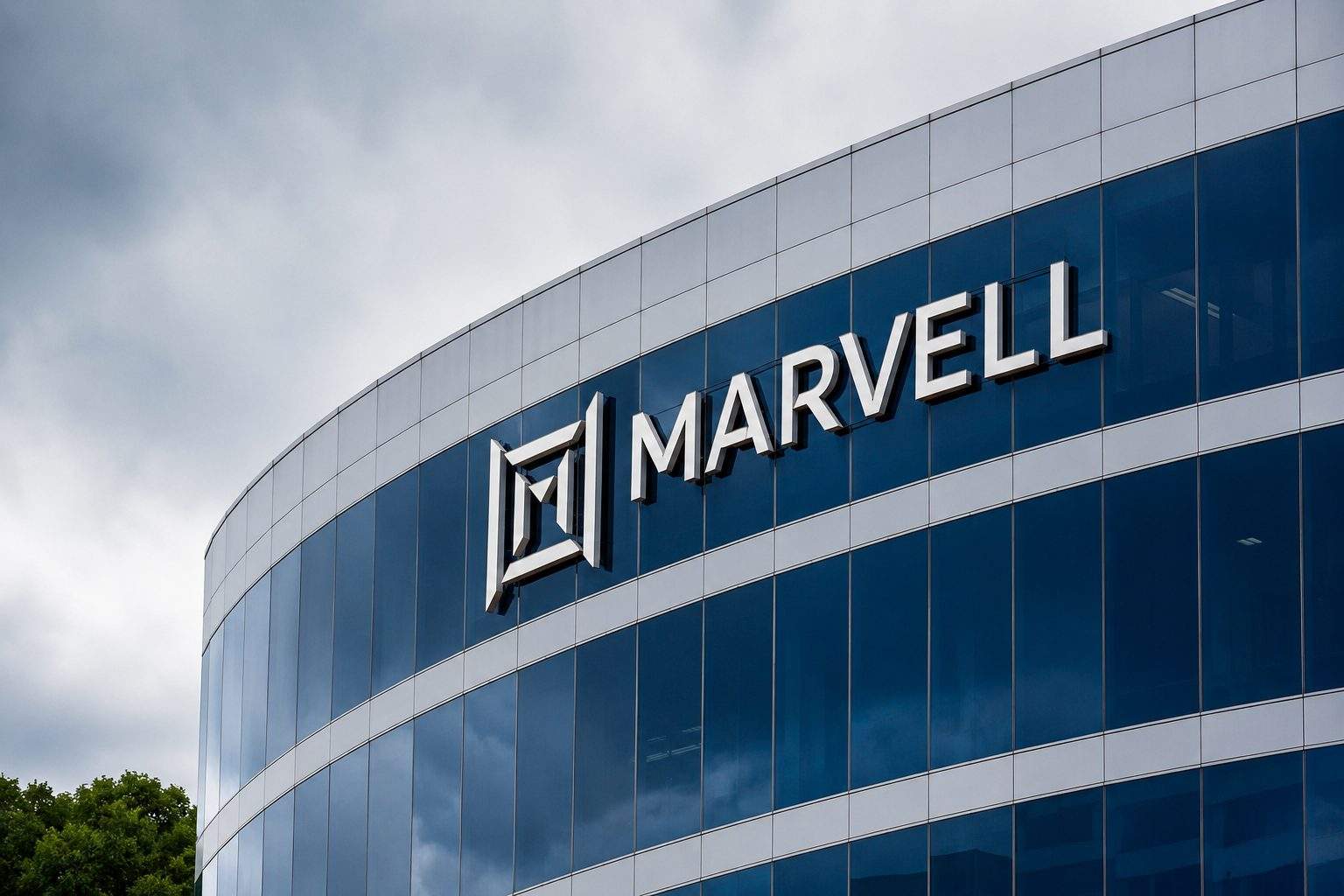
Marvell Technology NASDAQ:MRVL is the chip stock moving before Monday’s open: MRVL closed the latest regular session at $310.58, up 7.27% or $21.04, and was quoted at $313.31 in pre-market trade, another 0.88% higher. The immediate driver is index mechanics — Marvell joins the S&P 500 before the June 22 open — layered on top of AI-networking demand for optical and switch silicon.
For NASDAQ: MRVL, what changed versus the last regular session is not a new earnings release. It is ownership pressure. S&P Dow Jones Indices’ official rebalance list puts Marvell Technology into the S&P 500 as an Information Technology addition effective June 22, while Pool Corp. is removed; that is the kind of event that pulls benchmarked and passive money toward a name that was already trading like an AI infrastructure proxy.
The tape is stretched, but not random. Google Finance shows a $329.88 52-week and intraday high, a $302.36 session low, $271.70 billion in market value, 874.80 million shares outstanding, and a 2.29 beta. Translation for traders: the stock is still about 6.2% below the high, but it is no longer priced like a discovery story. It is priced like execution has to arrive on schedule.
The information gain is the multiple shift, not the headline. Using Google’s $2.92 EPS, the prior close implied roughly 99.2x trailing earnings; the $310.58 close implies about 106.4x; and the $313.31 pre-market quote pushes that to roughly 107.3x. At the $329.88 high, the same EPS base implies nearly 113x. That is a full re-rating in one tradable burst, not just a ticker added to an index.
The bull case has numbers behind it. Marvell’s fiscal Q1 2027 revenue hit a record $2.418 billion, up 28% year over year, with non-GAAP EPS of $0.80 and record operating cash flow of $638.8 million. Its data-center revenue was $1.8327 billion, or about 76% of total revenue, and management guided fiscal Q2 revenue to $2.7 billion at the midpoint with non-GAAP EPS of $0.93 ± $0.05. CEO Matt Murphy said he expects “revenue growth to continue accelerating each quarter throughout fiscal 2027.” Marvell Technology, Inc.
That is why the stock is reacting more like an AI network bottleneck trade than a traditional semiconductor name. Marvell’s June 1 product announcement said its Teralynx T100 is a 102.4 Tbps switch silicon platform for AI and cloud data centers, with sampling beginning this quarter, typical power under 1,000W, and up to 25% lower power than competitive solutions. Rishi Chugh, Marvell’s data-center switch business lead, said the T100 was “designed without the legacy baggage that inflates power.” Marvell Technology, Inc.
That matters because AI racks are becoming power problems. Marvell said GPU and XPU systems are approaching 120KW per rack, while networking components can consume roughly 15% to 25% of total rack power. Alan Weckel of 650 Group put the issue more bluntly, saying “data center infrastructure becomes a defining factor” in network efficiency and performance. Marvell Technology, Inc.
There is also a macro-correlation that the simple “S&P 500 addition” story misses. Reuters reported that the Philadelphia Semiconductor Index rose 6.4% on June 18 while the Nasdaq climbed 1.9%; MRVL’s 7.27% regular-session gain beat the chip index by only 0.87 percentage point. In other words, the index catalyst mattered, but most of the move still rode the broader semiconductor bid. Reuters
The scale is now too big to treat as a niche momentum trade. At $271.70 billion in market cap and 47.38 million average volume, Marvell enters the S&P 500 as a large, liquid AI-infrastructure constituent, not as a marginal add. S&P’s own announcement says the rebalance is meant to keep the index representative of market-cap ranges, which is exactly the point: the benchmark is making room for data-center silicon at the expense of older-economy exposure.
The bear case is not abstract: a break below the $302.36 session low would put the index-entry trade under pressure, and a full giveback would reopen the prior close near $289.54; fundamentally, Marvell’s latest 10-Q flags dependence on a few large customers, data-center concentration, export/tariff exposure, and foundry/geographic dependence, while its NVIDIA preferred stock is initially convertible into up to 21.778 million common shares. That mix makes the downside asymmetrical if AI bookings slow while the stock is still valued above 100x trailing earnings.
Management tried to remove one possible distraction before the index debut. Marvell appointed Dan Durn as CFO effective June 15, replacing Willem Meintjes, and reaffirmed its fiscal Q2 2027 outlook in the same announcement. For a stock trading on fast growth and a high multiple, that reaffirmation is not cosmetic; it keeps the market focused on July-quarter demand rather than a finance-suite transition.
The next catalyst is now simple and unforgiving: after passive index demand clears, MRVL has to prove that AI optics, switching, and custom XPU demand can support the $2.7 billion fiscal Q2 revenue guide and keep data-center growth accelerating. At this valuation, the market is no longer asking whether Marvell belongs in the S&P 500. It is asking whether the company can grow fast enough to deserve the multiple it just received.
Disclaimer: This article is for informational purposes only and does not constitute investment advice, a recommendation, or an offer to buy or sell any security. Investors should conduct their own research, consider their risk tolerance, and consult a licensed financial adviser before making investment decisions; market data can change rapidly.
Related articles: NASDAQ:KHC