December 25, 2025 brings a rare “holiday-perfect” mix for skywatchers: a waxing crescent Moon low after sunset, Saturn nearby in the evening, and brilliant Jupiter rising to dominate the night—plus lingering Ursid meteors and continued attention on space weather after a week of unsettled solar wind. Space
If you’re stepping outside tonight, you don’t need a telescope to have a great night. But if you did unwrap binoculars or a beginner scope for Christmas, this is one of the best nights of the season to start using them. Space
Night sky highlights at a glance for Dec. 25–26
- Right after sunset: Look low toward the southwest for a waxing crescent Moon and Saturn nearby. Space
- After dark through midnight: Turn east to spot Jupiter, now the standout “bright point” of the night in Gemini near Castor and Pollux. Space
- Late evening into pre-dawn: With the Moon setting before or around midnight for many locations, skies get darker—better for star clusters and any late Ursid meteors. Space
- Aurora watch (where applicable): Forecasts and news coverage point to continued interest in northern lights visibility, especially at higher latitudes, though NOAA’s updated 3‑day outlook keeps geomagnetic levels below storm thresholds. NOAA SWPC Services
Moon phase tonight: a crescent that sets early, leaving darker skies later
The Moon is in a waxing crescent phase tonight—bright enough to be beautiful in twilight, but not so bright that it ruins the rest of the night. Space.com’s Christmas-night guide pegs the Moon at roughly 35% illuminated, positioned low in the winter sky soon after nightfall. Space
Because lunar phase percentages vary a bit depending on time zone and the exact moment you check, you may see slightly different numbers on sky trackers. For example, Timeanddate’s “Night Sky” readout (example location: New York) shows the Moon around 28.7% tonight. Time and Date
The practical takeaway is the same: the Moon is not full and not overwhelming—and in much of the U.S., the Moon and Saturn set shortly after 11 p.m. local time, opening a darker window for late-night observing. Space
NASA’s December skywatching rundown also confirms the broader lunar timing for the month, placing the major phases on Full Moon (Dec. 4), Third Quarter (Dec. 11), New Moon (Dec. 19), and First Quarter (Dec. 27). NASA Science
What to look for on the Moon (binoculars help)
Even a small telescope can make the crescent Moon look “3D,” with shadows emphasizing craters and lava plains along the terminator line. Space.com notes that tonight’s thickening crescent is a good time to explore prominent lunar maria such as Mare Crisium and Mare Fecunditatis. Space
Planets tonight: Jupiter dominates, Saturn glows near the Moon
Jupiter: the brightest “star” of Christmas night
If you want one must-see object tonight, make it Jupiter.
Space.com’s late-December observing guide frames Jupiter as a perfect “Christmas Star” candidate: it’s shining around magnitude −2.5, it’s near annual opposition, and it’s bright enough to outshine almost everything except the Moon. Space
Where to find it:
- Look east after dark.
- Jupiter sits in the constellation Gemini, close to the twin stars Castor and Pollux. Space
Why it’s special right now:
- EarthSky notes that Jupiter will reach opposition on Jan. 10, 2026, meaning it’s in its best viewing window now—bigger and brighter in telescopes. EarthSky
- Space.com similarly emphasizes that Jupiter is approaching its annual opposition, making this a prime time to try spotting cloud bands (and, with a larger scope and timing, the Great Red Spot). Space
Saturn: a steady “golden” point near the crescent Moon
Soon after nightfall, look back toward the southwest. Space.com’s Dec. 25 skywatching guide says Saturn appears as a bright evening object less than 15 degrees from the crescent Moon, making a classic “Moon + planet” pairing for casual viewing. Space
If you do use a telescope, tonight comes with a twist: Saturn’s rings have been in a thin, edge-on presentation following a ring plane crossing earlier in 2025, so the rings can look more like a fine line than the wide “storybook Saturn” many people expect. Space
EarthSky’s December/January guide also places Saturn among the stars of Aquarius, shining around magnitude 1.1–1.2, and remaining an evening object into early 2026. EarthSky
Where are Venus, Mercury, and Mars?
If you’re wondering why the “usual bright suspects” aren’t obvious tonight, EarthSky sums it up simply: Venus, Mercury, and Mars are too close to the Sun this month to be easily visible. EarthSky
Timeanddate’s planet visibility breakdown (again, shown for a sample location) echoes that reality with specific “too close to the Sun” notes for those planets, while listing Jupiter up most of the night and Saturn best after sunset. Time and Date
Bonus targets: Uranus and Neptune (binocular challenge)
If you have binoculars and a darker sky, Timeanddate flags Uranus as viewable “after sunset and most of the night” (binoculars recommended) and Neptune as a faint after-sunset target (binoculars recommended, very difficult). Time and Date
Best stars and constellations tonight: Orion, Taurus, and a “north finder” you can’t miss
Once Jupiter is in view, the rest of the winter sky tends to “snap into place.”
Space.com notes that Orion shines to Jupiter’s right through the night, with the Hyades and Pleiades star clusters visible higher up in Taurus. Space
EarthSky adds more “holiday-week classics” for December evenings:
- Cassiopeia (the W/M-shaped pattern) high overhead/northward
- Perseus nearby—home to the spectacular Double Cluster (especially nice in binoculars) EarthSky
Polaris check: a simple way to orient your sky
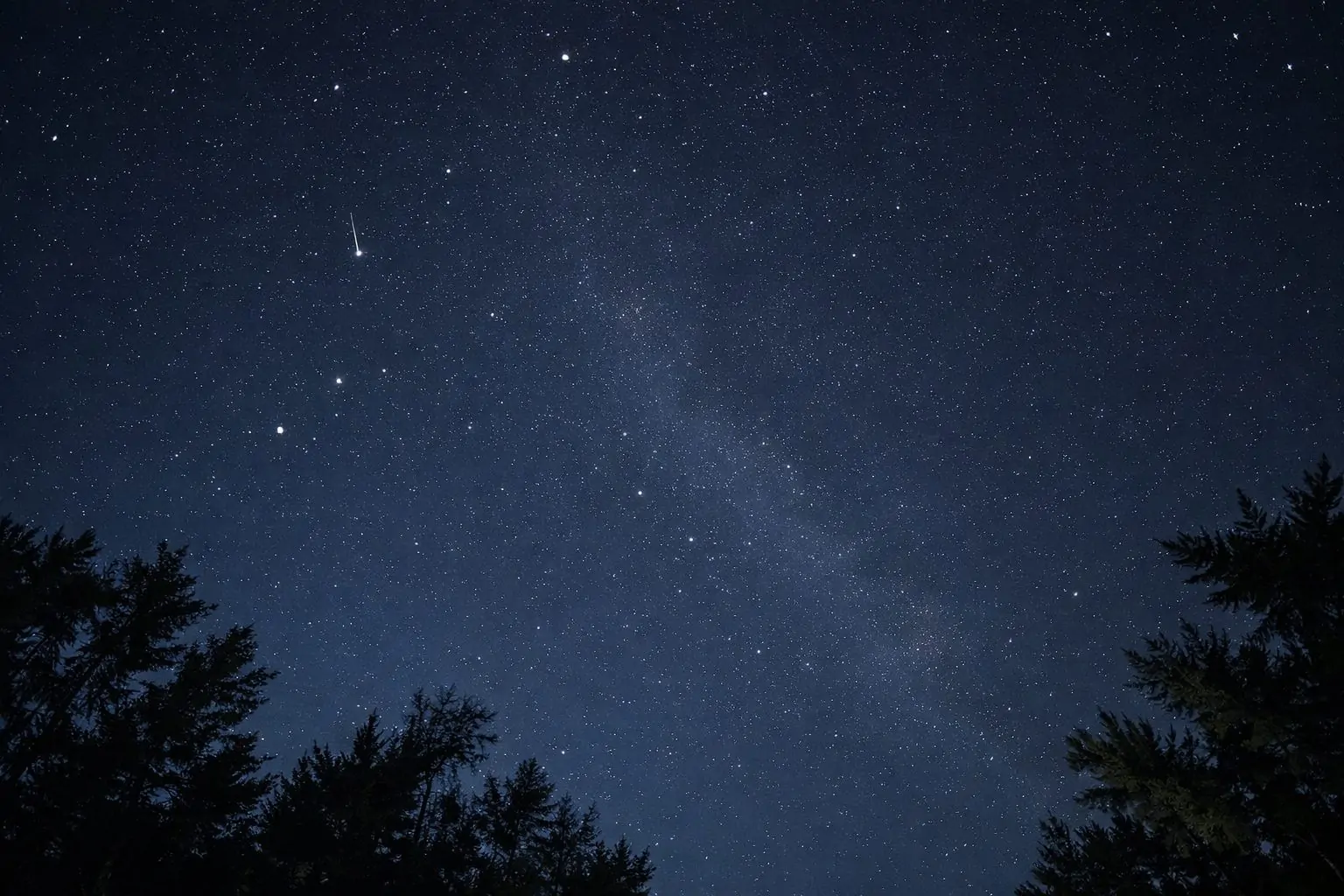
If you want a quick navigation trick, Space.com recommends using the Big Dipper as a pointer to Polaris (the North Star)—a helpful anchor if you’re hunting meteors or practicing long-exposure star photography. Space
Meteor watch: the Ursids are still active (but don’t expect a blizzard)
The “yuletide” meteor shower isn’t the Geminids—that was earlier in December—but the Ursids can still deliver a few memorable streaks.
Space.com reports that the Ursid meteor shower runs from Dec. 17 to Dec. 26, with peak activity on Dec. 21–22 and up to ~10 meteors per hour possible under dark skies. Space
The American Meteor Society’s live calendar reinforces that the Ursids remain active until Dec. 26, 2025, and describes typical rates of about 5–10 per hour around the peak period. American Meteor Society
Where to look:
- Ursid meteors radiate from Ursa Minor, near the bright star Kochab (a northern-sky target). Space
When to look tonight:
- Your best shot is often late night into pre-dawn, especially after the Moon is down (or lower), when skies are darker. Space
Coming up next: Quadrantids (with a catch)
The AMS calendar also lists the next major shower, the Quadrantids, active Dec. 28 to Jan. 12 with a Jan. 2–3, 2026 peak—but it also warns the Moon will be full at that peak, which can seriously wash out fainter meteors. American Meteor Society
Northern lights forecast: “Christmas aurora” buzz continues, but NOAA’s latest outlook stays below storm levels
If you’re hoping tonight includes aurora, here’s how the latest forecast and broader news coverage fit together.
NOAA’s 3-day space weather forecast (issued Dec. 25)
NOAA’s Space Weather Prediction Center “3‑Day Forecast” issued Dec. 25, 2025 (1230 UTC) projects the greatest expected Kp at 3.33 for Dec. 25–27 and states that no G1 (minor) or greater geomagnetic storms are expected in that window. NOAA SWPC Services
In plain language: conditions may be “quiet to unsettled,” which can still produce aurora at higher latitudes, but it’s not the kind of forecast that guarantees widespread lights far south.
Why aurora watchers are still paying attention
Space.com’s aurora coverage this week has emphasized unsettled conditions tied to solar wind and a potential coronal mass ejection influence earlier in the period, keeping observers alert around Christmas. Space
Meanwhile, ABC News highlighted the possibility of auroras in parts of the northern U.S., citing NOAA’s aurora viewline guidance and describing faster-than-normal solar wind from a coronal hole, with conditions that “could persist into Thursday.” ABC News
ABC also repeats a useful viewing rule of thumb from NOAA: in the U.S., the best aurora window is often between about 10 p.m. and 4 a.m. local time, and darker locations help. ABC News
Best approach tonight: treat aurora as a “check and see” bonus. If you’re in a high-latitude region, keep an eye on NOAA updates and be ready to step outside if alerts spike. NOAA SWPC Services
Comet and space-science news shaping today’s skywatching conversation
Interstellar visitor 3I/ATLAS: still a headline even after closest approach
December’s biggest skywatching “news” story isn’t just a planet—it’s an interstellar comet.
NASA’s December skywatching tips describe Comet 3I/ATLAS as the third object from outside our solar system discovered passing through our neighborhood, with its closest approach to Earth on Dec. 19—still about 170 million miles away—and note that seeing it generally requires a telescope with at least a 30 cm aperture, low in the pre-dawn sky near Regulus in Leo. NASA Science
NASA also published a detailed update from the Parker Solar Probe team noting the spacecraft observed 3I/ATLAS from Oct. 18 to Nov. 5, capturing roughly 10 images per day with its WISPR instrument—data that helped study the comet when it was hard to observe from Earth’s viewpoint near the Sun. NASA Science
Christmas Day “space vibe”: Roman telescope in the cleanroom
For a different flavor of astronomy news, Space.com’s Dec. 25 “photo of the day” focuses on NASA’s Nancy Grace Roman Space Telescope being inspected in a cleanroom—an oddly fitting “Silent Night” scene of engineers using lights and ultraviolet checks to ensure the observatory’s optics stay pristine. Space
Looking up at the ISS? Astronauts are looking down and sending holiday wishes
And if you’re doing any satellite spotting this holiday week, Christmas Day also comes with a human-spaceflight headline: Space.com reports Expedition 74 crew members aboard the International Space Station sent Christmas wishes while orbiting roughly 250 miles (400 km) above Earth. Space
A simple “two-part” plan for the best stargazing tonight
1) The early show (right after sunset)
- Start with the Moon + Saturn pairing low in the sky. Space
- If you have a telescope, set expectations: Saturn’s rings are currently presenting thin/edge-on, but the planet is still a beautiful sight. Space
2) The late show (after the Moon sets)
- Shift to Jupiter, which stays prominent for much of the night. Space
- Sweep through Orion, Taurus, and the Pleiades with binoculars. Space
- If you’re meteor watching, give yourself at least 20–30 minutes away from bright lights to fully adapt to the dark—your “meteor count” can multiply just from patience.
Bottom line
Night Sky Today on Dec. 25, 2025 is less about a single once-in-a-lifetime event and more about a stacked lineup: a crescent Moon and Saturn early, Jupiter blazing late, winter constellations in peak form, and enough meteor/aurora buzz to keep you checking the sky through midnight and beyond. NOAA SWPC Services