NEW YORK, January 1, 2026, 14:44 ET
- Breakthrough Listen researchers reported no evidence of an artificial radio signal from 3I/ATLAS in a deep scan near its closest pass.
- The object is only the third confirmed interstellar visitor after 1I/‘Oumuamua and 2I/Borisov.
- Astronomers continue tracking the fading comet and using it to refine search and orbit-measurement methods.
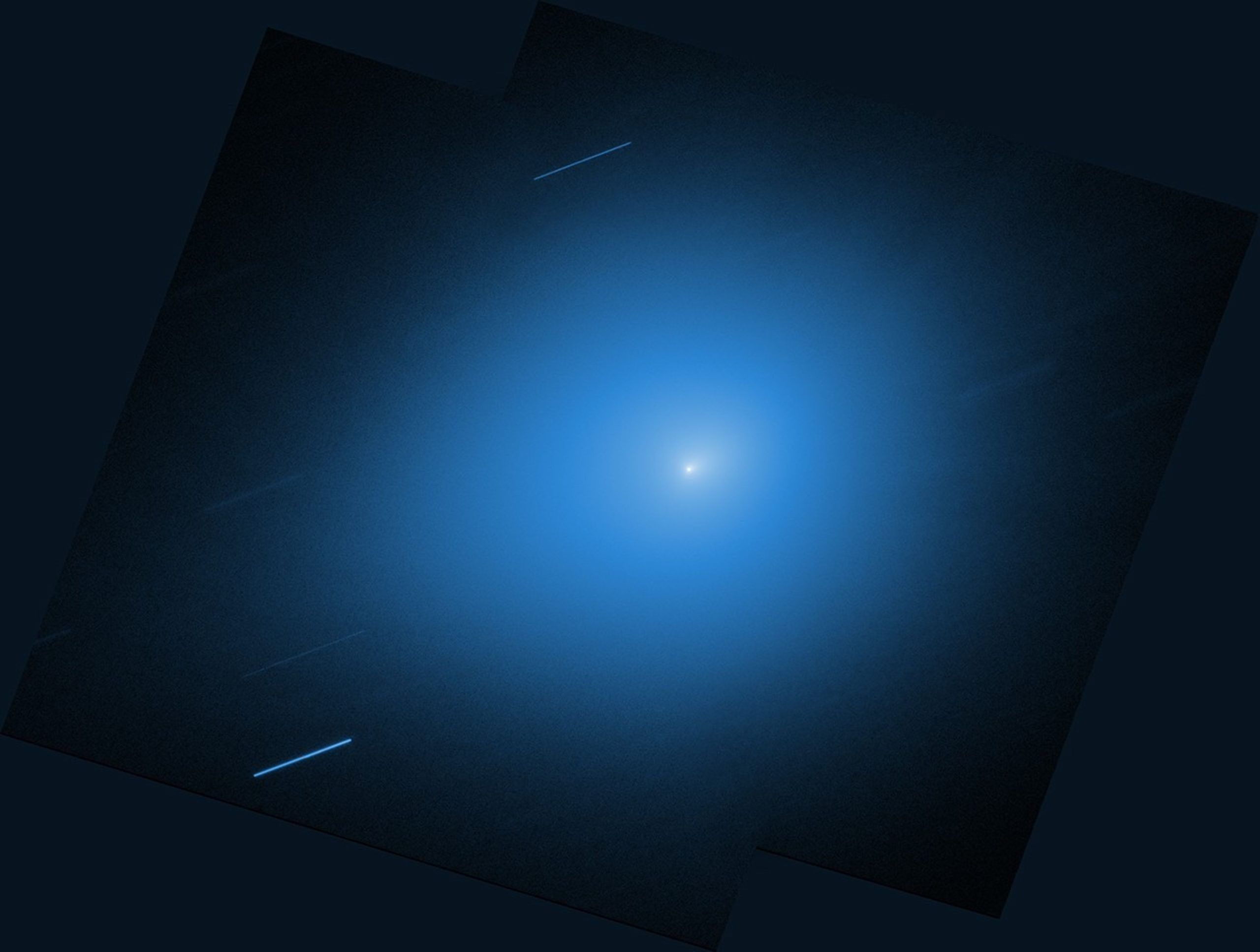
The most sensitive radio search yet for signs of extraterrestrial technology from interstellar comet 3I/ATLAS has found none, researchers reported this week.
The result matters because 3I/ATLAS is a rare visitor — only the third confirmed object known to have arrived from beyond the solar system — and it is already receding after a close pass by Earth in December.
Scientists have used the comet’s short observing window to test how quickly they can mount deep searches for “technosignatures,” a term for signals that would look engineered rather than natural, amid a surge of online speculation about the object.
Researchers with the Breakthrough Listen program used the 100-meter Robert C. Byrd Green Bank Telescope in West Virginia on Dec. 18, scanning four receiver bands from 1 to 12 gigahertz, and later rejected a small set of candidate detections as radio-frequency interference, a report on the work said. Phys.org
In a paper describing the Green Bank results, University of California, Berkeley astronomer Ben Jacobson-Bell and colleagues wrote: “Our survey concludes that there are no isotropic continuous-wave transmitters above 0.1 W at the location of 3I/ATLAS.” arXiv
The team expressed the limit in “effective isotropic radiated power,” a standard way to compare transmitter strength by assuming it radiates evenly in all directions, and they noted the threshold is below the roughly 1-watt level of a typical mobile phone.
Breakthrough Listen and collaborators have also searched 3I/ATLAS with other facilities, including the Allen Telescope Array and South Africa’s MeerKAT, and reported no artificial radio emission across those campaigns while continuing optical and infrared monitoring for any transient laser-like flashes. seti.org
NASA has said the comet posed no threat to Earth and never approached closely, passing about 1.8 astronomical units — nearly twice the Earth-Sun distance — from the planet on Dec. 19, 2025, and that it remains on a hyperbolic trajectory that will carry it out of the solar system. NASA Science
For skywatchers, the comet is now a faint imaging target rather than a naked-eye sight. BBC Sky at Night Magazine said it is best suited to astrophotography setups and “smart telescopes,” placing it around magnitude +15.6 at the start of 2026 as it tracks through the northern sky. Sky at Night Magazine
The International Asteroid Warning Network is running an observing campaign through Jan. 27 to improve astrometry — precise position measurements — for the comet, which can be harder to pin down than a point-like asteroid because its coma and tail can shift the apparent center. iawn.net
Interstellar visitors have been scarce. Astronomers previously tracked 1I/‘Oumuamua in 2017 and 2I/Borisov in 2019, each prompting a rush to collect data across the electromagnetic spectrum before the objects faded.
The new radio limits are unlikely to settle every claim circulating online, but the takeaway from the telescopes remains straightforward: in the most sensitive searches reported so far, 3I/ATLAS looks and behaves like a normal comet passing through from another star.