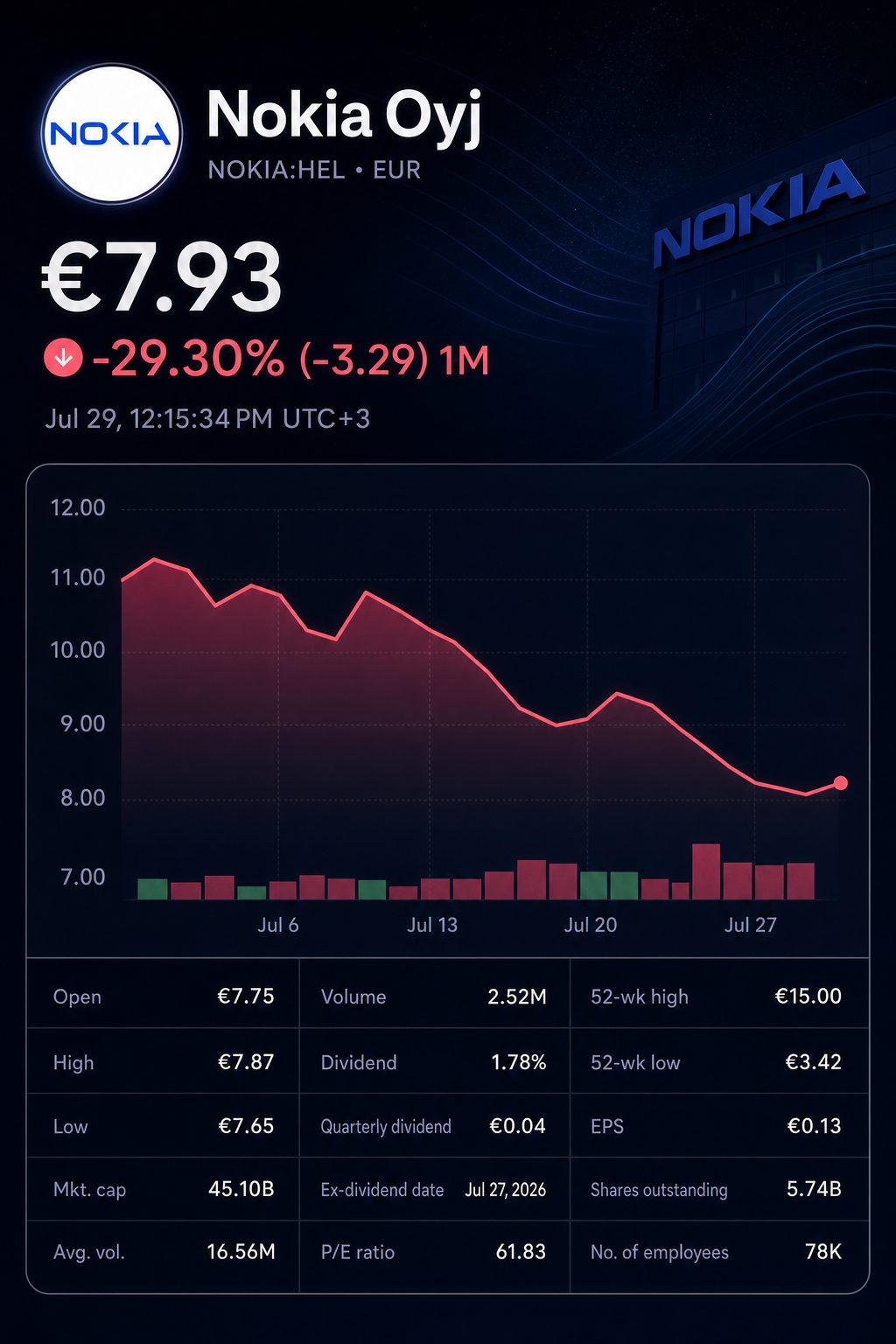
Nokia slipped 0.95%, changing hands at €7.75 after the Helsinki market opened.
AI and cloud orders in the second quarter were 6.3 times higher than the quarter’s sales.
Nokia’s increased upper end of its 2026 profit outlook is due to accounting factors rather than improved business performance.
Nokia Oyj HEL:NOKIA hovered close to €7.75 by midday Wednesday, deepening losses seen after its latest results. Shares have fallen roughly 15.4% since the July 22 close.
The company’s U.S. depositary shares declined by 3.3% on Tuesday. The Nasdaq Composite eased 0.2%. Shares continued to lag in Helsinki.
The trading pattern indicates a worry over conversion rather than weak demand. Nokia has secured AI orders more quickly than it has reported sales.
Based on company filings, AI and cloud orders in Q2 were 6.3 times higher than the quarter’s sales. In contrast, the Q1 proxy stood at roughly 2.8 times.
AI and cloud indicator
Q1 2026
Q2 2026
Sales
~€360 million
€446 million
New order intake
€1.0 billion
€2.8 billion
Order to sales ratio
2.8 times
6.3 times
Sales increase, year-over-year
49%
105%
Initial estimate: First-quarter sales represent 8% out of €4.5 billion in group sales on a comparable basis. Second-quarter sales were reported directly.
The proxy increased by over two times in just one quarter. This is separate from Nokia’s official book-to-bill metric. Nonetheless, it indicates that delivery commitments have grown faster than recorded revenue.
Chief Executive Justin Hotard stated, “Demand remains strong, while supply continues to be the main industry constraint.” Nokia anticipates about half of the €2.8 billion intake will convert over the next 12 months. Nokia Corporation | Nokia
The timing of the conversion window is important. Extending lead times increases transparency but delays both revenue and cash flow.
Nokia’s updated profit forecast of €2.1 billion to €2.6 billion contains no improvement in operations. The €100 million rise simply results from two units shifting to discontinued operations.
Management forecasts Q3 sales will increase by 3% to 7% from the previous quarter. Comparable operating profit is projected to hold steady, with growth anticipated in Q4.
Comparable operating profit for Q2 increased by 18% to €434 million, surpassing the analyst consensus of €382 million. Revenue advanced 8% to €4.82 billion.
Nokia posted a €50 million operating loss as it sped up restructuring, and reported softer results. The company projects restructuring cash outflows between €700 million and €800 million for this year.
Operating margin at Network Infrastructure increased to 8.1% compared with 6.4%. Mobile Infrastructure reported a margin decline to 11.6% from 12.2%.
Peer Ericsson NASDAQ:ERIC is facing similar cost challenges. The stock dropped almost 12% following a warning regarding increased memory-chip expenses.
That pressure does not eliminate Nokia’s growth in orders. Instead, it increases the expense of fulfilling them.
Risks: Conversion may be postponed if semiconductor supplies remain tight, component prices climb, or customers build products more slowly. Nokia also relies on a stronger profit contribution in Q4, which reduces flexibility for any timing delays.
The focus now shifts to conversion. Orders are no longer in short supply.
What is causing Nokia shares to continue declining despite strong results in the second quarter?
On July 28, the NYSE ADR settled at $8.93, marking a 3.3% decline for the session. Shares were trading 48.8% below the $17.45 peak reached on June 3. This performance came despite an 18% rise in comparable profit and surpassing estimates. UBS noted much of the good news was already factored into the stock's valuation. Several brokers cut their price targets after the results. The reaction points to investor demand for quicker order conversion and less impact from restructuring.
How robust were Nokia's second-quarter 2026 results?
Comparable net sales totaled €4.815 billion, up 8% in reported terms. Growth at constant currency stood at 9%, indicating a slight impact from foreign exchange. Comparable operating profit rose 18% to €434 million, surpassing the €382 million consensus from LSEG. Comparable diluted EPS increased to €0.07 from €0.04. Gross margin widened by 70 basis points to 46.0%.
Has Nokia actually increased its full-year profit forecast?
Nokia updated its guidance range to €2.1 billion–€2.6 billion from the previous €2.0 billion–€2.5 billion. The company characterized the €100 million adjustment as a technical change resulting from the transfer of two businesses to discontinued operations. Nokia said its operational outlook was unchanged. Management continues to anticipate a comparable operating profit slightly above the midpoint of the targeted range.
How significant are AI and cloud demand for Nokia at this time?
Sales to AI and cloud customers amounted to €446 million, marking a 105% year-on-year increase. Orders from these customers reached €2.8 billion in Q2, with Nokia forecasting that about half will be recognized as revenue within the next twelve months. Network Infrastructure revenue climbed 12%, driven by a 20% increase in Optical Networks and a 16% rise in IP Networks. Management points to supply, rather than demand, as the primary current bottleneck.
What can investors anticipate for the third and fourth quarters?
Nokia forecasts Q3 net sales will increase by 3% to 7% quarter-on-quarter. Comparable operating profit is projected to be roughly unchanged from Q2, attributing this to the timing of software revenue. The company anticipates a significant operating profit improvement in Q4. For the full year, Nokia continues to aim for Network Infrastructure growth of 12% to 14%, with combined IP and Optical Networks growth expected between 18% and 20%.
What caused Nokia to post an operating loss even though its comparable profit was strong?
Nokia posted an operating loss of €50 million, compared to a comparable profit of €434 million. The reported operating margin stood at minus 1.0%, while the comparable margin was 9.0%. Much of this difference resulted from accelerated restructuring. Nokia projects restructuring charges of €800 million in 2026, with related cash outflows seen between €700 million and €800 million. Investors should monitor both reported and comparable metrics.
Is there evidence that Nokia’s Mobile Infrastructure division is starting to recover?
Net sales for Mobile Infrastructure climbed 6% as reported to €2.68 billion. Growth at constant currency was 7%. Operating profit was unchanged at €310 million. The operating margin declined to 11.6%, down from 12.2%. Sales momentum returned, but margins did not recover.
What is the strength of Nokia's balance sheet and the level of its shareholder returns?
At the end of Q2, net cash and interest-bearing investments stood at €2.776 billion. Combined cash and interest-bearing investments totaled roughly €5.2 billion. The guidance for free cash flow conversion remains in the 55% to 75% range of comparable operating profit. Expected capital expenditure is between €800 million and €900 million. The board has declared a €0.04 dividend, to be paid on August 6. The maximum outstanding distribution authorization stands at €0.06 per share.
Has Nokia become a bargain following the latest decline in its share price?
Helsinki-listed Nokia finished at €7.828 on July 28. The consensus price target from 23 MarketScreener analysts was €10.32, suggesting about 32% potential upside based on Tuesday’s closing price. Analyst targets varied significantly, spanning from €4.65 up to €18.00. This wide range highlights the ongoing debate over Nokia’s valuation.
What upcoming events are expected to impact Nokia's stock?
Second-quarter results were published on July 23, with no new earnings statement expected this week. The €0.04 dividend will be paid on August 6. Nokia is set to announce third-quarter earnings on October 22. Order conversion and supply conditions will be important factors for the company in the meantime. Higher memory-component costs may weigh on equipment profit margins.
Mateusz Kaczmarek is a financial and technology journalist at TS2.tech. His coverage ranges from stocks and artificial intelligence to semiconductors and developments across global markets. He graduated from the Poznań University of Economics and Business and worked in financial analysis before becoming a business journalist. Follow Mateusz Kaczmarek on Google News.
Surprising starts and permits data can impact homebuilders, mortgage-sensitive stocks, Treasury yields, and the dollar if results deviate significantly from consensus estimates.
#02
Home Depot Q2
The results and outlook provide key insights into housing turnover, renovation demand, professional customer activity, and U.S. discretionary spending.
#03
09:15 ET industrial production
A robust or disappointing factory or utilities report can shift expectations for economic growth, cyclical stocks, bond yields, and the Federal Reserve’s policy direction.