
SANTA CLARA, California, April 30, 2026, 07:02 PDT
Marvell Technology, more known for its data-center backbone gear than headline-grabbing AI processors, drew fresh attention Thursday. The stock jumped about 3% early in the U.S. session, riding momentum from strong Big Tech earnings that sparked fresh wagers on higher AI outlays. Nvidia slipped 1.6%. Its lead in AI remains clear, though traders are scanning the landscape for what’s next.
Alphabet, Microsoft, Amazon, and Meta have each made it clear this week: their AI budgets are ramping up, not pulling back. Reuters puts their combined outlays on track to blow past $700 billion this year—last year, that number hovered near $600 billion. Where’s all that money going? Sure, Nvidia’s GPUs are still hot, but network gear, optical links, and custom chips are all seeing their slice of the action now.
Marvell lands right in that sweet spot. ASICs—short for application-specific integrated circuits—handle specialized jobs rather than broad computing. According to Reuters on Thursday, this niche has worked out for both Broadcom and Marvell. Over at Qualcomm, the company is targeting a release of data-center processors, inference accelerators, and custom ASICs by year-end, the outlet reported.
Marvell isn’t claiming Nvidia’s grip has slipped. What’s shifting is that cloud giants want options in building out AI infrastructure—especially around inference, where the models actually interact with people. Alphabet CEO Sundar Pichai recently said Google is offering its in-house AI chips to a select group of customers. Reuters reported earlier this month that Google and Marvell have been talking about jointly developing two AI chips to help models run more efficiently.
There’s little out there that can rival Nvidia’s scale. The company reported fiscal fourth-quarter revenue of $68.1 billion, fueled by its data-center division, which soared to a record $62.3 billion. For the full year, revenue reached $215.9 billion. “Enterprise adoption of agents is skyrocketing,” said founder and CEO Jensen Huang. Customers, he noted, are “racing to invest in AI compute.” NVIDIA Newsroom
Marvell’s footprint is considerably smaller. For fiscal 2026, the company delivered all-time high revenue of $8.195 billion, up 42% year-over-year. In the January quarter, data-center revenue accounted for 74% of the total. Chairman and CEO Matt Murphy highlighted what he called record design wins and bookings, which he says are accelerating faster than before.
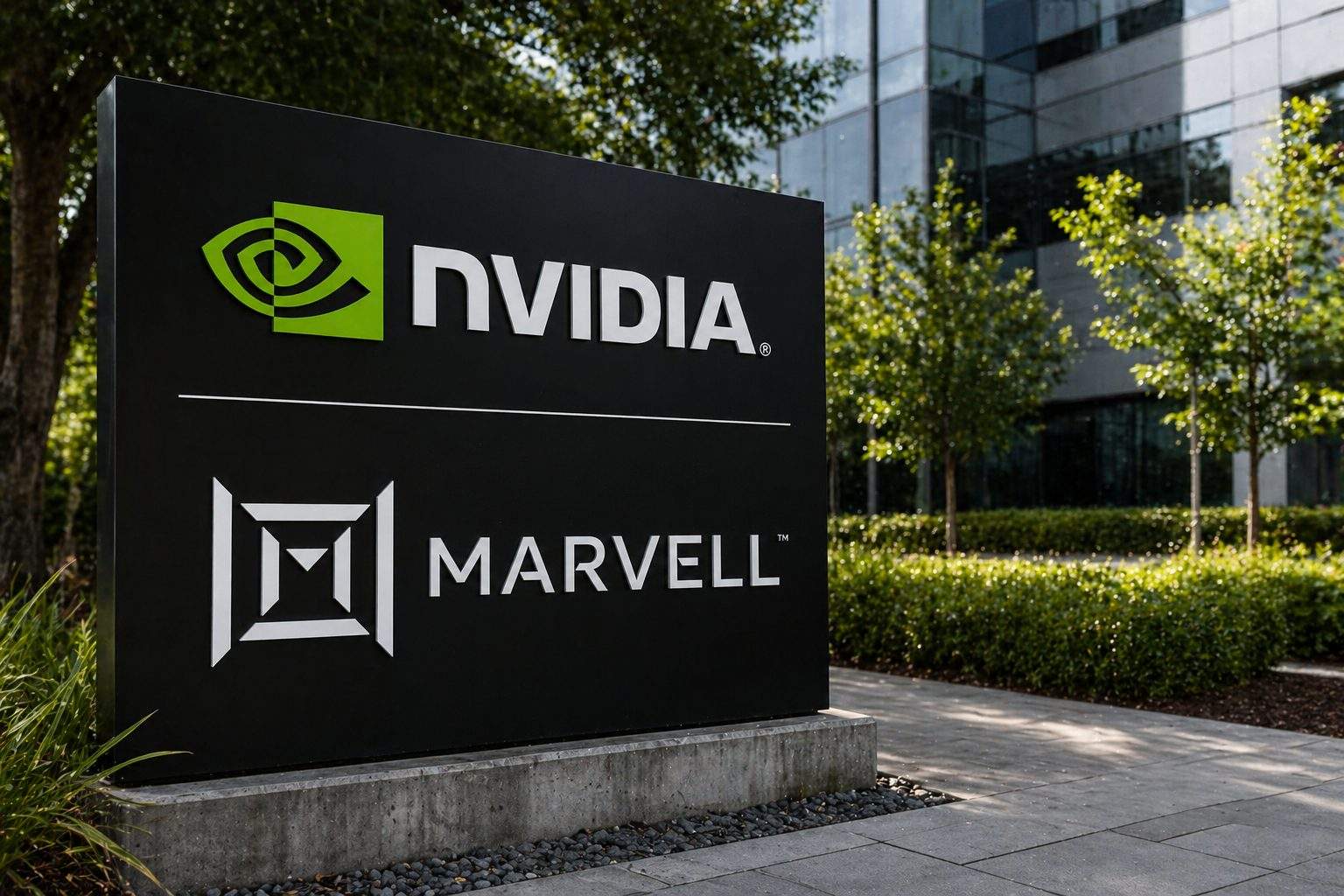
After Nvidia dropped $2 billion straight into Marvell, the investment landscape jolted. The two companies revealed a strategic partnership on March 31, laying out plans to team up on NVLink Fusion. It’s a rack-scale platform, targeting semi-custom AI infrastructure projects. The deal carves up responsibilities—Marvell is set to handle the custom XPU plus NVLink-ready networking components, while Nvidia supplies CPUs, networking silicon, interconnects, and the rest of the infrastructure.
Back then, Huang put it plainly: “the inference inflection has arrived.” Murphy, meanwhile, highlighted the deal as evidence—high-speed connectivity, optical interconnect, and accelerated infrastructure are now essential as AI adoption surges. One thing stands out here: the language doesn’t position Marvell as an Nvidia competitor. It’s clear Nvidia is looking to integrate Marvell’s technology directly into its own systems. Marvell Technology, Inc.
Analysts aren’t missing a beat on this one. Oppenheimer’s Rick Schafer framed the Nvidia-Marvell tie-up as “a vote of confidence” in Marvell’s AI positioning, pointing to its roles in both ASIC and connectivity. Over at Stifel, Tore Svanberg bumped his price target for Marvell to $140 from $120 and kept a Buy call in place—moves flagged earlier this month in an Insider Monkey analyst roundup. insidermonkey.com
Bank of America analyst Vivek Arya moved Marvell up to Buy after the company reported in March, TheStreet noted, pointing to momentum in AI optical connectivity and a sharper outlook on custom chip work with Microsoft and Amazon. Marvell isn’t chasing huge GPU wins—its edge sits with custom compute and the networking hardware that links thousands of chips as one system.
The chip wars aren’t letting up. Broadcom’s still the heavyweight in custom silicon. Qualcomm wants in on the data-center ASIC game. AMD remains Nvidia’s main rival in AI accelerators. Then there’s Marvell—a bit of a curveball. It partners with Nvidia, the AI chip king, but also benefits as cloud players hunt for more custom silicon.
Nvidia isn’t fading into the background just yet. According to Reuters, which cited industry sources on Thursday, the company’s B300 server units in China are fetching about 7 million yuan—roughly $1 million apiece. That’s nearly double what buyers pay in the U.S., with AI demand still surging and U.S. export rules tightening supply. When a product falls out of favor, you don’t usually see prices like this.
But risks loom large for Marvell. The annual filing points out that a significant chunk of revenue depends on just a few customers—one major win or loss can swing results. There’s always the risk these clients might build their own chips or move to in-house solutions instead. Marvell also warned that certain ASIC contracts could weigh on gross margins, meaning even as sales go up, higher costs or tighter pricing might keep profit growth in check.
No one’s really asking if Nvidia’s run is finished. What matters is whether a surge in AI spending creates fresh room for players like Marvell, working deep in the guts—hardware, switches, and tailor-made chips driving AI data centers. For now, Wall Street’s looking warmer toward that idea than it did a few months ago.
Related articles: NASDAQ:MRVL