
SCOTTSDALE, Arizona, April 29, 2026, 08:02 MST
- ON Semiconductor landed back-to-back EV chip agreements, each tied directly to 900-volt vehicle platform technology.
- Shares surged about 8% early Wednesday. First-quarter earnings are set for release next week.
- Fresh auto-chip design wins are drawing investor interest, but questions remain over whether those advances really offset a demand cycle that’s bumpier than some would like.
ON Semiconductor Corp., which operates under the onsemi brand, has deepened its push into China’s fast-growing EV sector. The company clinched a new deal with Geely Auto Group this week, expanding their partnership to deliver silicon carbide chips for Geely’s electric and hybrid models. Under the latest agreement, onsemi’s EliteSiC power technology will be rolled out across vehicles using Geely’s SEA-S platform, according to the company.
Timing matters. Onsemi will report first-quarter earnings after the bell on May 4, right on the heels of new customer deals that might shed light on where things stand for auto and industrial chip demand. The company closed its first quarter on April 3 and is set for a conference call at 5 p.m. Eastern that day.
Silicon carbide, or SiC, helps chips handle higher voltages while shedding less energy as heat than traditional silicon. Onsemi says shifting to 900-volt vehicle systems can ramp up efficiency, extend driving range, and cut down charging times. Bottom line: the electrical system delivers more power with less waste.
ON traded sharply higher late Wednesday morning, reaching $100.76, roughly 8% above its Tuesday close of $93.30. With that move, the company’s market cap hovered around $41.2 billion.
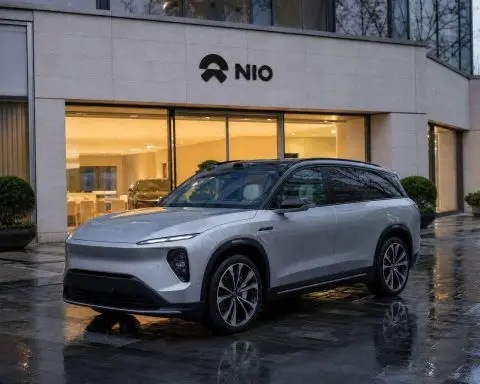
Geely’s update followed closely after its wider tie-up with NIO Inc. was revealed Monday, with both automakers targeting 900-volt EV systems. Onsemi said its EliteSiC M3e would let NIO upgrade from 400 to 900 volts, a move set to impact the ES9 flagship SUV and further models lined up for the 2026 Beijing Auto Show.
onsemi CEO Hassane El-Khoury zeroed in on “system efficiency and scalability,” labeling both “paramount” as electrification advances. Over at NIO, Alan Zeng, head of the XPT powertrain unit, pointed to the evolution with onsemi: what began with 400V systems has now moved to 900V platforms. onsemi
Geely’s relationship with the chipmaker is moving past the usual supply deals. “The EV market is entering a new phase,” El-Khoury said. For Geely Auto Group CEO Gan JiaYue, “closer coordination with technology partners is increasingly critical.” onsemi
Chipmakers got a boost, with the Philadelphia SE Semiconductor Index up 1.5% Wednesday, according to Reuters. Shares of NXP Semiconductors jumped 25% after the company projected second-quarter revenue and profit above Wall Street expectations. “Semiconductors have done much of the heavy lifting,” eToro U.S. investment analyst Bret Kenwell said. Reuters
The deals land against weaker numbers for financials. Onsemi posted a fourth-quarter revenue drop of 11% to $1.53 billion, and the company’s forecast for the first quarter sits between $1.435 billion and $1.535 billion. Management flagged $1.4 billion in free cash flow for 2025, earmarked for share repurchases.
Wall Street sentiment has improved, but caution lingers. Joseph Moore at Morgan Stanley lifted his price target on ON Semiconductor to $85 from $64, while maintaining an Equal Weight. He noted the “bar is quite high” as expectations have risen going into ON’s May 4 earnings. TipRanks
Here’s the thing: just because a partnership gets announced doesn’t mean the money starts flowing immediately. So far, Onsemi hasn’t shared any specifics on revenue, shipment volumes, or when production might ramp up for either the Geely or NIO agreements. EV demand isn’t exactly steady, either—it swings with new models, price moves and whatever consumers decide to do. For now, May 4 guidance is the next hard datapoint on the calendar.
Related articles: NYSE:NIO