
NEW YORK, July 25, 2026, 09:09 EDT — U.S. markets have finished trading.
- Microsoft’s public letter named 35 signatories, increasing from the 25 included in Nvidia’s initial PDF.
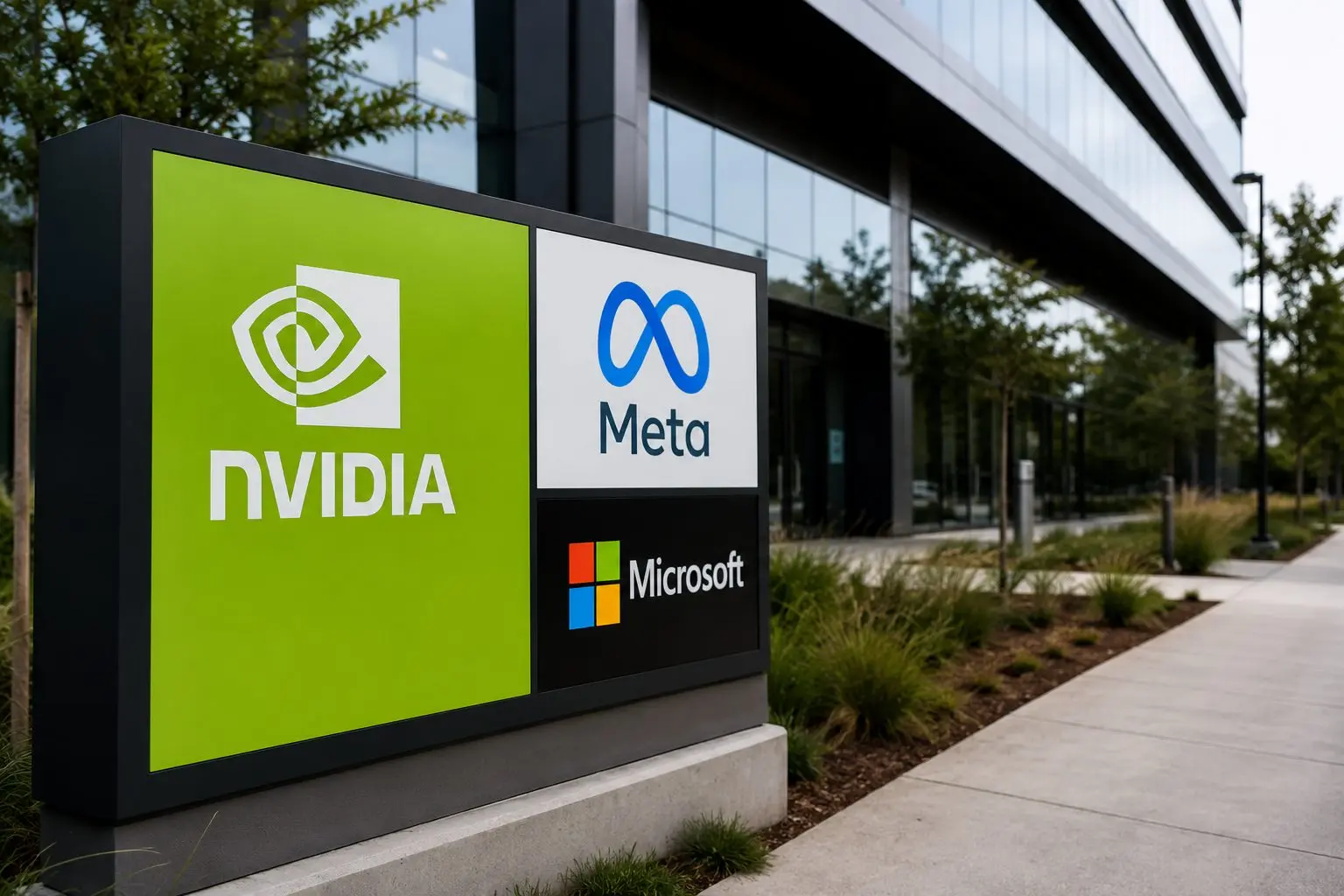
- Nvidia rose 2.0% over the week. Microsoft declined 3.1%, and Meta dropped 7.9%.
- Microsoft and Meta are set to release results on Wednesday. Consensus on 2026 hyperscaler capital expenditures is $682 billion.
Support for open-weight AI increased by 40% in a single day. On Saturday, Microsoft’s published list featured 35 supporters. Nvidia’s earlier document cited 25. OpenAI became a backer following the initial release.
The significance of that expansion outweighs the rhetoric seen on launch day. It aligns a wider segment of the industry behind focused enforcement instead of sweeping restrictions. Supporters represent sectors including chips, cloud services, models, and enterprise software.
The main question for investors is how open models will impact overall profits. Decreasing model expenses may put pressure on prices and lessen reliance on specific vendors. Broader use could also boost demand for chips and cloud resources. This dynamic might benefit high-volume suppliers as utilization increases.
The prior week’s price action reflected that economic divide and mostly occurred before Friday’s letter. Nvidia advanced 2.0%. Microsoft slipped 3.1%, and Meta dropped 7.9%. The Nasdaq Composite slid 2.1%.
| Asset | Friday close | Weekly move | Preliminary market-value change | Next catalyst |
|---|---|---|---|---|
| Nvidia | $206.84 | +2.0% | +$98 billion | Cloud capex updates |
| Microsoft | $381.70 | -3.1% | -$90 billion | Fiscal Q4, July 29 |
| Meta | $595.19 | -7.9% | -$130 billion | Second quarter, July 29 |
| Nasdaq Composite | 24,975.82 | -2.1% | — | Big Tech results |
Weekly changes reflect July 24 versus July 17. Market value calculations are initial estimates based on Friday’s closing capitalizations and static share quantities.
Meta and Microsoft will publish their earnings following the market close on Wednesday.
Based on that, Nvidia’s value increased by approximately $98 billion, while Microsoft and Meta together lost around $220 billion in value. Altogether, the three companies saw a net decrease of about $122 billion. The letter was sent after most of the week’s moves had already occurred.
The letter states that users ought to have the option to download, review, and alter models. According to the text, having choices reduces expenses and increases competition. It further separates valid distillation methods from illegal extraction, noting that the latter justifies specific legal and business responses.
Huang stated, “Open models strengthen safety and cybersecurity.” He added that such models also boost innovation and their spread. Altman expressed his wish for the United States to succeed in “both open source and proprietary models.” Fortune
The campaign launches as tensions rise regarding Moonshot AI’s Kimi K3. White House technology adviser Michael Kratsios alleged Moonshot replicated Anthropic content. Treasury Secretary Scott Bessent noted that penalties might be imposed for improper extraction. The reported actions have not been verified in the referenced reports.
Microsoft’s internal figures demonstrate the benefits of selecting different models. During its fiscal third-quarter earnings call, the company reported 5,000 Foundry clients had leveraged open-source models, while over 10,000 utilized several models. This approach can boost Azure consumption even when not all models are proprietary.
That theory faces a test on Wednesday. Microsoft will announce results for its fiscal fourth quarter after markets close. Meta is set to disclose its second-quarter numbers the same day. Earnings calls for both companies are expected to focus on AI demand, margins, and capital expenditures.
Visible Alpha, a unit of S&P Global NYSE:SPGI, forecasts hyperscaler capex to reach $682 billion in 2026, almost $300 billion higher than the previous year. The projection increases to $878 billion for 2027, taking total spending over two years above $1.5 trillion.
Visible Alpha’s preliminary consensus forecasts Azure AI Services will generate $23.7 billion in revenue in fiscal 2026. Meta is expected to report $60.2 billion in second-quarter revenue. For 2026, consensus shows Meta’s capex at $136.7 billion, increasing by $67 billion from the previous year.
Risks: Once weights are made public, tracking or retracting them may prove challenging. Reduced model pricing could pressure software profit margins. Sanctions or tighter security measures have the potential to limit rollout. Significant capital expenditures may exceed revenue increases.
Investors face their first significant challenge on Wednesday. The issue is not if open models will proliferate, but whether this expansion leads to sufficient paid usage to offset infrastructure costs.
Related articles: NASDAQ:META