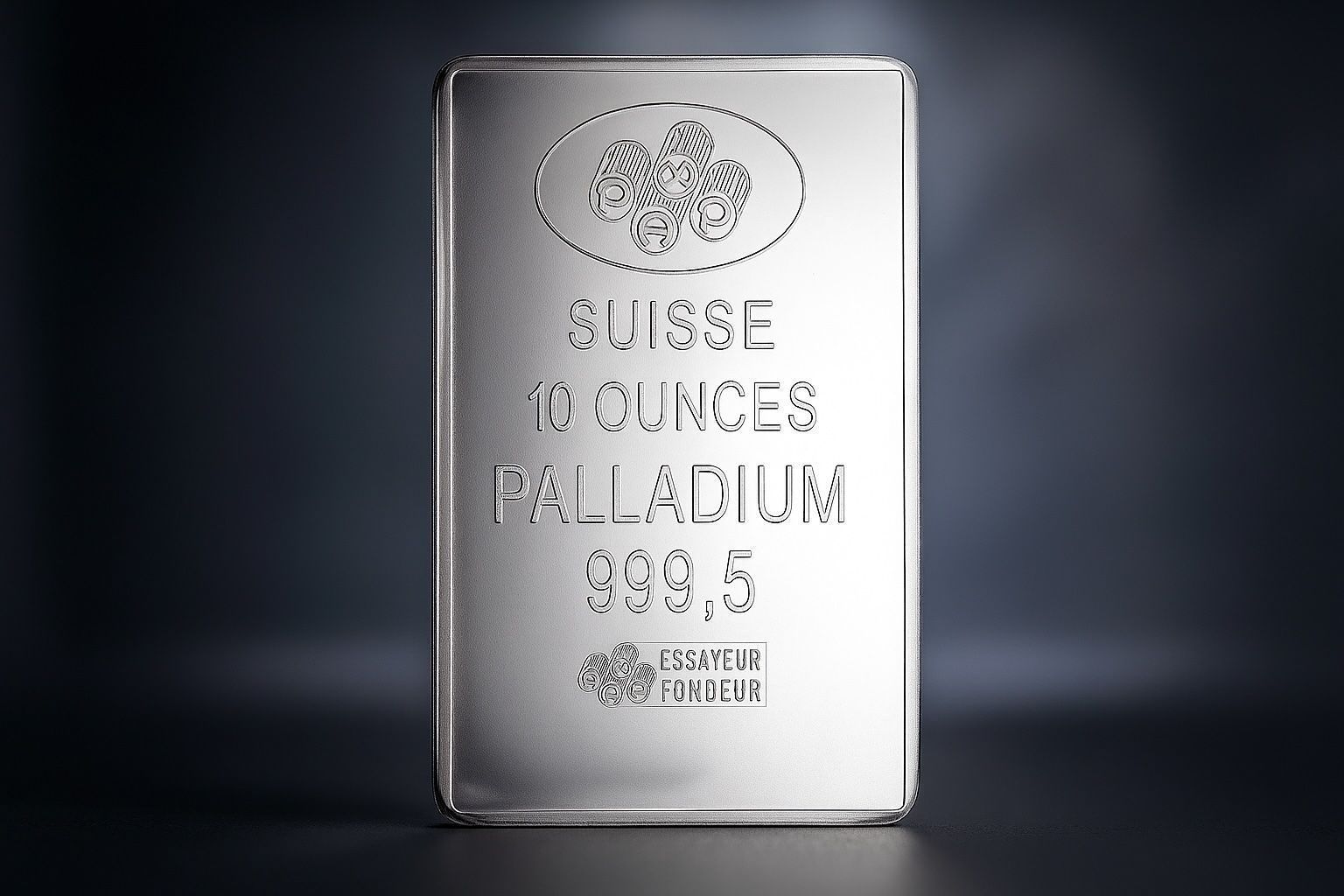
Palladium price today is trading in a tight—but headline-sensitive—band after a strong late-year run across precious metals. On Tuesday, Dec. 16, 2025, spot palladium was quoted around $1,563.69 per ounce, down 0.2% on the day, while still hovering near a two‑month high, according to Reuters market pricing. Reuters
Across major pricing venues, intraday quotes vary by timestamp, spread, and whether you’re looking at spot metal, OTC dealer quotes, or exchange-traded derivatives. For example:
- A U.S. bullion dealer screen showed palladium around $1,586.77/oz in the morning, down about 0.73% at the time of capture. JM Bullion
- A widely followed trading platform had XPD/USD near $1,560.40, with an intraday range roughly $1,553–$1,600 and a 52‑week range near $886–$1,642. Investing.com
Taken together, “palladium price today” can be fairly summarized as mid-$1,500s per ounce, with traders watching whether the market can sustain a break above the $1,600 area—or if profit-taking pulls it back toward the low-to-mid $1,500s.
Why palladium prices are moving today
Palladium’s day-to-day action is being pulled by the same forces steering the broader precious-metals complex: U.S. interest-rate expectations, the dollar, and risk appetite.
Reuters reported that investors were cautious ahead of key U.S. jobs data and upcoming inflation releases, a setup that helped drive profit-taking in metals after a sharp 2025 rally. In that context, palladium eased slightly even as platinum remained firm. Reuters
This matters because palladium—like gold and silver—is a globally priced asset. When markets expect lower rates or a softer dollar, non-yielding assets often benefit; when data risk is high, metals can see short-term “de-risking” moves. Reuters also highlighted that delayed or incomplete U.S. data collection (linked to the U.S. government shutdown) is complicating the economic picture, adding another layer of uncertainty for traders setting positions. Reuters
The biggest palladium demand headline: Europe’s 2035 combustion-engine rethink
One of the most important fresh catalysts for palladium’s medium-term demand narrative hit on Dec. 16: signals that the European Commission may soften its stance on phasing out new combustion-engine cars.
A Reuters report said the European Commission is set to backtrack on the planned 2035 ban on new combustion-engine cars by allowing continued sales of some non‑electric vehicles, amid heavy pressure from major member states and the auto industry. Under the proposal described by Reuters, the target shifts from 100% emissions reduction to 90% by 2035 (relative to 2021 levels), potentially extending the life of plug‑in hybrids and “range extender” vehicles. Reuters
A separate Reuters piece added that the Commission was weighing a compensation scheme that could allow combustion-engine vehicle sales beyond 2035, with mechanisms involving alternative fuels and green steel accounting. Reuters
Why that policy shift matters for palladium price forecasts
Palladium is tightly linked to internal-combustion powertrains because it’s used in catalytic converters that reduce harmful emissions in gasoline engines. A prolonged hybrid/ICE runway in Europe—if it becomes law—could slow the pace at which palladium’s core demand base erodes.
Reuters quoted a commodities strategist at WisdomTree saying the policy move is “likely to be supportive for internal combustion vehicles,” which use platinum and palladium. Reuters
In short: even small changes in the expected timeline for ICE decline can ripple into palladium’s forward demand curve, and that can influence both speculative positioning and longer-dated price expectations.
Supply and balance: “Deficit” depends on whether investment demand is included
While demand headlines grab attention, palladium is also reacting to supply-balance messaging—especially from Russia’s Norilsk Nickel (Nornickel), the world’s largest palladium producer.
A Dec. 16 analysis note published by FXStreet, citing Commerzbank commodity analyst Carsten Fritsch, summarized Nornickel’s updated balance expectations:
- For 2025: Nornickel expects palladium to be balanced without investment demand, but a 200,000‑ounce deficitincluding investment demand. FXStreet
- For 2026 (excluding investment demand): Nornickel expects a 100,000‑ounce deficit. FXStreet
Mining.com’s Reuters-sourced recap echoed the same core figures: balanced in 2025 excluding investment demand, a 200,000‑ounce deficit including it, and a 100,000‑ounce deficit in 2026 excluding investment activity. MINING.COM
The key takeaway for investors
When you read “palladium market deficit,” check the fine print: is investment demand included? In a market as small and concentrated as palladium, swings in ETF/physical investment behavior can meaningfully change the headline balance—and therefore sentiment.
That investment dimension has been visible in broader precious-metals commentary as well. An India Bullion and Jewellers Associations (IBJA) daily market report dated Dec. 16 noted that, since earlier in the rally, palladium gained about 25% alongside strong moves in silver and platinum—an example of how momentum can spread beyond gold into the wider metals complex. ibja.co
Palladium price today vs. futures: what the market is paying on-exchange
Spot palladium is commonly referenced in news headlines, but many institutions and active traders also track exchange-traded futures.
On Barchart, NYMEX Palladium Dec ’25 (PAZ25) was shown around $1,592.80, up about $78.60 at the time of the snapshot. Barchart.com
The spot-futures spread can shift rapidly based on liquidity, near-term supply availability, and financing conditions—so it’s normal to see different “palladium price today” numbers depending on which benchmark you follow.
Forecasts and outlook: where analysts see palladium heading into 2026
Palladium’s rally in 2025 has forced analysts to revisit scenarios for 2026. The market now sits at the intersection of two competing stories:
- Structural support: tight supply, concentration of production, and policy developments that may extend ICE/hybrid demand.
- Structural headwinds: long-term electrification and substitution risks that can cap upside in a metal heavily tied to gasoline autocatalysts.
Here are the most relevant, currently circulating forecasts and outlook signals as of mid‑December 2025:
Morgan Stanley: palladium seen at $1,325/oz in 2026
Reuters reported that Morgan Stanley forecasts palladium at $1,325 per ounce in 2026, alongside higher projections for platinum, citing structural imbalances and differing demand drivers. Reuters
Heraeus: wide 2026 range, with downside risk from BEVs
In a Dec. 8, 2025 forecast release, Heraeus Precious Metals projected palladium in a broad $950–$1,500 per ounce range for 2026 and argued the market could face a widening surplus if automotive catalyst demand declines as battery EV market share increases. heraeus-precious-metals.com
WPIC: palladium deficit in 2025, small surplus in 2026 (base case)
The World Platinum Investment Council’s multi-year supply/demand view stated that the palladium market is expected to record a small deficit in 2025, before transitioning to a small surplus in 2026. platinuminvestment.com
Reuters poll: 2026 median at $1,262.50 (raised after the 2025 rally)
A Reuters poll published earlier in Q4 reported a median 2026 palladium forecast of $1,262.50/oz, up from $1,100 in the prior poll, reflecting how much sentiment changed after 2025’s surge. Reuters
How to read the forecast spread:
Even among reputable forecasters, 2026 expectations cluster in the low-to-mid $1,200s (poll/consensus) with some institutions leaning higher (Morgan Stanley) and others emphasizing a broader downside-risk range (Heraeus). That dispersion reflects real uncertainty over (a) how quickly ICE demand falls, (b) how persistent supply tightness proves to be, and (c) whether investment demand remains a meaningful factor rather than fading as prices consolidate.
Technical and positioning signals traders are watching
Beyond fundamentals, palladium is also attracting attention because it is trading close to levels that tend to matter for momentum and short-term positioning:
- One platform’s intraday range near $1,553–$1,600 effectively marks the day’s support/resistance band, with the upper end acting as a “breakout test” zone. Investing.com
- The same platform shows a 52‑week high near $1,641.56, a reminder that the market is not far from levels that could trigger further momentum buying if re-tested. Investing.com
- That platform’s technical summary at the time indicated a “Strong Buy” signal, reflecting trend strength rather than a guarantee of future returns. Investing.com
What to watch next for palladium price action this week
If you’re following palladium prices closely, the next catalysts are likely to be macro-driven first—and then policy- and supply-driven:
- U.S. labor and inflation data: Reuters flagged nonfarm payroll expectations and upcoming CPI/PCE releases as key inputs for Fed expectations, which often move the dollar and real yields—two big drivers for metals. Reuters
- EU legislative details: Traders will look past headlines to the actual structure and timing of any post‑2035 ICE allowances (and whether they materially alter automakers’ production planning). Reuters+1
- Producer balance updates: The market will continue to reprice how meaningful a deficit is if it depends on investment demand—especially if ETF/physical buying slows after a strong run. FXStreet+1
- Palladium vs. platinum dynamics: With platinum far stronger in 2025, substitution and autocatalyst loadings remain a live debate for 2026. Outlooks that treat palladium as “narrow-demand” are likely to stay influential as investors weigh relative value across PGMs. platinuminvestment.com+1
Bottom line: palladium price today is stable, but the narrative is shifting
Palladium price today is not making an outsized move—yet—but the story underneath it is evolving quickly.
- Near-term: the metal is trading around the mid-$1,500s with modest pullbacks tied to profit-taking and high-impact U.S. macro data risk. Reuters+2Investing.com+2
- Medium-term: Europe’s apparent willingness to relax the 2035 combustion-engine phaseout could be a meaningful demand-support signal for palladium’s core autocatalyst use case. Reuters+1
- Forward outlook: forecasts for 2026 span from about $1,262 (poll median) to $1,325 (Morgan Stanley), while some forecasters emphasize a broad range tied to the pace of EV adoption and potential surplus conditions. Reuters+2Reuters+2
For now, palladium remains one of the most policy- and narrative-sensitive metals on the board—where a single regulatory shift, balance revision, or macro surprise can move prices quickly because the market is comparatively small and concentrated.