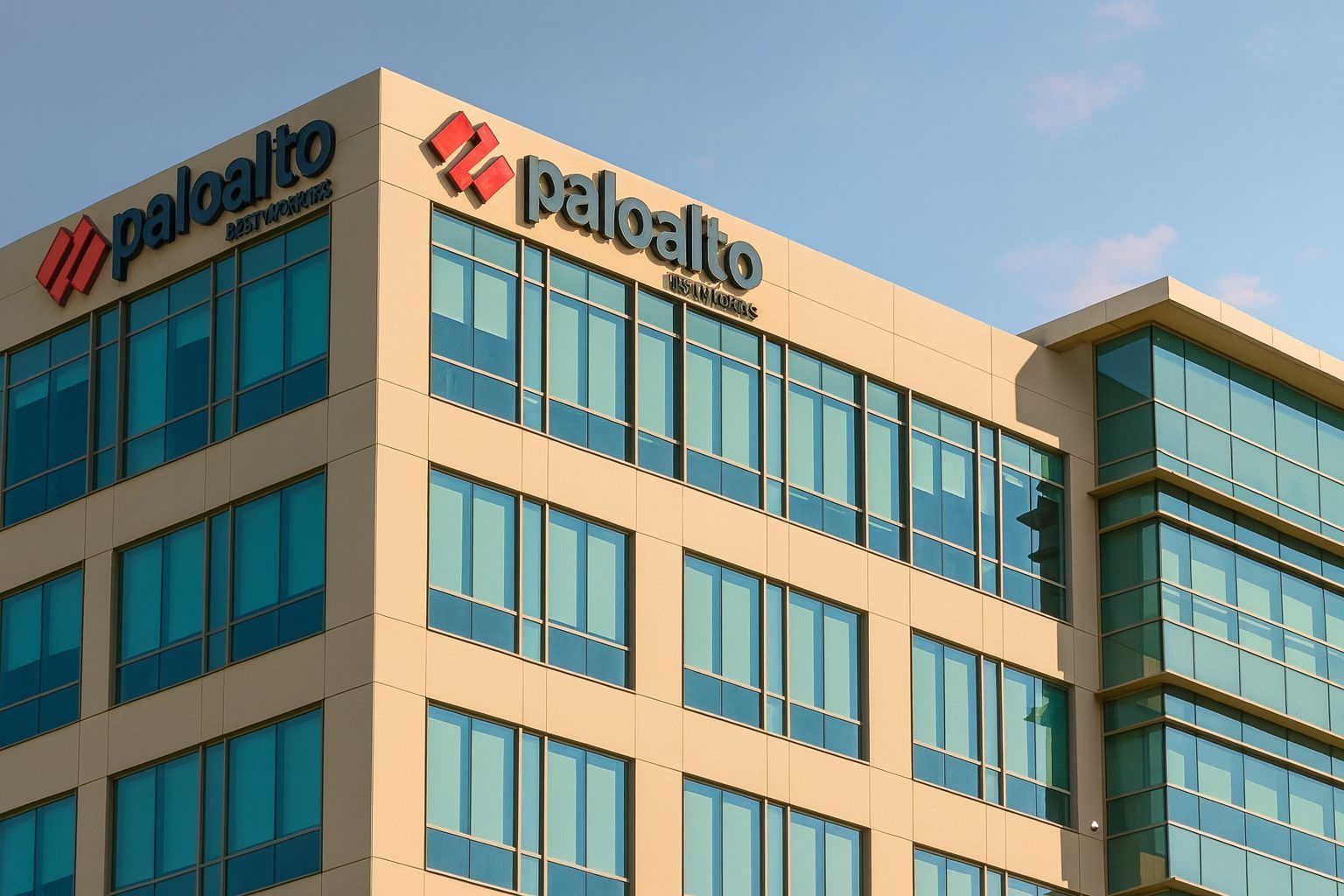

Palo Alto Networks, Inc. (NASDAQ: PANW) stock traded lower on Monday, Dec. 15, 2025, even as fresh Wall Street commentary kept the cybersecurity heavyweight firmly in “platform winner” territory. By late U.S. trading, PANW was $186.39, down about 2.8% on the day, after opening near $191.34 and touching an intraday high of $192.51 and low of $186.27.
That dip is notable because Dec. 15’s headline flow was mostly supportive: a prominent bull reiterated a $250 target while another research firm raised its target to $250, and a widely read comparative analysis revisited why cybersecurity “platformization” remains a central investment theme. Investing.com+2MarketScreener+2
Below is a complete, publication-ready breakdown of the key Dec. 15, 2025 news, forecasts, and analyses shaping the PANW stock narrative—plus the fundamental catalysts investors keep coming back to.
What happened to Palo Alto Networks stock on Dec. 15, 2025?
PANW’s decline on Monday looked less like a company-specific shock and more like a valuation-and-sentiment reset: the stock slipped despite an analyst backdrop that continues to price Palo Alto as a premium cybersecurity consolidator and AI-era platform vendor.
The tension investors are managing right now is straightforward:
- Bulls point to Palo Alto’s expanding platform footprint (network, cloud, security operations, identity) and strong recurring revenue metrics.
- Skeptics focus on premium valuation and near-term go-to-market shifts (contract duration, payment structure) that can muddy reported growth and revenue visibility.
Dec. 15’s research notes leaned bullish—but the stock still fell, a reminder that even “consensus winners” can trade down when markets are sensitive to multiples.
Dec. 15 analyst headline #1: Citizens reiterates “Market Outperform,” keeps $250 price target
In a Dec. 15 analyst note carried by Investing.com, Citizens reiterated its positive stance on Palo Alto Networks and kept a $250 price target. The firm explicitly framed its thesis around Palo Alto’s “ambitious platform strategy” and ongoing product expansion designed to consolidate a broad slice of the cybersecurity total addressable market. Investing.com+1
A key detail from the note: Citizens justified a premium valuation using forward free-cash-flow style multiples, arguing the stock’s target multiple sits above peer averages because Palo Alto is positioning itself as a platform consolidator rather than a point-solution vendor.
The note also referenced Palo Alto’s recent quarterly execution and cited other firms maintaining constructive targets (including $250 from Cantor Fitzgerald and $230 from BMO in the same context).
Takeaway: $250 is increasingly being treated as a psychological “bull-case waypoint” for PANW—high enough to imply meaningful upside, but now common enough to reflect a shared Street narrative around platformization and monetization of AI-driven security.
Dec. 15 analyst headline #2: Wolfe Research lifts PT to $250 from $225, maintains “Outperform”
A second Dec. 15 catalyst: Wolfe Research raised its price target to $250 from $225 and maintained an Outperform rating, according to MarketScreener/MT Newswires.
Even though the full article is paywalled, the headline move matters because it reinforces a theme across multiple desks: $250 is becoming a “cluster target” among bulls following Palo Alto’s earnings/guidance cycle and M&A-led platform expansion.
Takeaway: With Citizens reiterating $250 and Wolfe moving to $250 on the same day, the Street signal was clear: analysts are still willing to pay a premium multiple for the PANW platform story, even amid choppy tape.
Dec. 15 analysis: PANW vs. CrowdStrike debate resurfaces — and it highlights PANW’s near-term friction
A Dec. 15 comparative deep-dive published on Nasdaq (from Zacks) asked a question investors keep revisiting: PANW vs. CRWD—who has the edge right now? Nasdaq
The bull case Zacks laid out for PANW
The piece underscored Palo Alto’s breadth across network, cloud and endpoint security, and specifically highlighted ongoing growth opportunities in Zero Trust, SASE, and private 5G security.
It also included a concrete datapoint that continues to resonate with enterprise buyers: in fiscal Q1 2026, SASE was Palo Alto’s fastest-growing segment, with SASE ARR up 34% year over year, and it cited a $33 million SASE deal with a large U.S. cabinet agency covering 60,000 seats after replacing an existing provider.
The near-term challenges called out
At the same time, the analysis emphasized near-term headwinds that can weigh on sentiment:
- Shortened contract durations
- Shifts in $1M+ deals from multi-year payments to annual payments
- A slower transition from legacy platforms to cloud-based AI-powered platforms, which can affect top-line stability and reported growth cadence Nasdaq
The piece also contrasted valuation and performance, noting CrowdStrike’s stronger YTD return and ultimately concluding CRWD had the edge “at present,” assigning PANW a weaker Zacks rank in that framing. Nasdaq
Takeaway: Even on a day when price targets moved up, one of the most-read Dec. 15 analyses reminded investors that PANW’s platform transition mechanics (contract structure, payment terms, and migration pacing) are a real part of the debate.
Dec. 15 “quality” angle: StockStory spotlights PANW’s cash generation
Another Dec. 15 publication angle came from a StockStory piece distributed via FinancialContent. It framed Palo Alto Networks as a “cash-producing” name, citing a trailing 12-month free cash flow margin of 38.6%, along with profitability and efficiency metrics, as part of its positive positioning. FinancialContent
Takeaway: In a market that frequently rotates between growth and profitability, PANW’s cash profile continues to be used as a defensive-growth argument—especially compared with less profitable software peers.
Forecasts as of Dec. 15, 2025: Where Wall Street price targets cluster
Even with the stock down on the day, aggregated forecasts remained constructive.
Consensus targets: low-to-mid $220s on average
MarketBeat’s analyst aggregation showed:
- Average price target: $225.09
- High: $255
- Low: $135 MarketBeat
StockAnalysis posted a similar picture:
- Average target: $223.18
- High: $255
- Low: $135
- Consensus rating: Buy StockAnalysis
With PANW at $186.39 during Dec. 15 trading, those averages imply roughly ~20% upside to the mean target, while a $250 target implies roughly ~34% upside—but also signals that investors are paying for a premium “platform leader” multiple. MarketBeat+1
The valuation caveat showing up in day-of analysis
A Dec. 15 DailyForex technical/fundamental snapshot emphasized that PANW looked “expensive” on P/E comparisons and suggested downside risks can dominate in the short term even when target prices suggest upside. DailyForex
Meanwhile, Citizens’ note itself acknowledged the premium framing, pointing to valuation multiples that sit above peer-group averages in its model.
Bottom line on forecasts: On Dec. 15, the Street’s central tendency stayed bullish, but commentary also made clear that valuation sensitivity is high—which can translate into sharp pullbacks even without negative company-specific headlines.
The fundamentals behind the targets: Q1 FY2026 results and updated FY2026 guidance
Dec. 15’s analyst notes repeatedly referenced Palo Alto’s most recent earnings and outlook—because that’s the foundation for the raised targets.
From the company’s fiscal Q1 2026 results release (reported Nov. 19, 2025):
- Revenue: $2.5B, up 16% YoY
- Next-Generation Security ARR: $5.9B, up 29% YoY
- Remaining performance obligation (RPO): $15.5B, up 24% YoY
- Non-GAAP EPS: $0.93 (as reported in the release) PR Newswire
Guidance that matters for PANW stock valuation
Palo Alto’s release also provided a detailed outlook:
Fiscal Q2 2026 guidance
- Total revenue: $2.57B to $2.59B
- Next-Gen Security ARR: $6.11B to $6.14B
- Non-GAAP EPS: $0.93 to $0.95 PR Newswire
Full fiscal year 2026 guidance
- Total revenue: $10.50B to $10.54B
- Non-GAAP EPS: $3.80 to $3.90
- Non-GAAP operating margin: 29.5% to 30.0%
- Adjusted free cash flow margin: 38% to 39% PR Newswire
This guidance aligns with Reuters’ reporting around the Chronosphere acquisition timing, which also noted Palo Alto raised its annual revenue and profit forecasts.
Why investors care: These figures help explain why analysts are comfortable modeling PANW as a high-multiple, high-cash-flow compounder—particularly if platformization drives deeper customer adoption and reduces tool sprawl.
Strategic catalysts still shaping the stock: M&A + AI platform expansion
Although not “new” on Dec. 15, the strategic backdrop is the reason Dec. 15 research notes could credibly argue for premium targets.
Chronosphere: a $3.35B AI-era observability push
Reuters reported that Palo Alto agreed to acquire Chronosphere for $3.35 billion, aiming to integrate it with Cortex AgentiX so AI agents can use Chronosphere’s data to detect performance issues and investigate root causes.
The same Reuters report noted investor sensitivity to deal timing and price, including commentary that announcing the acquisition before closing the CyberArk deal could weigh on shares, and highlighted Chronosphere’s ARR and valuation context.
CyberArk: $25B identity security move
AP reported Palo Alto’s agreement to acquire CyberArk in a cash-and-stock deal valued at about $25 billion, positioning Palo Alto to expand deeper into identity security. The report detailed the consideration for CyberArk shareholders and indicated expected closing in the latter half of Palo Alto’s fiscal 2026 (pending approvals).
Reuters also referenced CyberArk’s shareholder approval timing and reiterated that both CyberArk and Chronosphere deals were expected to close in the second half of fiscal 2026.
AI product expansion: Cortex Cloud and Prisma AIRS
Separately, Reuters reported in October that Palo Alto launched new versions of Cortex Cloud and Prisma AIRS, including a Prisma AIRS version integrating Protect AI technology and an expanded agentic approach through Cortex AgentiX.
Why this matters for PANW stock: The Street’s “$250 thesis” is essentially a bet that Palo Alto can keep bundling more of the security stack—network, cloud, SecOps, and identity—while using AI/automation to improve outcomes and justify premium pricing.
Technical and sentiment check on Dec. 15: why the stock can fall even as targets rise
On Dec. 15, multiple “snapshot” style analyses leaned cautious on near-term technicals even while fundamentals/targets stayed constructive.
- Investing.com’s technical read for PANW signaled “Strong Sell” based on moving averages. Investing.com
- DailyForex argued downside could persist and flagged the stock as expensive on P/E comparisons, despite upside implied by consensus targets.
- Meanwhile, Citizens’ own note implicitly acknowledged valuation premium by discussing EV/FCF multiples above peer averages.
Interpretation: When a stock is widely owned and priced as a premium compounder, it doesn’t take negative earnings to trigger drawdowns—sometimes it’s enough for the market to “re-price the multiple” temporarily.
What investors will watch next
Even though your request focuses on Dec. 15, PANW stock typically trades on a short list of forward catalysts:
- Next earnings date (estimated)
Market calendars commonly estimate Palo Alto’s next earnings around Feb. 12, 2026 (not yet confirmed by the company in those listings). - Platformization traction
Watch for continued SASE ARR momentum and large-platform deal disclosures like the $33M SASE win referenced in the Dec. 15 Zacks analysis. - Deal progress and integration signals
Investors will be looking for clarity on timing, approvals, and integration milestones for CyberArk and Chronosphere, since both deals are central to the “platform expansion” pitch. Reuters+1 - Valuation discipline vs. growth durability
With targets clustering in the low-to-mid $220s and bulls pushing $250, the path higher likely depends on PANW proving it can sustain strong ARR growth and cash generation through the contract/payment mix shift.
The Dec. 15, 2025 bottom line for Palo Alto Networks stock
On Dec. 15, 2025, PANW stock fell roughly 2.8% even as research commentary turned more constructive around $250 targets.
The day’s story wasn’t about a single breaking headline—it was about how the market is weighing a premium-priced cybersecurity platform:
- Analysts continue to reward Palo Alto’s breadth, recurring revenue metrics, and AI-driven platform direction.
- At the same time, investors are sensitive to valuation and near-term execution nuances (contract duration, payment terms), which can pressure the stock even when forecasts remain bullish.



![US Stock Market Today 08/28/2026 [UPDATE: 01:00 EDT] [Marvell Pins Near Overnight Low as Analyst Targets Diverge]](https://ts2.tech/wp-content/uploads/2026/08/US-market-dashboard-2026-08-28-0058-480x384.jpg "US Stock Market Today 08/28/2026 [UPDATE: 01:00 EDT] [Marvell Pins Near Overnight Low as Analyst Targets Diverge]")