
Published 5 December 2025
PLS Group Limited (formerly Pilbara Minerals Limited) has turned into one of the loudest signals in the global lithium story as 2025 wraps up. The ASX‑listed lithium producer has rebranded, expanded into Brazil, ramped up downstream projects – and become one of the most heavily shorted large‑cap stocks in Australia, all while its share price has surged from last year’s lows.
This article brings together the latest news, forecasts and analysis on PLS Group Limited stock as of 5 December 2025, drawing on company filings, broker research and lithium‑market data.
PLS Group share price snapshot on 5 December 2025
As of trading on 5 December 2025, PLS Group shares are changing hands at around A$3.8 per share, implying a market capitalisation of roughly A$12 billion. Brokerage data from Stake and StockAnalysis both show the stock in the high‑A$3.70s to low‑A$3.80s range during Friday trade.
Key current stats:
- Price: ~A$3.79–A$3.80 (intraday 5 December 2025) Stake+1
- Market cap: about A$12 billion Stake+1
- 1‑year performance: up around 55–60% based on recent price of ~A$3.8 versus 52‑week lows near A$1.07 TechStock²+2TechStock²+2
- 52‑week range: approximately A$1.07 – A$4.26 TechStock²+1
- Earnings: trailing EPS about –A$0.06 per share, leaving the stock on a negative P/E (~–59x) due to FY25 losses.
In other words, the share price has already staged a powerful comeback in 2025, while the reported earnings still reflect the hangover from the lithium price crash.
From Pilbara Minerals to PLS Group: new name, broader strategy
One of the most important developments for the stock in late 2025 is the formal change of corporate name from Pilbara Minerals Limited to PLS Group Limited.
- At the 2025 Annual General Meeting, shareholders approved a special resolution to change the company name to PLS Group Limited, aligning the legal name with a “PLS” corporate brand introduced earlier in the year. Company Announcements+1
- The name change became legally effective in late November, and the ASX implemented the change from 3 December 2025, while keeping the ticker symbol as PLS.
- The company and several news services frame the rebrand as signalling a multi‑asset, multi‑jurisdiction lithium group rather than a single‑mine Western Australian producer.
PLS Group now trades on:
- ASX: PLS
- US OTC: PILBF StockAnalysis+1
- Frankfurt: PLR StockAnalysis
The brand shift is more than cosmetic. It reflects the addition of the Colina lithium project in Brazil, the ramp‑up of a lithium hydroxide joint venture in South Korea, and the company’s ambition to be a global supplier of lithium materials rather than a single‑region miner.
Fresh headlines: new CFO, board refresh and JPMorgan’s exit
In the week leading into 5 December 2025, PLS Group delivered a cluster of market‑moving corporate announcements.
New Chief Financial Officer
On 1 December 2025, PLS Group announced the appointment of Alex Willcocks as its next Chief Financial Officer, effective May 2026.
According to the company and follow‑up coverage:
- Willcocks brings more than 20 years of finance experience, including senior roles at Wesfarmers Group.
- The company explicitly links the hire to its evolution into a global, multi‑asset lithium business spanning Australia, Brazil and South Korea.
For investors, a CFO transition at this point in the cycle matters: PLS is juggling multiple expansion projects, a large cash pile and a still‑volatile commodity price backdrop, so capital allocation decisions will be scrutinised.
Board update: new Non‑Executive Director
On 2 December 2025, PLS Group issued a Board update confirming the appointment of Robert Nicholson as a Non‑Executive Director, effective 1 January 2026.
This continues a multi‑year pattern of board and executive refresh as the company has grown from a single‑mine developer into a diversified lithium producer.
JPMorgan ceases to be a substantial holder
Also this week, JPMorgan Chase & Co. and affiliates lodged a “Ceasing to be a substantial holder” notice, indicating their interest has fallen below the 5% threshold as at 2 December 2025. TipRanks+2Intelligent Investor+2
Substantial holders can influence sentiment and governance, so the exit of a major global bank:
- removes one large, potentially price‑sensitive shareholder from the register;
- may have contributed to recent trading volatility as positions were unwound.
Operations and growth strategy: Pilgangoora, Colina and the value chain
Behind the ticker and the rebrand, the investment case still begins with Pilgangoora.
Pilgangoora: a scaled, low‑cost hard‑rock lithium asset
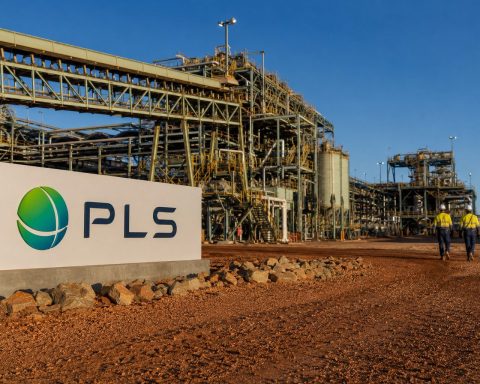
PLS Group owns 100% of the Pilgangoora operation in Western Australia, one of the world’s largest independent hard‑rock lithium projects.
Key operational milestones and metrics:
- FY25 production: around 755–756 kt of spodumene concentrate, exceeding the company’s 700–740 kt guidance after completing the P680 and P1000 expansion projects.
- September 2025 quarter:
- Production of roughly 224.8 kt and sales of 214 kt of concentrate.
- Revenue of about A$251 million, up roughly 30% quarter‑on‑quarter.
- Unit operating costs around A$540/t, down about 13% on the prior quarter.
- Cash balance in the region of A$850m+ plus undrawn credit facilities, leaving the balance sheet in a clear net‑cash position.
These numbers show why PLS has been repeatedly described as a relatively low‑cost, scale producer that can remain operationally profitable deeper into a down‑cycle than many peers.
Brazil: the Colina lithium project via Latin Resources acquisition
On 4 February 2025, PLS completed the acquisition of Latin Resources Limited, gaining the Colina lithium project in Minas Gerais, Brazil.
Subsequent announcements indicate:
- Colina is being positioned as a potential top‑10 hard‑rock lithium operation by production (excluding Africa).
- A new Mineral Resource estimate for Colina was released in August 2025, aligning reporting with PLS Group standards and confirming significant scale.
Strategically, Colina gives PLS:
- a growth pipeline outside Australia;
- exposure to Brazil’s emerging “lithium valley”;
- optionality over how aggressively to grow once lithium prices stabilise.
Downstream and midstream: POSCO JV and WA demonstration plant
PLS is also moving further down the value chain:
- The POSCO Pilbara Lithium Solutions joint venture in Gwangyang, South Korea has completed a lithium hydroxide plant that is now ramping up, giving PLS exposure to chemical‑grade margins as well as raw concentrate sales.
- In Western Australia, a mid‑stream demonstration plant supported by a A$15 million WA government grant is being advanced after a temporary pause, targeting value‑added lithium products closer to the mine.
Alongside ongoing studies into a potential P2000 expansion that could lift Pilgangoora to more than 2 Mtpa of production capacity, these projects are designed to keep PLS near the front of the global cost curve while capturing a larger share of the downstream margin.
FY25 results: strong volumes, tough earnings
The full‑year numbers to 30 June 2025 show the flip side of that growth story.
According to company and analyst summaries:
- Revenue fell about 39% year‑on‑year to roughly A$769 million, despite record production, as realised lithium prices tumbled.
- Underlying EBITDA dropped roughly 83% to around A$97 million.
- Net profit after tax swung to a loss of roughly A$196 million, consistent with analyst compilations from Simply Wall St and Longbridge.
- Despite the earnings hit, PLS ended FY25 with around A$1.0 billion in cash and total liquidity near A$1.6 billion, and a debt‑to‑equity ratio of about 13%.
Earlier in the downturn, the company had already flagged a significant interim loss for the first half of FY25, citing depressed lithium pricing and write‑downs on joint ventures, reinforcing just how brutal the price reset has been for even the strongest producers.
The upshot: operationally, PLS is performing well and has expanded capacity, but the financial statements still show the scars of the lithium bear market.
Analyst forecasts and valuation: neutral consensus, wide dispersion
PLS Group is heavily covered by the sell‑side, with around 30–31 analysts following the stock across its ASX, OTC and Frankfurt lines.
Recent consensus snapshots compiled by Investing.com, Fintel and Simply Wall St (as summarised in recent research) suggest: Yahoo Finance+3TechStock²+3Investing.com+3
- 12‑month target price (ASX):
- Investing.com: average around A$3.00, range roughly A$2.10–A$4.40.
- Fintel: slightly lower average near A$2.9, range about A$1.3–A$3.8.
- Rating mix: roughly 4 Buy, 9 Hold, 4 Sell, producing an overall “Neutral” consensus despite the recent rally.
- US OTC (PILBF) targets: clustered around US$1.37–2.35, with averages implying ~30% downside from recent US pricing.
Individual broker actions in 2025 underline the split:
- UBS downgraded PLS from Neutral to Sell in late September 2025, with a target of A$2.25, arguing that valuation had run ahead of fundamentals after strong share price gains – while still calling PLS one of the best‑positioned producers for a lithium recovery.
- Barrenjoey Markets more recently upgraded from Underweight to Neutral, lifting its target to A$3.60 as lithium prices and sentiment improved.
- Other brokers such as Jefferies and JPMorgan remain cautious, with targets in the low‑to‑mid A$2s and rating language ranging from Hold to Underweight.
Forward‑looking earnings expectations are also structurally optimistic:
- Consensus forecasts compiled by Simply Wall St envisage revenue rising to roughly A$1.4–1.6 billion by FY28, implying low‑20s annual growth from FY25 levels.
- Those same models expect PLS to swing from the FY25 loss to net profit of A$250–320 million by FY28.
However, several valuation frameworks judge the stock as expensive on these forecasts:
- Some discounted cash‑flow and dividend‑discount models cluster around “fair value” estimates well below A$3 per share, in some cases under A$1, reflecting conservative long‑term lithium price assumptions. TechStock²+2strawman.com+2
In short, fundamental analysts broadly like the asset quality but disagree sharply on how much to pay for it.
Short interest and technical picture: a crowded battleground
PLS Group is not just a fundamental story; it’s also one of the biggest battleground stocks on the ASX.
Short interest
Regulatory filings and specialist trackers show that:
- ASIC daily short‑selling data for late November 2025 puts short positions at around 10.9% of issued shares (about 351 million shares) on 24 November.
- Earlier in November, the same data set recorded shorts above 14% of shares on issue.
- ShortMan’s aggregated series shows short interest around 10.8–10.9% in late November / early December, down roughly 3–4 percentage points over the past month, indicating partial short covering into the rally.
- FNArena’s “Short Report” for the week ending 20 November 2025 ranks PLS among the 10 most shorted stocks on the ASX, with short interest near 11.8%. FNArena.com+2FNArena.com+2
Historically, Pilbara/PLS has been near the top of short‑interest rankings, with levels north of 20% during previous cycles, making it a repeat character in Australian short‑squeeze debates.
The current configuration – double‑digit short float plus strong recent price momentum – is inherently unstable: good news can force rapid short covering, while any disappointment can amplify downside if bearish positions expand again.
Technical tone
Technical research services (including StockInvest) broadly describe PLS as: StockInvest+2StockInvest+2
- in a strong upward trend over the last few months;
- having gained roughly 70–80% since mid‑September 2025;
- but flashing short‑term overbought signals, with recent pull‑backs from late‑November highs.
For traders, that translates to a classic momentum profile: the medium‑term trend is up, but volatility and sharp reversals are part of the package.
Lithium market backdrop: from glut to tentative tightness
No view on PLS Group makes sense without the lithium macro.
The downturn: 2023–2024
Across 2023 and 2024, lithium prices collapsed as new supply surged and EV demand growth undershot earlier optimistic forecasts:
- Some benchmark prices fell over 80% from 2022 peaks to late 2024.
- Pilbara/PLS saw profits drop more than 80%, including an 86% earnings decline in one year, as reported in Australian business press.
- The company responded by pushing hard on costs and pausing or slowing some growth initiatives, while still completing the P680 and P1000 expansions at Pilgangoora.
The turn: 2025 and beyond
By 2025, several independent sources were starting to signal a tightening market:
- Fastmarkets projects only a 10,000‑tonne surplus in 2025 and a shift into a 1,500‑tonne deficit in 2026, as high‑cost supply is cut and delayed projects push out new capacity.
- A Reuters survey of analysts earlier this year suggested stabilisation and modest recovery in lithium prices by late 2025 as inventories clear and EV sales re‑accelerate, particularly in China.
- In late October 2025, JPMorgan upgraded its spodumene price forecasts from around US$800/t to US$1,100–1,200/t for 2026–27, and raised its long‑term price assumption to US$1,300/t, citing rapid growth in grid‑scale energy storage as well as EV demand.
For PLS Group, this matters disproportionately. With:
- a large, low‑cost asset at Pilgangoora;
- expansions already paid for; and
- a strong balance sheet with net cash,
even relatively small changes in realised lithium prices can have outsized effects on free cash flow and earnings.
Outlook for PLS Group stock into 2026: key upside and downside drivers
Nothing here is personalised financial advice, but the current setup for PLS Group is clear enough that most analysts converge on the same list of drivers.
Main bullish arguments
Supportive factors for the bull case include:
- Tier‑1 resource base: Pilgangoora is large, long‑life and competitive on costs, with completed expansions and potential further growth to P2000.
- Global diversification: The Colina project in Brazil plus the POSCO JV in South Korea reduce single‑asset risk and broaden the revenue base over time.
- Balance sheet strength: Billions in assets, low net gearing, and close to A$1 billion in cash/lquidity give PLS room to ride volatility and keep investing.
- Leverage to a tightening lithium market: If Fastmarkets’ and JPMorgan’s tighter market views prove conservative, PLS’s earnings could rebound faster than consensus expects.
For investors who believe lithium prices are heading meaningfully higher into the late 2020s, PLS Group offers a pure‑play, scaled, low‑cost exposure with a visible growth pipeline.
Main bearish arguments
The bear case focuses on valuation and risk:
- Rich valuation versus current earnings: At roughly A$3.8 per share and with FY25 earnings negative, the stock trades well above many “fair value” estimates that assume more conservative long‑run prices. TechStock²+3Stake+3StockAnalysis+3
- Consensus price targets sit below the market: Average 12‑month targets around A$3.0 leave the stock on modest implied downside, not upside, from today’s price.
- Execution risk: PLS is integrating a Brazilian acquisition, ramping a hydroxide JV overseas and studying further expansions. Cost overruns or delays could erode returns.
- High short interest: Double‑digit short float means a significant cohort of sophisticated investors is betting against the stock at current levels, often on the view that the market is embedding too‑optimistic lithium prices.
- Macro and policy uncertainty: EV subsidies, Chinese demand, US‑China trade tensions and critical‑minerals policy could all impact lithium prices and project economics in unpredictable ways.
Put bluntly: great asset, messy cycle, spicy short interest. Whether that’s attractive or terrifying depends on an investor’s risk tolerance, time horizon and view of the lithium price curve.
Bottom line
As of 5 December 2025, PLS Group Limited stands at a pivotal point:
- a rebranded, multi‑asset lithium group;
- a share price near record highs after a ferocious 2025 rally;
- freshly appointed leadership in the CFO’s office and the boardroom;
- heavy short interest and sharply divided analyst opinions;
- and a lithium market that looks set to move from glut toward balance, but with plenty of uncertainty left.