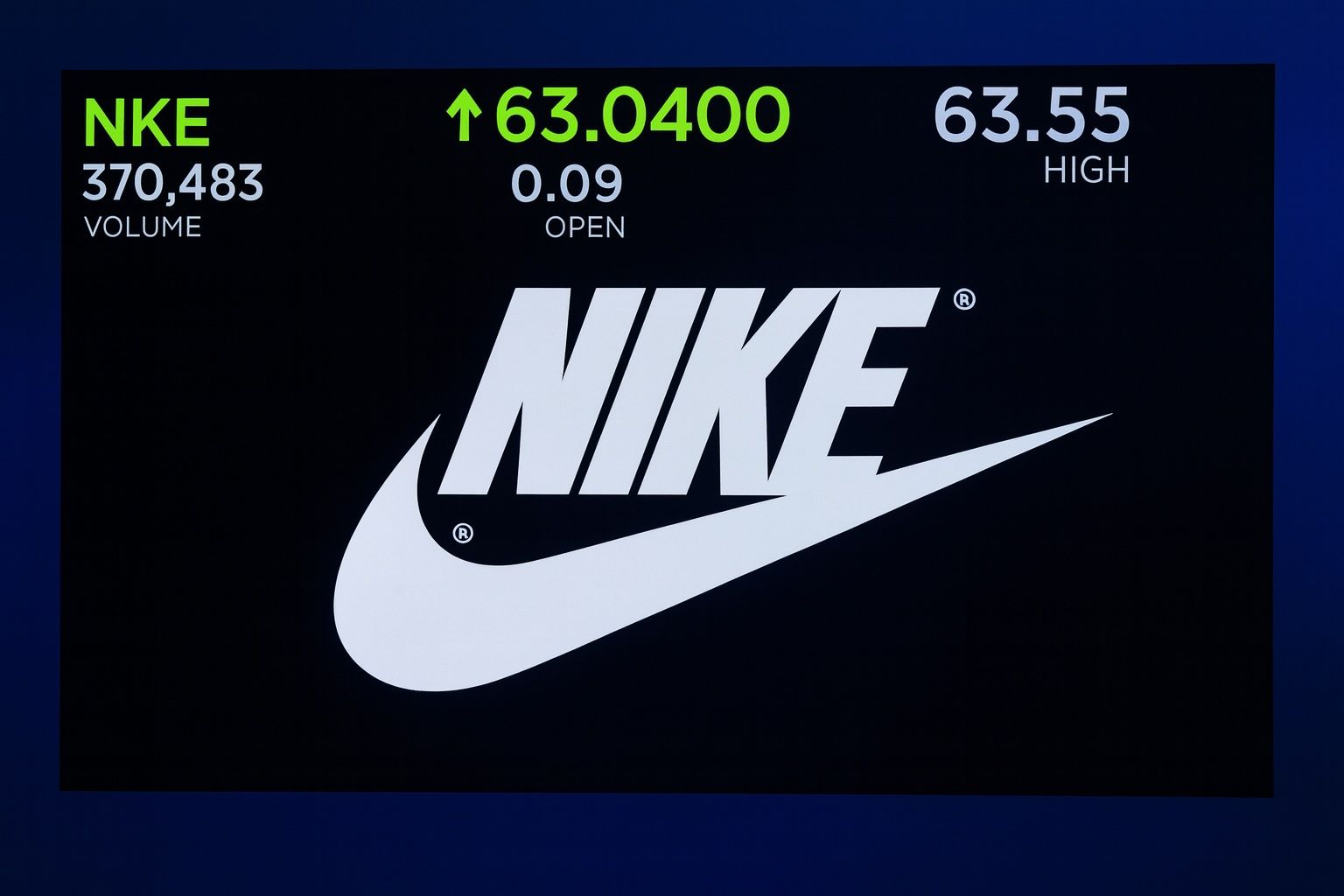

- Stock near lows: Nike shares closed ~ $64.6 on Oct 31, 2025 (after-hours $64.72)marketbeat.com, just above a 52-week low (~$52) and well below the year’s high (~$84)marketbeat.commarketbeat.com. Trading volume has risen to ~10–18 million shares daily in late Oct (17.8M on Oct 31)marketbeat.commarketbeat.com.
- Recent financials: In Q1 FY2026 (quarter ended Aug 31, 2025), Nike reported flat revenues (~$11.7B, +1% year/year) and EPS $0.49investors.nike.com. However, gross margin fell 320 basis points (to 42.2%) as heavy discounting and higher U.S. tariffs squeezed profitsinvestors.nike.com. Net income declined ~31%investors.nike.com.
- Analyst outlook: Many Wall Street analysts remain moderately bullish (25 Buys vs. 8 Holdsmarketbeat.com), citing the potential for a turnaround under CEO Elliott Hillmarketbeat.com. Price targets range ~$78–$90 (consensus ~$82)marketbeat.com. However, estimates have been cut recently – e.g. Zacks trimmed its Q2 FY2026 EPS forecast to $0.37 (from $0.50)marketbeat.com – reflecting near-term headwinds.
- Technical picture: Technical indicators are weak. ChartMill scores NKE 0/10, noting that both medium- and short-term trends are negativechartmill.com. The stock is trading near the bottom of its recent range (~$64–72)chartmill.com, with key resistance zones at ~$67–68 and ~$69–70chartmill.com.
- Peer trends: Apparel peers have been under pressure. Adidas warned of heavy U.S. discounting and tariff dragreuters.com, and Under Armour hit 52-week lows (~$4.72) with cut forecastsmarketbeat.commarketbeat.com. Consumer spending trends remain soft, especially in discretionary items.
- Macro factors: High tariffs on imports (~$1.5B hit expected in FY2025reuters.com) and slowing consumer demand are major overhangs. Fed officials note consumer spending is “slowed but still exceeds the longer-run trend”reuters.com. Geopolitical risks (trade policies) and potential recession fears also weigh on consumer confidence.
Latest News and Market Drivers
Nike has been in the news for several turnaround efforts and headwinds. In late September, CEO Elliott Hill emphasized big marketing investments (e.g. World Cup campaigns) even as tariff costs and China softness persistreuters.comreuters.com. Reuters reports that despite clearing inventory and a surprise 1% revenue bump in Q1 FY2026 (ended Aug 31), Nike warned Q2 sales will dip “low-single digits”reuters.comreuters.com. Tariff burdens have climbed (now ~$1.5 billion vs. $1B prior) as most manufacturing is in Vietnam/China/Indonesiareuters.com.
Consumer demand remains cautious. For example, retailers like Foot Locker have scaled back Nike orders, citing weak demand. A Reuters analysis notes U.S. and European market share for Nike declined last year, and Foot Locker said Nike sales fell ~7% in Q3 2024reuters.com. (General retail data show Nike had to discount products to clear inventory, a trend expected to continue into the holidaysreuters.com.) Overall, media commentary highlights that Nike’s sales have yet to reaccelerate and that rebuilding retailer relationships is a work in progressreuters.cominvesting.com.
Most recently (Nov 1-2, 2025) there were no new company-specific announcements. However, industry news is relevant: Adidas (a competitor) reported weak U.S. orders and aggressive discounting, warning that tariffs and a “nervous” consumer are impacting apparel salesreuters.com. This suggests Nike may face similar market caution. On the positive side, events like the NFL season and upcoming World Cup offer marketing tailwinds, and Nike’s new NikeSKIMS women’s line (with Kim Kardashian) was launched late Octoberreuters.com, although analysts say its impact will take time.
Stock Price and Premarket Movement
As of Friday’s close (Oct 31), Nike stock was ~$64.59marketbeat.com. The MarketBeat summary shows Nike has fallen roughly 13% in the past monthmarketbeat.com, underperforming broader averages. It remains well below its 50-day moving average (~$73.5) and has retraced most of this year’s gains. On Monday morning (Nov 3), premarket activity could hinge on Friday’s mixed cues (slight after-hours uptick to ~$64.72marketbeat.com) and any weekend news. StockInvest’s quantitative model forecasts a flat open (~$64.70) with a modest intraday range ($63.7–65.5)stockinvest.us. Of course, actual moves will depend on market sentiment and any overnight developments.
Trading volume has been relatively robust for Nike. October daily volumes were often 10–15 million, spiking to ~17.8M on Oct 31marketbeat.com. This high turnover indicates increased investor interest (or concern) as the stock slides. MarketBeat notes Nike’s market cap (~$95B) and P/E (~35) as of late Octmarketbeat.com. In comparison, its volume and volatility are elevated versus earlier in the month. Premarket screens may show active futures or options betting, but at this writing there’s no single news catalyst like an earnings release. Watch any moves in index futures or retail sentiment (e.g. online polls) early Monday for clues.
Analyst Commentary and Forecasts
Wall Street analysts have a wide range of views on Nike. MarketBeat data shows a Moderate Buy consensus: 3 Strong Buys, 25 Buys, 8 Holds (and a few Sells)marketbeat.com. The average price target (~$82.21) is ~26% above the current pricemarketbeat.com. Notably, Bank of America (June) and Bernstein have Buy ratings with targets in the high-$70s to $90smarketbeat.com. HSBC recently even upgraded to “Strong Buy” (though details were older). On the flip side, some forecasters are cautious: Zacks cut its Q2 FY2026 EPS estimate from $0.50 to $0.37marketbeat.com, reflecting expectations of tougher comps and continued discounting.
Nike management’s guidance is modest. After the Q1 beat, CFO Matt Friend said they expect another mid-single-digit sales decline in Q2, and reiterated that inventory cleanup and full-price selling are prioritiesinvesting.cominvesting.com. On the earnings call Hill and Friend emphasized product innovation and brand momentum as keys to recoveryinvesting.com. Analysts at Zacks comment that the “stock is currently trading near its fair value” but highlight current challenges (weak DTC, margin pressure, China softness)reuters.com.
Notable quotes: Zacks strategist David Bartosiak warned on Q1 results, “the underlying fundamentals are still shaky” despite the beatreuters.com. Morningstar’s David Swartz has said that a few new product launches won’t be enough in the near term; Nike “needs to create a whole new franchise…that takes years”reuters.com. On the other hand, Kavar Capital’s John Nagle praised the SKIMS tie-up as potentially positive for the women’s segmentreuters.com. Overall, experts agree Nike is a long-term franchise but face a “show-me” environment in 2025, meaning upcoming results and holiday sales will be scrutinized closelyreuters.com.
Financials and Valuation
Nike’s fundamentals remain strong by historic standards, but recent results show pressure. The official Q1 FY2026 release reports $11.7 billion in revenue (up 1% reported), versus $11.02B expectedinvesting.com. EPS was $0.49 (vs. ~$0.47 estimate)investing.com. However, gross margin fell 3.2 percentage points to 42.2% due to lower full-price selling and higher tariffsinvestors.nike.com. Net income dropped ~31% as taxes and operational costs weighed on profitsinvestors.nike.com. Nike still sports a healthy balance sheet: inventories ($8.1B) are slightly lower than last yearinvestors.nike.com, and cash/short-term investments (~$8.6B) remain ample. The company returned ~$714M in Q1 via dividends and buybacks (Dividends up 6% YoYinvestors.nike.com).
Valuation metrics: The stock trades near 35× trailing EPSmarketbeat.com, above its historical range. ChartMill’s analysis notes Nike is “quite expensive at the moment” despite good growth and profitability scoreschartmill.com. In fact, ChartMill gives Nike a solid 6/10 fundamental rating, highlighting top-quartile ROE (~21.5%) and long dividend growth (23 years of raises)chartmill.cominvesting.com. But it also notes a recent dip in returns on capital (3-yr ROIC ~16.6% vs current 10.9%)chartmill.com. These metrics suggest Nike’s core business is healthy, but near-term earnings (FY2026 EPS expected ~$1.63marketbeat.com) may lag prior peaks.
Earnings forecasts have been pared back. Zacks sees full FY2026 EPS ~$1.63 and FY2027 ~$2.45marketbeat.com, implying significant growth (driven partly by expectation of cost cuts and sales recovery). Analysts will closely watch the holiday quarter (ending Nov 30) results due mid-Dec; consensus had been roughly -11.5% sales and EPS ~$0.29 for Q3 FY2025reuters.com. Any upside in those figures could spark optimism.
Technical Outlook
Technically, Nike’s chart is bearish. As noted, ChartMill assigns a score of 0/10, warning that “prices have been falling strongly lately” and it’s “better to avoid new long positions”chartmill.com. The stock has traded between roughly $64.25 and $72.39 over the past monthchartmill.com and is near the low end of that range. On its daily chart, major resistance lies in the mid-$60s: ChartMill identifies resistance zones around $67.5–67.7 and $69–70 (formed by trendlines and moving averages)chartmill.com. A break above $67.5 in coming sessions would be needed to signal a possible bottom.
Key moving averages are also bearish: MarketBeat notes the 50-day MA (~$73.5) is well above the current pricemarketbeat.com, and the 200-day (~$67.3) is only slightly above. If Monday’s trading were to break above $67, it might suggest a technical bounce, but otherwise the momentum indicators (MACD, RSI) remain weak. Volume patterns show spikes on down days (e.g. Oct 31 down ~0.5% on high volumemarketbeat.com), signaling distribution. In short, until there is a catalyst, chart-watchers expect range-bound or slightly lower moves.
Sector and Competitor Trends
Nike’s struggles reflect a broader malaise in athletic apparel. Adidas (a key European rival) just reported that U.S. retailers are heavily discounting, causing sales weakness. Adidas’s CEO warned that retailers are “very nervous” about the U.S. economy and expecting more discounts, slashing full-price salesreuters.com. Adidas’s North America sales declined ~5% (Q3 FY2025) and margins will be hurt by Trump’s tariffsreuters.com – a story nearly identical to Nike’s challenges.
Meanwhile, Under Armour (another U.S. peer) is also under pressure. In late Oct, UAA stock hit a new 52-week low (~$4.72)marketbeat.com. MarketBeat reports consensus price targets near $6.7 and a majority of analysts downgrading the stockmarketbeat.com. Under Armour’s last results showed flat/declining revenues and marginal profits, and its stock charts point down. Specialty retailer Lululemon (for women’s athleisure) is holding up better on strong growth, which highlights Nike’s difficulty in the women’s segment (hence the SKIMS pushreuters.com). Retailers like Foot Locker and Dick’s have noted softer foot traffic and heavy discounting this fall, signaling demand is weak across the spacereuters.com.
Investors are also watching broader consumer retail signals. The MarketBeat apparel screener notes that all top apparel names (Nike, Lululemon, Target, etc.) have seen elevated trading volumes, reflecting volatility from changing consumer preferencesmarketbeat.com. In summary, Nike is not alone in facing a cyclical downturn: peers across athletic and casual apparel are warning of inventory gluts and cautious shoppers.
Macroeconomic Context
Consumer discretionary stocks like Nike are especially sensitive to the economy. High inflation and interest rates in 2025 have crimped some spending on non-essential goods. Fed officials say spending growth has slowed to near-trendreuters.com, and housing and credit remain weak under high rates. The Fed’s recent policy actions (another 0.25% cut in Oct, with future cuts in doubt) reflect a split on inflation persistencereuters.com.
Tariffs remain a big story. The Trump administration’s duties on Vietnamese/Chinese exports add ~15% to the cost of U.S. Nike products. As Reuters notes, Nike expects ~$1.5 billion in tariff costs in 2025 (versus $1B prior estimate)reuters.com. This policy uncertainty may linger, keeping margins under pressure.
Geopolitics could also matter. A recent Trump-Xi meeting at the APEC summit addressed tariffs (agreement details are still emerging)reuters.com, but until major trade disputes ease, apparel importers face higher costs. On the consumer side, surveys show Americans plan to spend more on holiday gifts in 2025cbsnews.com, but much of that may go to essentials or services. In short, Nike’s stock will be influenced not only by company actions but also by broad trends: inflation moderation, tariffs and trade policy, and overall consumer confidence going into the holiday season.
Sources: Official Nike releases and earnings call transcriptsinvestors.nike.cominvesting.com; Reuters news on Nike’s turnaround and challengesreuters.comreuters.comreuters.com; MarketBeat and ChartMill analysis on stock/volume/technicalsmarketbeat.comchartmill.comchartmill.com; sector commentary on Adidas and Under Armourreuters.commarketbeat.com; macroeconomic commentary from Fed officialsreuters.com and consumer surveyscbsnews.com. All data current as of market close Nov 2, 2025.