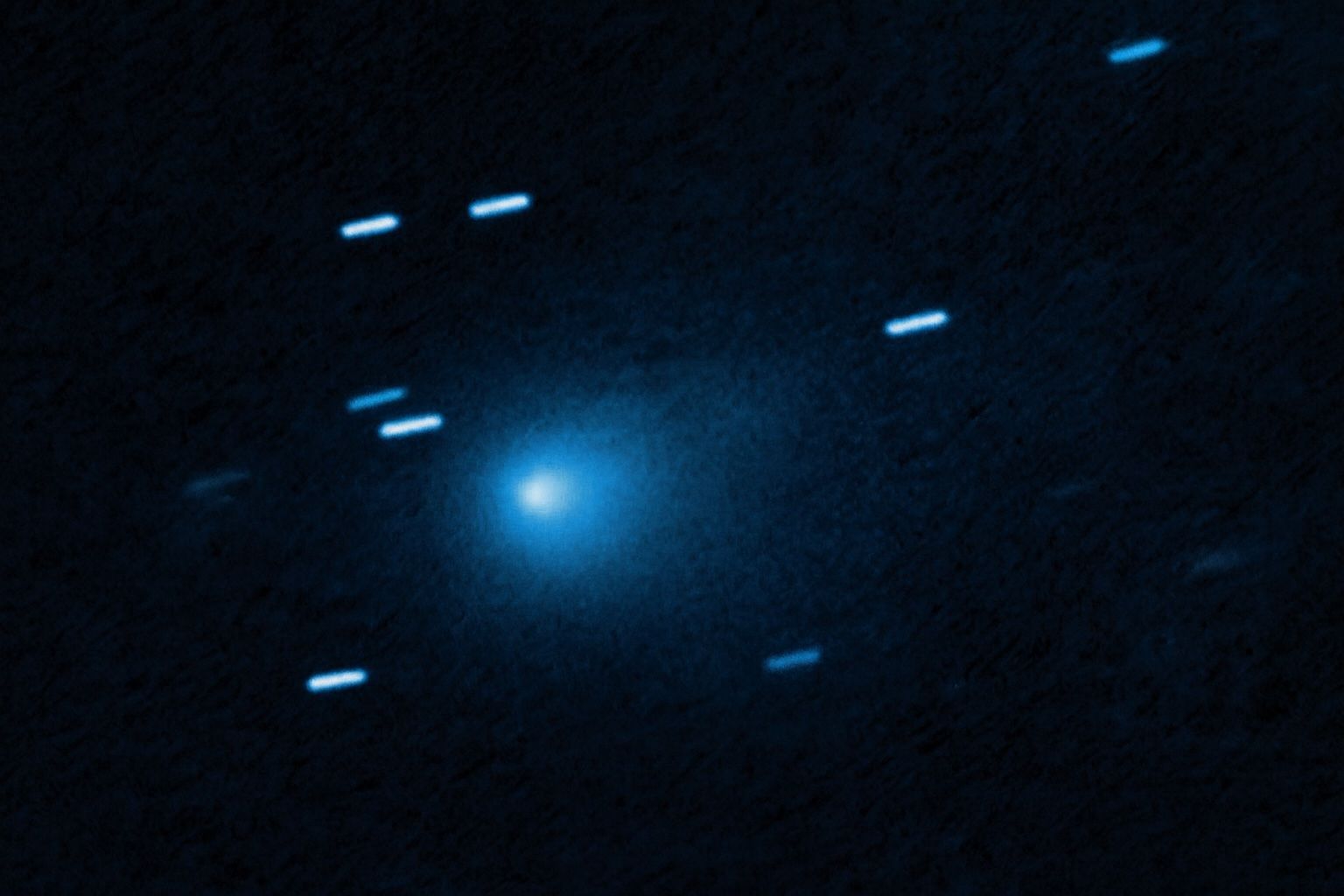

- Discovery & Nature: Comet 3I/Atlas was first spotted on July 1, 2025, by the ATLAS survey telescope in Chile. It is only the third known interstellar object (after ʻOumuamua and comet Borisov) ever observed passing through our solar system esa.int space.com. Its orbit is strongly hyperbolic and it’s barreling along at roughly 219,000 km/h (about 60 km/s) dailygalaxy.com space.com, confirming it originated in another star system.
- Mars Flyby (Oct 3, 2025): 3I/Atlas will make a very close approach to Mars – roughly 30 million kilometers away – on October 3, 2025 apnews.com esa.int. This is the comet’s nearest pass to any planet. In fact, ESA reports that between October 1–7 its Mars orbiters (Mars Express and the ExoMars Trace Gas Orbiter) will be trained on 3I/Atlas, reaching minimum distance (~30 million km) on Oct 3 esa.int skyatnightmagazine.com. NASA, meanwhile, has announced that its Mars surface assets (the Perseverance and Curiosity rovers) and the Mars Reconnaissance Orbiter will also try to observe the comet during this window skyatnightmagazine.com. (NASA’s Psyche mission – en route to asteroid 16 Psyche – will likewise “catch a glimpse” of 3I/Atlas near Mars space.com.)
- Jupiter Mission (Nov 2025): After Mars, ESA’s Jupiter Icy Moons Explorer (JUICE) will turn its instruments toward 3I/Atlas between Nov 2–25, 2025 esa.int space.com. This timing is intentional: 3I/Atlas reaches perihelion (closest approach to the Sun) in late October, and JUICE will view it immediately afterward. At perihelion the Sun’s heat will erupt the comet’s ices into a bright halo and long tail, and JUICE – with its powerful cameras – is expected to capture 3I/Atlas in its most active state esa.int space.com. ESA notes that data from this period “will yield the most valuable data, revealing its true chemical makeup and activity at peak intensity” (with a luminous gas-and-dust halo) space.com.
- Earth Perspective (Dec 2025): 3I/Atlas will remain distant from Earth the whole time. It makes no threat to us (closest Earth approach ~1.8 AU or about 169 million miles in December 2025 apnews.com science.nasa.gov). That Earth flyby will also allow renewed observations once the comet comes back around from the Sun’s glare. Meanwhile, astronomers on Earth have already gathered plenty of data: Hubble imaged the comet in July, and Webb, SPHEREx and other telescopes observed it through August science.nasa.gov dailygalaxy.com.
- Size & Composition: Analysis of the telescopic images shows a surprisingly large cloud of material. Hubble’s observations put an upper limit on the nucleus of about 5.6 km in diameter (but it could be as small as ~0.44 km) science.nasa.gov. Most strikingly, infrared spectra from JWST and SPHEREx reveal 3I/Atlas is surrounded by an immense carbon-dioxide plume – roughly 95% CO₂ output, with only trace water vapor dailygalaxy.com. This contrasts with typical solar system comets (which usually release mostly water ice), suggesting the comet’s chemistry may be very different.
- Scientific Opportunity: Astronomers describe 3I/Atlas as a “messenger from afar.” As Space.com explains, studying it will let scientists directly compare “its makeup with comets formed in our own solar system” – testing whether other planetary systems share familiar ingredients or host exotic chemicals space.com. In particular, observing 3I/Atlas at perihelion (via JUICE and other craft) will allow measurement of its full gas and dust composition, essentially giving the comet a chemical fingerprint. If its makeup matches known comets, that would suggest common building blocks across the galaxy; if not, we may be seeing novel compounds unique to another star’s environment space.com dailygalaxy.com.
- Strange Anomalies & Theories: The comet has already surprised observers. Gemini South images showed a faint “anti-tail” stretching away from the Sun – an unusual configuration more aligned with the solar wind direction than normal comet tails dailygalaxy.com. Very Large Telescope spectra have even picked up cyanide and nickel (but no iron) in the coma, an odd ratio some have likened to industrial processes dailygalaxy.com. These oddities have prompted fringe theories. Notably, Harvard astrophysicist Avi Loeb co-authored a paper arguing 3I/Atlas’s “glow profile and orbital trajectory” “defy conventional explanations” thesouthafrican.com, even speculating about artificial (“alien”) origins. However, the mainstream view remains that 3I/Atlas is a natural comet. UCLA’s David Jewitt (who led the Hubble study) told NPR that 3I/Atlas shows “classic signatures of cometary behavior”: its dust production and ejection speeds are “within expected ranges for comet activity” thesouthafrican.com, and it is still far from the Sun (~4 AU), so strong gas emissions would only appear later thesouthafrican.com. In short, most experts caution that 3I/Atlas likely follows the physics of a comet born in the cold outer regions of some distant star.
Looking Ahead: What 3I/Atlas Can Teach Us
This week’s close approach marks just the beginning of an intensive observation campaign. Once 3I/Atlas dives behind the Sun in late October, Earth-based telescopes will lose it, but Mars and Jupiter satellites (and later telescopes on Earth in December) will continue the story. During perihelion and its outbound journey past Jupiter (in early 2026) the comet should reveal its secrets – or at least its usual cometary face. As one commentator notes, watching 3I/Atlas in this active phase “will give some of the clearest insights yet into the mystery of interstellar comets” space.com. Whether it behaves as expected or throws more curveballs, astronomers around the world will be monitoring every hint of gas, dust or light it sheds. This rare cosmic encounter is unfolding in real time, with NASA, ESA and observatories pooling data in hopes of finally understanding the nature of this galactic visitor space.com thesouthafrican.com.
Sources: Observations and mission plans from NASA and ESA; reports from The Independent/AP apnews.com space.com; analysis and expert commentary from Space.com space.com space.com; astronomy press (Sky & Telescope) skyatnightmagazine.com skyatnightmagazine.com; and published studies (Avi Loeb et al., David Jewitt, et al.) thesouthafrican.com thesouthafrican.com. All dates and figures are current as of October 2025.
Related articles: Space