- Astronomers detected the brightest black hole flare ever observed, emitting as much light as 10 trillion Sunsspace.com.
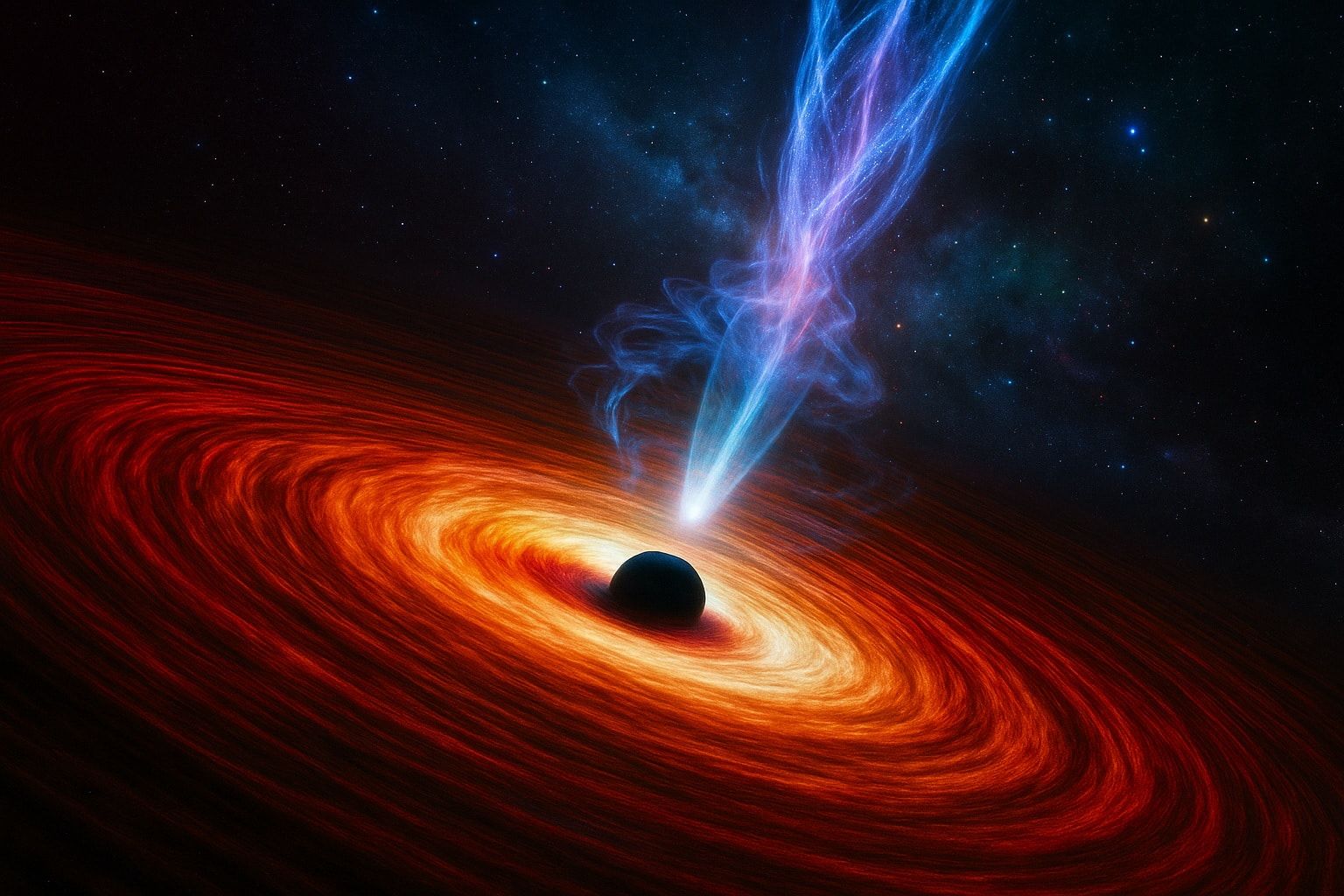
- The flare is a tidal disruption event (TDE): a supermassive black hole shredded and swallowed a giant star (≥30 × Sun’s mass)reuters.comspace.com.
- The responsible black hole (~300–500 million Mₛᵤₙ) lies in a galaxy ~10–11 billion light-years awayreuters.comspace.com. Light from this explosion began its journey when the Universe was very young.
- Discovered in 2018 by Caltech’s Zwicky Transient Facility (ZTF) surveyspace.com, the flare took months to reach peak brightness and is slowly fading nowspace.com.
- Research led by Matthew Graham (Caltech) was published Nov 4, 2025 in Nature Astronomyreuters.com. Graham calls it “unlike any AGN we’ve ever seen”space.com – a “one-in-a-million” event in energy and durationtheriver973.iheart.comspace.com.
- Beyond this flare, related space news: NASA announced over 6,000 confirmed exoplanets as of Nov 5, 2025clarksvilleonline.com (with 8,000+ more candidates); upcoming missions (Roman Telescope, Habitable Worlds Observatory) will keep the discoveries comingclarksvilleonline.com.
- Market snapshot: Space-sector stocks are mixed. Rocket Lab (RKLB) closed around $56.57stockanalysis.com; Virgin Galactic (SPCE) about $3.50investing.com. Boeing (BA) closed ≈$198.05longforecast.com (analysts forecast ~7% drop to ~$187 by month-endlongforecast.com). Lockheed Martin (LMT) ≈$484.81longforecast.com (forecast ~5.5% down to ~$465 in late Novlongforecast.com).
An Unprecedented Cosmic Flare
On Nov. 4, 2025 astronomers worldwide were abuzz: a supermassive black hole had produced the most luminous flare ever recorded. At its peak the outburst was “30 times brighter than any prior black hole flare,” equivalent to 10 trillion Sunsspace.com. This “superflare” came from a galaxy over 11 billion light-years away – meaning we see it as it happened more than 10 billion years agoreuters.comspace.com. In cosmic terms this was a spectacular event: “a one-in-a-million object” as Caltech’s Matthew Graham describestheriver973.iheart.com. Nature News confirms it as “the biggest black-hole outburst ever seen,” a fireworks show powered by a star being literally eaten alivenature.comspace.com.
The discovery began back in 2018, when the Zwicky Transient Facility (ZTF) spotted an unusually bright point of light in the skyspace.com. Follow-up observations showed it brightened by a factor of ~40 over a few months and then very slowly fadedspace.com. Eventually, spectroscopic measurements (from Palomar and Keck telescopes) pinned down its distance – putting it in the early Universetheriver973.iheart.comreuters.com. Only then did the team realize the true scale of the event.
The Star-Eating Black Hole: How It Happened
All evidence points to a tidal disruption event (TDE) – a star strayed too close to the galaxy’s central black hole and was torn apart by gravityreuters.comspace.com. Reuters explains: the flare was “apparently caused when this celestial beast shredded and swallowed a huge star”reuters.com. In other words, the black hole’s tidal forces spaghettified the star – stretching it into a long, thin filament of gas as it was pulled inreuters.com. That shredded stellar debris formed a super-hot accretion flow around the black hole, glowing immensely bright in UV and X-rays.
K.E. Saavik Ford (CUNY) vividly describes the process: once the star is disrupted, “material then spiraled around the supermassive black hole as it fell in” and heated upreuters.com. The data show that about 10⁵⁴ erg of energy has been emitted so far – roughly the equivalent of converting an entire solar mass into pure lightnature.comspace.com. (As Ford analogizes, “If you convert our entire sun to energy… that’s how much energy has been pouring out from this flare”space.com.) In short, this star was massively oversized – the models suggest it started with at least 30 times the Sun’s mass, maybe far morereuters.comspace.com.
The team considered alternative explanations (like a supernova or a gravitational lens magnifying a normal AGN flare) but found them inadequate. As Reuters notes, multi-wavelength observations from California, Arizona and Hawaii “ruled out” jets, supernovae or lensing – none fit the data, leaving the star-swallowing scenario as the only viable modelreuters.com. Notably, K.E. Saavik Ford adds that such a massive star in a galactic core is rare – but stars near a supermassive black hole can “grow larger” by accreting gas from the AGN’s diskspace.com. In essence, dense galactic centers may produce unusually hefty stars, only to have the central black hole eventually consume them in explosive fashion.
Probing the Early Universe with Black Hole Flares
Why is this one flare so significant? First, its sheer energy output challenges models. Space.com points out this flare is 30× more powerful than any previously known AGN transientnature.comspace.com. Very few astrophysical processes can free such vast energy. Because this black hole is so distant, observing its flare offers a rare window into black hole physics when the Universe was young. As Harvard’s Joseph Michail (CfA) notes, these distant flares “probe the interaction of supermassive black holes with their environments early in the universe”news4jax.com. In other words, they help us understand how the first massive black holes grew and influenced their galaxies shortly after the Big Bang.
Another reason this event stands out: it occurred in an active galactic nucleus (AGN). Most tidal disruption flares seen before have happened in otherwise quiet galaxies; in a busy AGN the steady glow from the accretion disk usually drowns out smaller flares. As Space.com explains, “most [TDEs] haven’t occurred in an AGN” because the normal AGN emissions can camouflage themspace.com. This black hole, however, is exceptionally massive (~300–500 Mₛᵤₙ) and hungry, so its flare was large enough to punch above the background lightspace.com. Matthew Graham colorfully likens the situation to “a fish only halfway down the whale’s gullet” – the black hole is still digesting the star, so we’re seeing the meal in progressspace.com. The physics of time dilation even works in our favor: because the black hole’s gravity is so extreme, clocks near the event run slower, so what took 7 years for us appears only 2 years to the black holespace.com.
Scientists will continue to watch this flare fade. Its gradual decline is textbook for a TDE – the stellar debris slowly accretes and cools. Future observations across the spectrum (including X-ray telescopes like Swift, Chandra or upcoming missions) may reveal new details. Graham and colleagues will also scour archival ZTF data to hunt for other hidden flares, and eagerly await the Vera C. Rubin Observatory (Legacy Survey of Space and Time) going onlinespace.com. Rubin’s deep, time-domain sky maps should uncover many more rare flares, both in distant AGNs and nearby galaxies. As Graham puts it, “We never would have found this rare event in the first place if it weren’t for ZTF… We’ve been observing the sky with ZTF for seven years, so when we see anything flare or change, we can see what it has done in the past and how it will evolve”space.com.
Moreover, this discovery fuels excitement in multi-messenger astronomy. Rapid, high-energy bursts may produce gravitational waves or neutrinos that future detectors could catch. ESA scientists studying a different black hole event (“Ansky”) note that such repeating eruptions “are also likely associated with gravitational waves that ESA’s future mission LISA might be able to catch”sciencedaily.com. Combining X-ray, optical and gravitational-wave data would give a more complete picture of these cosmic catastrophes. In short, every new black hole outburst is a laboratory for extreme physics.
Related Space News: Exoplanets and Beyond
This week’s space headlines have been dominated by more than just black holes. NASA announced that the tally of confirmed exoplanets has just passed 6,000clarksvilleonline.com. These planets orbit other stars, and thousands more candidates await verification. “This milestone represents decades of cosmic exploration,” said NASA astrophysicist Shawn Domagal-Goldmanclarksvilleonline.com. In the very near future, new telescopes like NASA’s Nancy Grace Roman Space Telescope and the proposed Habitable Worlds Observatory will push that number even higher and study these worlds in detailclarksvilleonline.com.
Meanwhile, the James Webb Space Telescope continues to surprise astronomers (for example, Mizzou researchers found 300 surprisingly bright early-galaxy candidates in Webb datasciencedaily.com). On Nov. 5, 2025 SpaceNews and NASA bulletins also highlighted the discovery of a new moon around Uranus using Webbscience.nasa.gov. All these developments – black-hole flares, distant galaxies, exoplanets, new moons – underscore how much of the Universe’s story we’re now able to observe and how much remains to learn.
Industry and Market Perspective
Intense astrophysics discoveries often spark interest in the aerospace and tech sectors. For context, a few space-related stocks are worth watching. Rocket Lab (NASDAQ: RKLB), a small-satellite launch company, closed around $56.57 on Nov. 4, 2025stockanalysis.com. Virgin Galactic (NYSE: SPCE) – a space tourism firm – traded near $3.50investing.com. In the defense/space hardware realm, Boeing (NYSE: BA) closed at $198.05longforecast.com. Long-term forecasts are modest: one analyst model projects Boeing might average ~$191 in November and finish around $187 (a ~7% decline)longforecast.com. Lockheed Martin (NYSE: LMT) – a major defense and space contractor – closed near $484.81longforecast.com, with similar projections showing a slip to about $465 by late Novemberlongforecast.com. Analysts point out that government budgets and satellite demand could buoy these firms, but uncertainty (supply chain issues, interest rates) tempers the outlook. Overall, space-sector equities have mixed performance; any sustained surge will likely depend on broader industry trends (e.g. launch activity, NASA budgets, satellite orders) beyond any single scientific discovery.
Looking Ahead
The black hole superflare of Nov 2025 will be studied for years to come. As Caltech’s Matthew Graham remarked, it was an event “unlike any we’ve ever seen”space.com – a reminder that the cosmos still holds the capacity to surprise. Future observatories (Rubin, Roman, Athena X-ray, LISA, etc.) will be crucial to find and follow more such rare events. Each one helps fill in the story of how black holes grow and shape their galaxies. For the public, the image is awe-inspiring: a distant galaxy’s heart lighting up with the power of 10 trillion Suns, as a giant star meets its end. And for scientists, it’s a gold mine of data on gravity, high-energy physics and the early Universe.
Sources: Authoritative reports from Nature Astronomy, Reuters, Space.com, the Associated Press, NASA and related outletsspace.comreuters.comnews4jax.comclarksvilleonline.comsciencedaily.comlongforecast.comlongforecast.com (citations inserted in text).