
NEW YORK, July 31, 2026, 17:13 EDT — Trading on Wall Street has ended for the day.
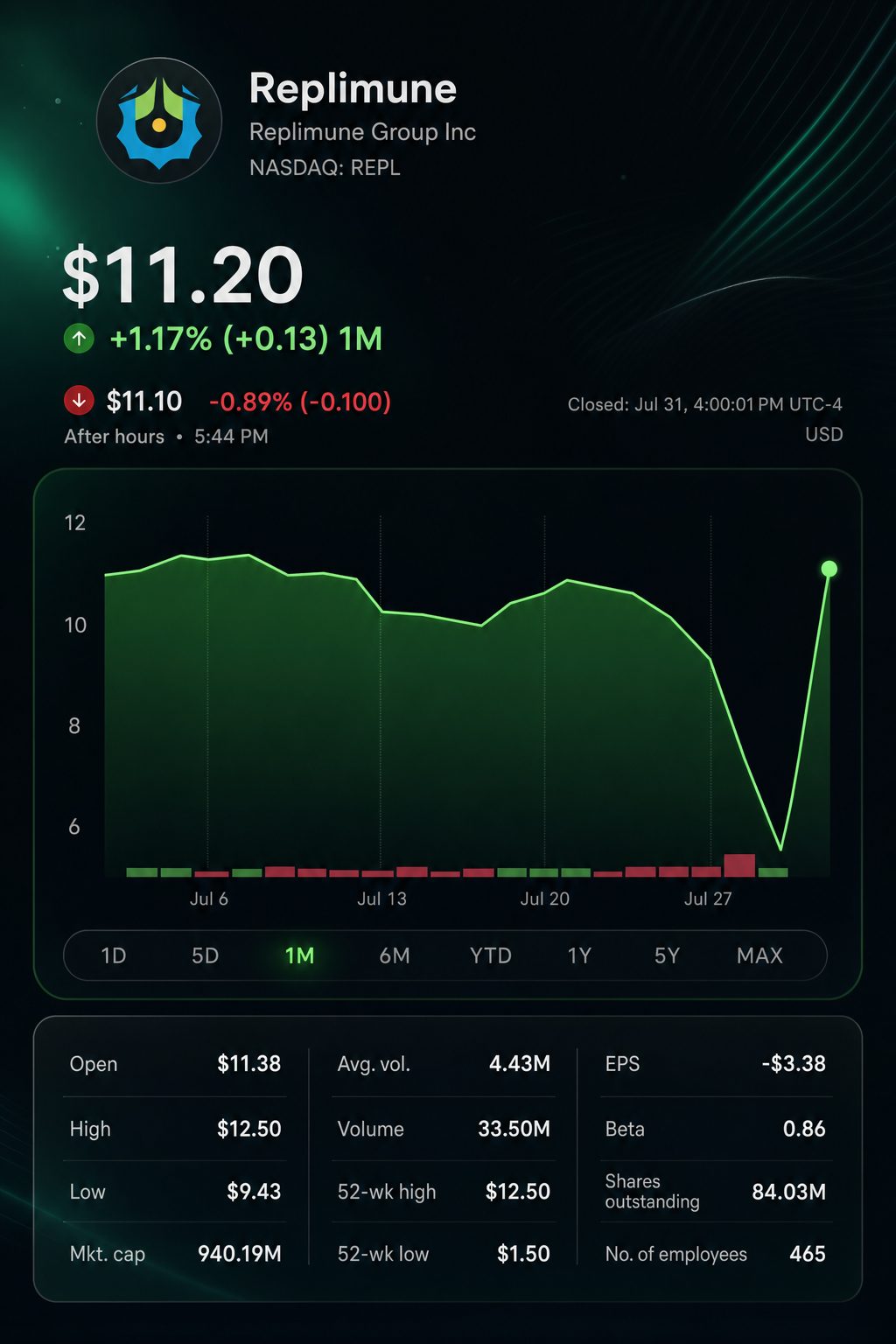
- Replimune finished at $11.20, rising 107.0%, with trading volume 7.5 times its average.
- FDA advisers voted 10–3 that the efficacy data for RP1 was both evaluable and clinically significant.
- The FDA recorded a primary response rate of 15.7%, compared to the 33.6% reported by Replimune.
Replimune stock finished Friday at $11.20, gaining 107.0%. The surge came after an FDA advisory panel voted 10–3 in favor of RP1. The company’s reported market capitalization jumped by about $485 million to $940.2 million. Trading volume was 33.38 million shares, 7.5 times the usual level.
The ballot focused on the reliability of the data rather than on granting approval. Advisers determined that the IGNYTE efficacy findings could be assessed and were clinically significant. The FDA has set Sunday, August 2, as its target decision date. The agency previously turned down the application on two occasions.
The main message for investors is the weight placed on regulatory uncertainty. An initial estimate of economic share factors in 14.06 million reported pre-funded warrants. Based on this, the increase on Friday contributed approximately $568 million to equity value. The pipeline value, adjusted for net cash, increased by 2.65 times.
| Valuation measure | Pre-panel reference | Friday close | Change |
|---|---|---|---|
| Share price | $5.41 | $11.20 | up 107.0% |
| Economic shares | 98.09 million | 98.09 million | unchanged |
| Economic equity value | $530.7 million | $1.099 billion | rise of $567.9 million |
| Less March 31 net cash | $185.6 million | $185.6 million | unchanged |
| Implied pipeline and operations value | $345.1 million | $913.0 million | increase of 164.6%, or 2.65 times |
Initial estimate: factors in common stock and pre-funded warrants, omits options and restricted stock units, and assumes March 31 net cash remains unchanged.
Despite Friday’s rally, shares recorded a sharp reversal over the week. The stock ended 15.5% higher compared to its July 24 close. Earlier, shares had dropped 44.8% as of Tuesday after FDA staff released its review.
| Trading reference | Close | Change | Volume | Context |
|---|---|---|---|---|
| July 24 | $9.70 | — | 3.27 million | Previous week’s closing price |
| July 28 | $5.35 | -44.8% from July 24 | 24.02 million | FDA staff releases documents |
| July 29 | $5.41 | +1.1% on the day | 14.30 million | Reference before the panel |
| July 31 | $11.20 | +107.0% | 33.38 million | Closing price following the vote |
| Weekly result | — | +15.5% | — | July 24–July 31 |
The main issue concerns the difference in response rates. Replimune stated an objective response rate of 33.6%. In contrast, the FDA’s primary review found the rate to be 15.7%. The median duration of response dropped by 10.7 months.
| IGNYTE assessment | Patients | Responders | Objective response rate | Median response duration |
|---|---|---|---|---|
| Replimune assessment | 140 | 47 | 33.6% (25.8%–42.0%) | 24.8 months |
| FDA main analysis | 140 | 22 | 15.7% (10.1%–22.8%) | 14.1 months |
| FDA reanalysis | 89 | 22 | 24.7% (16.2%–35.0%) | 14.1 months |
The FDA determined that 53% of sponsor-defined responders did not have a non-injected target lesion. All 140 patients were kept in the analysis, but many responses were reclassified. This lessened the strength of evidence for an effect beyond tumors treated with local injection. Attribution was further complicated by nivolumab.
Evan Seigerman, analyst at BMO Capital Markets, part of Bank of Montreal NYSE:BMO, stated that the testimony presented a “compelling case for RP1 despite FDA criticism.” He described accelerated approval as “almost certain.” However, panel member John Carrino described the data as “really messy.” Reuters
Replimune CEO Sushil Patel described the vote as “an important step forward.” He stated that the company will continue its collaboration with the FDA ahead of the deadline. Replimune Group Inc.
RP1 is administered directly into tumors and used in combination with Bristol-Myers Squibb Co.’s NYSE:BMY Opdivo. Panel members cited Iovance Biotherapeutics, Inc.’s NASDAQ:IOVA Amtagvi as the other treatment option available. Iovance shares dropped 13.4% on Friday as Replimune’s stock price doubled. The contrasting stock performance does not indicate direct replacement.
| Comparison | RP1 plus Opdivo | Amtagvi |
|---|---|---|
| Company | Replimune and Bristol-Myers Squibb | Iovance |
| Regulatory status | FDA verdict awaited | Received accelerated approval |
| Treatment format | Oncolytic therapy injected into tumor with nivolumab | T cells grown from patient’s tumor |
| Care requirements | Labeling details not yet determined | Requires hospital stay, lymphodepletion and IL-2 after infusion |
| July 31 stock move | REPL +107.0% | IOVA -13.4% |
Amtagvi needs tumor tissue to be collected and produced for each patient. The drug’s label specifies that treatment must occur in a hospital with intensive care facilities. Panelist Hussein Tawbi remarked that RP1 seemed “a lot safer, a lot easier.” fda.gov
Approval would reveal another limitation: launch preparedness. After April’s rejection, Replimune reduced its workforce by around 55%. The company currently lacks internal teams for sales, marketing, or commercialization. Restoring these capabilities will require both financial resources and time.
As of March 31, cash and short-term investments totaled $268.9 million, while debt stood at $83.3 million. Operating cash usage for the fiscal year amounted to $280.3 million. Management forecasted sufficient funding into early 2027, factoring in expected launch scale-up.
FDA’s decision deadline comes ahead of Monday’s normal market hours. Investors are set to assess the approval outcome, details on labeling, and requirements for confirmatory trials. Information regarding launch schedule and financing strategy could become relevant right away.
Risks are still focused. The FDA does not have to follow the panel’s recommendation. A further rejection, limited label, or strict post-market conditions could undo Friday’s advance. Even with approval, risks around funding and implementation remain.
The panel’s vote altered the framing of the question, leaving the dataset unchanged. Investors are now factoring in increased odds of approval along with tougher launch challenges. Both expectations will be tested at Sunday’s FDA deadline.