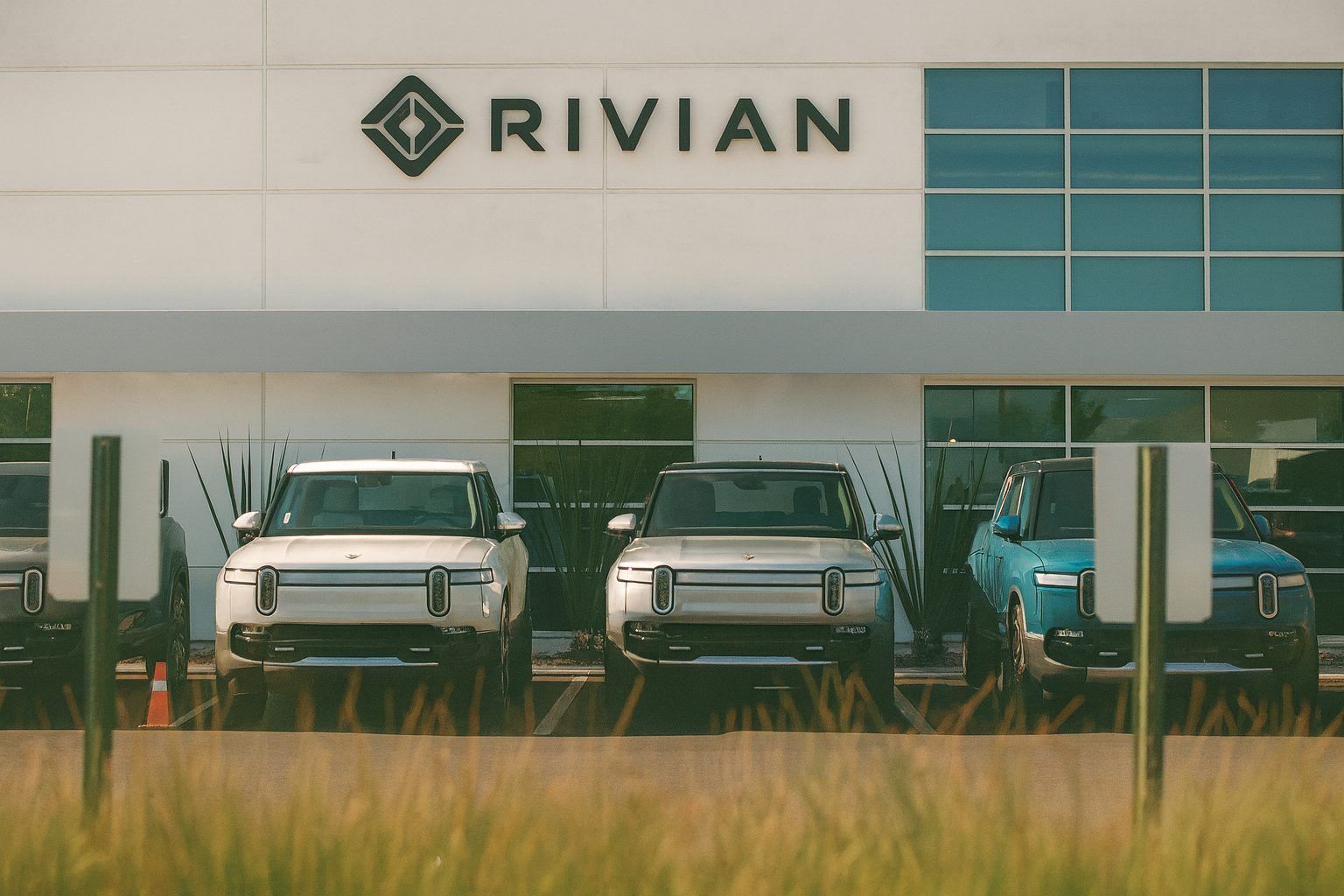
Rivian stock (NASDAQ: RIVN) fell sharply on Dec. 11, 2025 after the company unveiled its in-house autonomy chip, Autonomy+ subscription pricing, and a LiDAR-based roadmap. Here’s what moved the stock after the bell and what matters before the Dec. 12 market open.
Rivian Automotive, Inc. (NASDAQ: RIVN) tried to tell investors a bold story on December 11, 2025: we’re becoming an “AI-defined vehicle” company, not “just” an EV maker. The company’s inaugural Autonomy & AI Day showcased custom silicon, a next-generation autonomy platform, and a subscription-based driver-assistance offering meant to create higher-margin software revenue over time. Rivian+2Business Wire+2
Wall Street’s immediate response was… not exactly fireworks.
Rivian shares closed at $16.43, down 6.11% on the day, after trading in a wide range between $15.73 and $17.42 on heavy volume. In late trading, the stock ticked up to about $16.63 by around 7:59 p.m. ET—a modest after-hours bounce after a rough regular session.
Below is what Rivian announced, why the market sold first and asked questions later, and what traders and longer-term investors will likely focus on before the December 12, 2025 open.
What happened to Rivian stock after the bell on Dec. 11, 2025?
The clean “tape read” looks like this:
- Close (4:00 p.m. ET): $16.43 (down 6.11%)
- After-hours (around 7:59 p.m. ET): ~$16.63 (up about 1.22% from the close)
- Intraday range: ~$15.73 low / ~$17.42 high
- Volume: roughly ~97M shares (depending on data source)
So yes, there was a small after-hours rebound—but the headline is the big down day, which arrived despite Rivian delivering exactly what many investors expected from the event: a roadmap, a chip, and a subscription monetization plan.
The headline announcements from Rivian’s Autonomy & AI Day
Rivian’s event (livestreamed from its Palo Alto offices) centered on one strategy: vertical integration—own the compute, own the software, own the data loop.
1) Rivian unveiled its in-house autonomy chip (RAP1) and Gen 3 compute module (ACM3)
Rivian introduced its first autonomy-focused custom silicon, Rivian Autonomy Processor (RAP1), a custom 5nm processor that integrates processing and memory into a single multi-chip module. The chip powers Rivian’s third-generation autonomy computer, Autonomy Compute Module 3 (ACM3).
Rivian and its press release highlighted these specs for ACM3:
- 1600 sparse INT8 TOPS (trillion operations per second)
- Processing power of 5 billion pixels per second
- RivLink interconnect for scaling compute
- An in-house AI compiler and platform software
Additional coverage emphasized that Rivian is moving away from Nvidia-based autonomy compute with this shift, and that TSMC will produce the chip.
Why it matters: For autonomy, compute isn’t a “nice-to-have.” It’s the engine room for perception (seeing), prediction (what happens next), and planning (what the car does). Building chips is expensive and risky—but it can also be a long-term differentiator if Rivian uses it to improve performance per watt and control its roadmap.
2) Rivian is choosing a different sensor philosophy than Tesla: LiDAR is in
Rivian said it plans to integrate LiDAR into future R2 models as part of a multi-modal sensor strategy—augmenting cameras and other sensors with detailed 3D spatial data and redundancy for edge cases.
But there’s a timeline nuance investors will fixate on: Rivian’s press release says its Gen 3 autonomy hardware (ACM3 + LiDAR) is under validation and is expected to ship on R2 models starting at the end of 2026.
That matters because the R2 is widely viewed as Rivian’s volume inflection product—so anything that sounds like “late 2026” will get parsed hard.
3) Universal Hands-Free is expanding dramatically (near-term software catalyst)
Rivian also announced Universal Hands-Free (UHF) for second-generation R1 vehicles, saying it will be available on over 3.5 million miles of roads across the U.S. and Canada and can operate off-highway on roads with clearly painted lines.
Multiple outlets framed this as Rivian’s attempt to compete more directly with GM’s Super Cruise, Ford’s BlueCruise, and Tesla’s driver-assistance stack—moving from limited hands-free coverage to something much broader.
4) Autonomy+ subscription pricing: $2,500 one-time or $49.99/month
Rivian announced Autonomy+, a subscription (or one-time purchase) for driver-assistance and autonomy features:
- $2,500 one-time purchase or$49.99 per month
- Launching in early 2026
Several reports noted the pricing undercuts Tesla’s Full Self-Driving costs (though the products and capabilities are not the same today).
Cars.com further reported Autonomy+ is expected to include features such as lane change on command and auto parking (parallel and perpendicular), alongside hands-free assist.
5) “Large Driving Model” and an AI assistant (the “software-defined vehicle” pitch)
Rivian introduced a foundational autonomy model it calls the Large Driving Model (LDM)—trained “like a Large Language Model,” and intended to distill driving strategies from massive datasets into the vehicle. Business Wire+1
Rivian also discussed an AI assistant for vehicle tasks and ownership experience. Coverage described “Rivian Assistant” as launching in early 2026, with deep integration into vehicle functions and support for third-party apps (with examples like Google Calendar mentioned in reporting). The Verge+1
If the announcements were big, why did Rivian stock drop?
The quick (and slightly cynical) answer: Rivian talked about 2026–2027 benefits while investors are still wrestling with 2025 realities.
Here are the main forces behind the selloff, based on the day’s reporting and analysis:
1) The market heard “massive ambition,” but also “massive spending”
Autonomy isn’t a feature; it’s an industry unto itself. Custom chips, sensor stacks, and AI training pipelines are capital-hungry, and the payoff can be years out. MarketWatch and Barron’s coverage emphasized investor skepticism tied to the cost of scaling these efforts versus Rivian’s path to sustainable profitability.
2) The “timeline gap” is real: revenue later, costs now
Autonomy+ is positioned as a new recurring revenue stream, but Rivian says it launches in early 2026. The most meaningful hardware (Gen 3 compute + LiDAR) is expected on R2 models starting end of 2026.
That’s a long time in public markets—especially for a company still navigating EV demand swings and cost pressures.
3) EV demand headwinds haven’t magically disappeared
Rivian’s broader business has been operating under a cloudier demand outlook after the lapse of U.S. federal EV tax credits earlier this fall, and the company has discussed both demand pressure and cost pressure (including tariff-related impacts) in recent months.
On Dec. 11 specifically, CEO RJ Scaringe said on an Automotive News podcast that tariff impacts for Rivian have stabilized to the “low hundreds of dollars” per vehicle after previously being higher—helpful, but not exactly a stock-sparking miracle. Repairer Driven News
4) Investors also digested an insider stock sale headline
Another piece of Dec. 11 coverage: a report that Rivian CEO RJ Scaringe sold 17,450 shares on Dec. 9 for about $306K, executed under a Rule 10b5-1 trading plan (pre-arranged). While not necessarily a negative signal—10b5-1 plans are common—the headline can still weigh on sentiment when a stock is sliding.
The “Tesla vs. everyone” subtext: Rivian picked a hybrid path
A lot of the Dec. 11 commentary essentially boiled down to: Rivian is borrowing pieces of Tesla’s playbook (subscription autonomy, data flywheel, vertical integration) but it’s not copying Tesla’s sensor philosophy.
- Tesla: heavy on cameras (“vision”), famously resistant to LiDAR
- Rivian: cameras + multi-modal sensors, explicitly adding LiDAR for redundancy and edge cases
Business Insider summarized Rivian’s move as stepping deeper into Tesla’s turf via in-house chips, a subscription model, AI assistant, and an autonomy roadmap—while still diverging on LiDAR.
This matters because autonomy debates get quasi-religious fast. Some investors like LiDAR’s redundancy; others worry about integration complexity and costs. Either way, Rivian made a clear choice—and the market now gets to price the consequences.
Forecasts and analyst framing circulating on Dec. 11
Because you asked specifically for news + forecasts + analyses dated Dec. 11, 2025, here’s what was prominent:
- Reuters framed the announcements as a strategic shift: custom chip (built with TSMC), Autonomy+ pricing, and a push toward higher autonomy levels over time—while noting the stock fell after the news.
- Rivian’s official release (via Business Wire) put firm stakes in the ground: chip specs, UHF coverage, early-2026 Autonomy+ launch, and end-of-2026 timing for Gen 3 autonomy hardware shipping on R2.
- The Verge added technical color on compute performance (TOPS) and positioned the move as Rivian trying to catch up in autonomy while still losing billions annually, with a new subscription and assistant planned for 2026.
- MarketWatch / Barron’s / WSJ emphasized skepticism: the market isn’t convinced an autonomy roadmap offsets near-term profitability concerns, and the company still faces macro headwinds like tax credit changes and intense competition.
- IBD highlighted the LiDAR decision and the scale-up of hands-free coverage, framing it as a meaningful divergence from Tesla’s approach.
What to know before the Dec. 12, 2025 market open
Pre-market setups are where narratives either harden or melt. Here are the practical “watch items” likely to matter most as trading resumes Friday:
1) Will the after-hours bounce hold—or fade at the open?
The stock’s move from $16.43 close to about $16.63 late Thursday is small but notable: it suggests bargain-hunting (or short-covering) showed up after the initial reaction. The real test is whether buyers defend the name into Friday’s liquidity.
2) Investors will scrutinize Rivian’s dates more than its demos
The market tends to punish “cool tech someday” and reward “shipping + monetizing soon.”
The two key time anchors Rivian put out are:
- Autonomy+ launches early 2026
- Gen 3 autonomy hardware + LiDAR shipping on R2 models starting end of 2026
If Friday research notes focus on “end of 2026,” the stock may stay under pressure—even if the technology story is compelling.
3) Watch for follow-on analyst notes and “the Street’s second take”
Big event days often trigger a wave of analyst commentary the next morning: some firms re-underwrite the long-term story, while others emphasize execution and cash burn risk.
Even on Dec. 11 coverage, the market conversation was already split between “this builds a software revenue engine” and “this is expensive ambition with delayed payoff.” MarketWatch+1
4) Near-term catalysts still revolve around deliveries, margins, and demand
Autonomy headlines can dominate a cycle, but Rivian’s fundamentals still hinge on:
- EV demand after tax-credit changes
- Cost structure and manufacturing efficiency
- R2 execution (the mass-market hinge point)
5) Keep the next earnings window on the radar (not imminent, but relevant)
Most earnings calendars currently point to around Feb. 19, 2026 (after market close) for Rivian’s next report, though dates can shift and may remain unconfirmed until the company updates.
That matters because Autonomy & AI Day just raised the bar: investors will look for clearer spending contours and milestone timing in the next formal reporting cycle.
The bigger Rivian context (because one event doesn’t fix an industry)
Rivian isn’t building this autonomy stack in a vacuum. It’s doing it while also navigating:
- A tougher EV demand backdrop after federal incentive changes
- Tariff and supply chain realities (which management says have stabilized vs earlier swings)
- Strategic partnerships, including its technology collaboration with Volkswagen, which VW has suggested could eventually extend beyond EVs.
In other words: Rivian is trying to become a software-and-autonomy platform company at the same time it’s fighting the normal battles of being an automaker. That’s either visionary… or deeply masochistic. Sometimes it’s both.
Bottom line
Rivian’s Dec. 11 Autonomy & AI Day delivered a real roadmap—custom silicon, a LiDAR path, hands-free expansion, an AI assistant, and Autonomy+ priced at $2,500 or $49.99/month. The market still sold the stock hard into the close, with only a mild after-hours recovery.
Before the Dec. 12 open, the key isn’t whether Rivian’s chip and AI strategy sound impressive (they do). The key is whether investors believe the timeline and economics are tight enough to justify the spend—especially with EV demand and incentives still in flux.