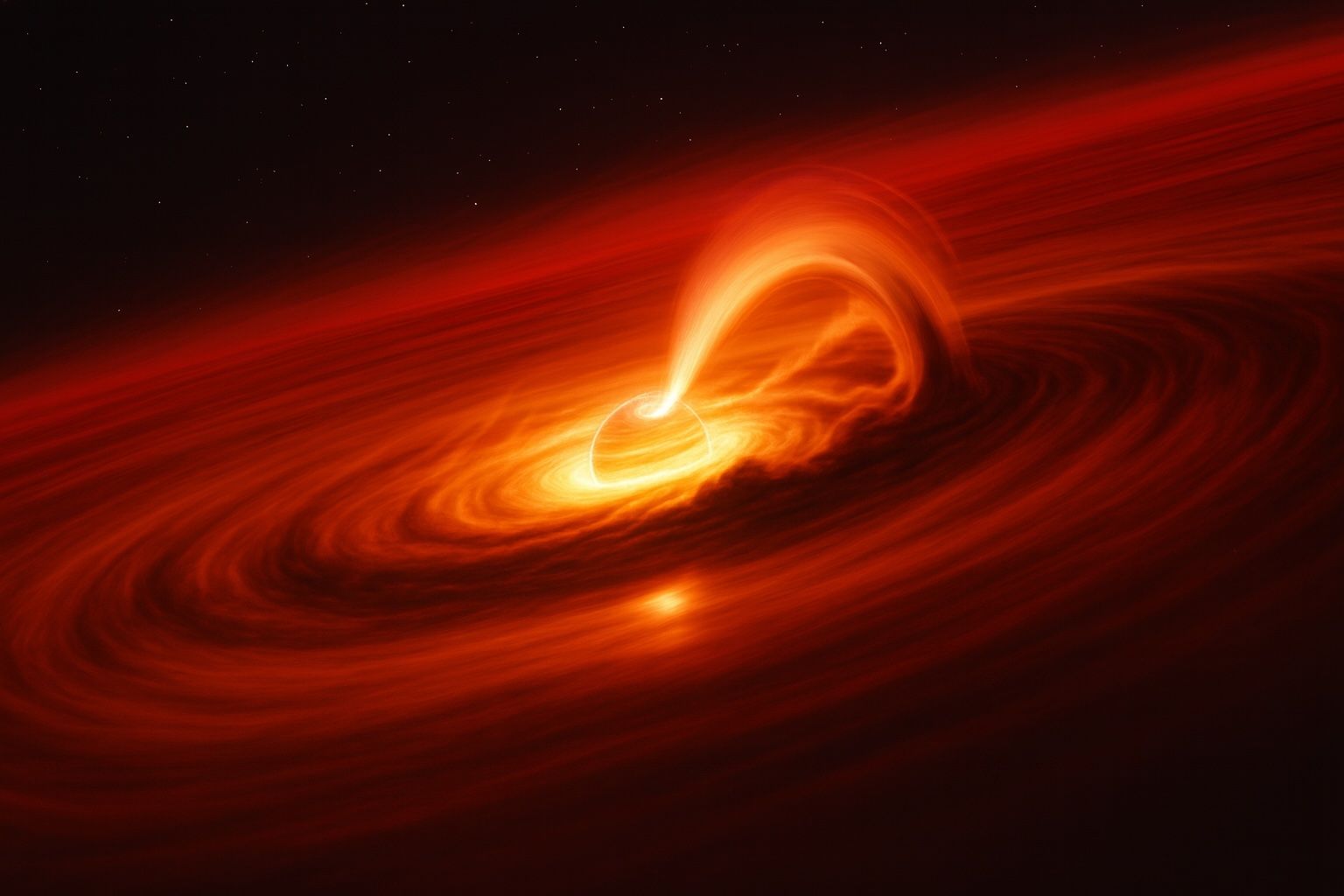

- Cha 1107-7626: A free‑floating “rogue” planet 5–10× Jupiter’s mass, about 620 light-years away in the Chamaeleon constellation phys.org.
- Record Accretion: In August 2025 it underwent a growth spurt, sucking up gas and dust at ~6 billion tons per second phys.org – roughly eight times faster than just months before phys.org.
- Strongest Ever: Astronomers report this is “the strongest accretion episode ever recorded” for any planet phys.org, blurring the line between planets and stars space.com eso.org.
- Star‑like Behavior: The outburst involved magnetically funneled accretion and even water vapor in the disk – phenomena previously seen only in newborn stars sciencealert.com phys.org.
- Young and Forming: Cha 1107-7626 is only ~1–2 million years old (still assembling from its birth cloud) cbsnews.com, which helps explain its tumultuous infancy.
- Observations: The discovery (published Oct. 2, 2025) comes from data with ESO’s Very Large Telescope (X-shooter spectrograph) and NASA’s James Webb Space Telescope eso.org.
A Cosmic Feeding Frenzy
Astronomers have long known that rogue planets (also called free‑floating planetary‑mass objects) drift through space without a host star sciencealert.com. Most are cold and quiet, but Cha 1107-7626 is anything but quiet. In late June 2025, it suddenly brightened dramatically. Follow-up observations revealed an EXor‑type accretion burst – a rapid feeding episode like those seen in infant stars sciencealert.com. By August, the planet’s accretion rate had skyrocketed: at its peak it was pulling in roughly 6 billion tons of cosmic gas and dust every second phys.org. This translates to about 10⁻⁷ Jupiter masses per year – an unheard‑of rate for any planet sciencealert.com.
Víctor Almendros‑Abad, an astronomer at INAF–Palermo and lead author of the study, marveled at the finding: “This is the strongest accretion episode ever recorded for a planetary‑mass object” phys.org. He added, “People may think of planets as quiet and stable worlds, but with this discovery we see that planetary‑mass objects freely floating in space can be exciting places” phys.org. The growth spurt didn’t just inflate the planet’s mass – it reshaped the chemistry of its surrounding disk. Water vapor appeared in the disk during the outburst (but wasn’t there beforehand) phys.org, and the signature of dust warmed, signaling intense energy input.
Ray Jayawardhana (Johns Hopkins University), a co-author on the paper, emphasized how unusual this behavior is for a planet: “We’ve caught this newborn rogue planet in the act of gobbling up stuff at a furious pace,” he said hub.jhu.edu. Jayawardhana noted that by comparing observations before and during the burst, the team saw strong magnetic activityat work – much like the magnetically funneled accretion seen in young stars hub.jhu.edu. In fact, this event is so star‑like that researchers are struck by the similarity: “We’re struck by quite how much the infancy of free‑floating planetary‑mass objects resembles that of stars like the Sun,” Jayawardhana explained hub.jhu.edu.
What Are Rogue Planets?
By definition, a rogue planet doesn’t orbit a star cbsnews.com. They are thought to number in the billions or even trillionsin our galaxy, though most remain undetected because they emit little light cbsnews.com. Cha 1107-7626 (sometimes called Cha 1107 for short) is one of the lowest-mass free‑floaters known to still have a gas disk space.com. At 5–10 Jupiter masses phys.org, it falls well below the ~13‑Jupiter mass boundary for brown dwarfs, and far below the ~80‑Jupiter limit for hydrogen-fusing stars sciencealert.com. In practical terms, Cha 1107-7626 will never ignite nuclear fusion – it’s a planet by all usual definitions, albeit a newborn and rapidly growing one cbsnews.com.
Astronomers still debate how rogue planets form. Some may be born like stars: a fragment of a collapsing gas cloud that never gained enough mass to shine on its own. Others might have formed around a star and later been ejected by gravitational interactions eso.org. Co-author Aleks Scholz (University of St. Andrews) sums up the puzzle: “The origin of rogue planets remains an open question: are they the lowest-mass objects formed like stars, or giant planets ejected from their birth systems?” eso.org. The new observations of Cha 1107-7626 suggest that at least some of these objects grow more like stars. As Scholz’s colleague Belinda Damian (St. Andrews) notes, “This discovery blurs the line between stars and planets and gives us a sneak peek into the earliest formation periods of rogue planets” eso.org.
How the Discovery Was Made
Cha 1107-7626 was first spotted in 2008 in the Chamaeleon I star-forming region (a nursery of young stars about 620 light-years away). Early data hinted it was a planetary-mass object with a disk. In 2025 a team led by Almendros-Abad mounted a focused campaign using the European Southern Observatory’s Very Large Telescope (VLT) in Chile and the James Webb Space Telescope (JWST). They took periodic spectra with VLT’s X-shooter instrument from April through August. Initially the planet’s brightness was steady, but in late June 2025 it suddenly flared. sciencealert.com. The spectra showed strong hydrogen emission lines – a telltale sign of magnetospheric accretion (material being funneled by magnetic field lines onto the object). Follow-up JWST infrared observations also picked up new water vapor and carbon-rich compounds in the disk space.com phys.org. In total, the team tracked the burst for about two months.
According to the ESO press release, by August Cha 1107-7626’s disk inflow had accelerated to eight times its earlier rate phys.org. The researchers calculated an accretion rate near 10⁻⁷ Jupiter masses per year – about 6 billion metric tons per second sciencealert.com. They believe strong magnetic fields are at play. Much like in young stars, the planet’s magnetic field probably acted like a cosmic funnel, channeling disk gas onto the planet’s poles phys.org. This is one of the first times such magnetic accretion has been seen in such a low-mass object. Astronomer Amelia Bayo (ESO) calls this “awe-inspiring”, noting that it means even mini-planets can behave like stars during formation phys.org.
Implications for Planet Formation
Cha 1107-7626’s flare is more than a curiosity – it provides a rare window into how isolated planets grow. If some rogue planets form like stars, they would naturally go through episodic accretion bursts as observed. The new data bolster that scenario. As Ray Jayawardhana puts it, the findings “underscore that similarity” to star formation and imply “some objects comparable to giant planets form the way stars do, from contracting clouds of gas and dust accompanied by disks of their own” hub.jhu.edu. In other words, the line between very small stars and very large planets may be blurrier than once thought.
On the other hand, the data don’t entirely rule out an ejection origin. But the star-like disk chemistry changes (the sudden appearance of water vapor, the presence of silicates and hydrocarbons in the disk) hint that Cha 1107-7626 has been evolving in isolation from its birth cloud, much as a brown dwarf would. The team’s paper (in ApJ Letters) lays out these clues. As co-author Belinda Damian noted, it’s a “sneak peek into the earliest formation periods of rogue planets” eso.org.
Expert Voices
Experts across the field have been excited by the discovery. Almendros-Abad (INAF–Palermo) says the event demonstrates that “planetary-mass objects freely floating in space can be exciting places,” and stresses the record-breaking nature of the burst phys.org phys.org. Ray Jayawardhana (JHU) emphasizes the rarity: “We’ve caught this newborn rogue planet in the act of gobbling up stuff at a furious pace” hub.jhu.edu. Aleks Scholz (St. Andrews) reminds us the origin question is still open-ended eso.org, and Amelia Bayo (ESO) marvels that “a planetary object can behave like a star” during formation phys.org. Their words highlight both the wonder and the scientific significance of this rogue world’s growth spurt.
The Future of Rogue Planet Research
Discoveries like Cha 1107-7626’s outburst are paving the way for a new era in understanding rogue planets. They show that advanced telescopes (like VLT and JWST) can not only find these faint objects, but monitor them over time. Looking ahead, ESO’s upcoming Extremely Large Telescope (ELT) – with its gigantic mirror – should be able to spot many more free-floaters and catch such events in action phys.org. Even the NASA/ESA Nancy Grace Roman Space Telescopeis expected to identify rogue planets via microlensing surveys. Each new find will help answer the big questions: How common are these lonely worlds? How do their formation and evolution compare to planets around stars?
For now, Cha 1107-7626 stands as the most dramatic example yet of a planet building itself in the dark. Its 6-billion-ton-per-second feeding frenzy has been recorded in detail, and scientists are poring over the data. As the lead researcher Almendros-Abad concludes, this result truly “blurs the line between planets and stars” eso.org. In a universe full of surprises, this rogue planet has given astronomers a vivid reminder that even lonely wanderers can be wildly active and illuminating.
Sources: Peer-reviewed study (ApJ Letters, 2025) and reporting from ESO, CBS News, Space.com, ScienceAlert, BBC Sky & Telescope, Johns Hopkins University, and other outlets eso.org phys.org sciencealert.com skyatnightmagazine.com hub.jhu.edu.