NEW YORK, July 28, 2026, 4:58 p.m. EDT — Regular U.S. trading has ended, with after-hours deals now active.
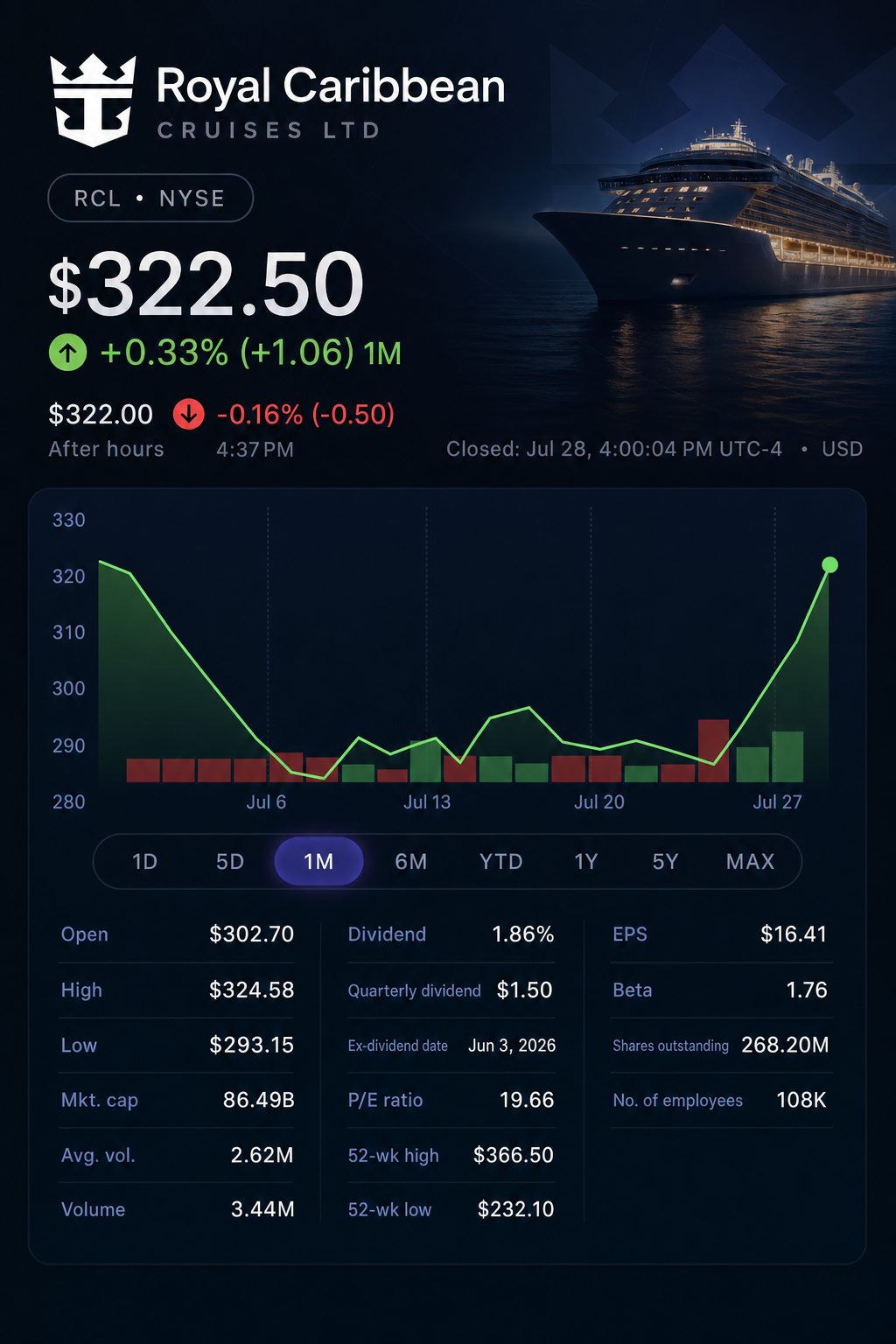
Royal Caribbean closed up 5.7% at $322.50.
The company lifted its 2026 adjusted-profit midpoint by 2.9%, as revenue growth eased to 9%.
A midpoint estimate indicates that Q2 accounted for 66% of the guidance rise.
Royal Caribbean Group NYSE:RCL finished the session up 5.7% at $322.50 after raising its profit outlook for 2026. The gain was recorded even as the company reported weaker bookings on some routes and reduced its revenue guidance.
Investors favored profit gains over top-line expansion. Adjusted earnings per share, or EPS, are expected to climb 14% this year, while revenue is forecast to grow 9%. Management in April anticipated about 11% EPS growth alongside a 10% revenue increase.
Adjusted earnings per share for the second quarter reached $4.21, surpassing the analyst consensus from LSEG by 5.8%. Revenue increased by 6% to $4.83 billion, narrowly exceeding the projected $4.82 billion. However, adjusted EPS declined from $4.38 reported in the same quarter last year.
The context is important for the annual forecast revision. The midpoint was raised by 50 cents, moving from $17.30 to $17.80. Second-quarter results surpassed management’s earlier midpoint by 33 cents. As a result, based on midpoint math, 66% of the projected increase had already been realized.
LSEG forecasts and company outlook are shown below for comparison. Midpoints are calculated arithmetically.
Measure
Earlier benchmark
Latest
Change
Q2 adjusted EPS against analyst forecast
$3.98
$4.21
+5.8%
Q2 adjusted EPS compared to company midpoint
$3.88
$4.21
+$0.33
Projected full-year revenue increase
About 10%
9%
-1 percentage point
Full-year net-yield midpoint
2.80%
2.60%
-0.20 percentage point
Midpoint for full-year adjusted EPS
$17.30
$17.80
+2.9%
The company tightened its net-yield forecast to 2.35%-2.85%, compared to its previous range of 2.3%-3.3%. Net yield refers to adjusted gross margin per available passenger cruise day.
Management attributed weaker demand on certain routes to ongoing Middle East tensions. CEO Jason Liberty noted that including airfare led to higher costs for Americans on European cruises. As a result, some customers postponed vacations or opted for Caribbean itineraries instead.
Bookings remained higher than the same period last year and reached record-high prices. Occupancy levels continued to be robust. CFO Naftali Holtz said 2027 trends were “pacing ahead of historical levels.” PR Newswire
Near-term pressure remains a focus. Net yields for the third quarter are expected to remain about stable. Revenue is forecast to increase by 8%, with unit costs apart from fuel projected to decrease 1.2%-1.7%. The adjusted earnings per share outlook stands at $6.26-$6.36.
Fuel continues to be a key factor. Fuel costs for the quarter increased by 27% to $355 million. The projection for yearly fuel spending dropped by $10 million to approximately $1.34 billion. Swaps currently hedge around 58% of expected 2026 fuel consumption.
Royal Caribbean is “relatively well positioned,” according to Consumer Edge analyst Michael Gunther. He pointed to the group’s primary brand and its comparatively strong presence among higher-income clientele. Reuters
Cruise stocks climbed as well. Carnival NYSE:CCL advanced 4.1% to $28.23. Norwegian Cruise Line Holdings NYSE:NCLH increased 5.9% to $21.22. Royal Caribbean’s price-to-earnings ratio stood at 19.7, compared to 12.6 for Carnival and 17.1 for Norwegian.
Norwegian is set to report on Thursday. The results will indicate if Royal Caribbean’s solid pricing power is seen throughout the industry.
Risks: Booking softness may offset small savings. Royal Caribbean estimates a $156 million impact from a 1% shift in full-year yield. A 1% change in ex-fuel costs would have a $73 million effect. Prolonged conflict, softer affluent demand, or increased airfares could undermine the higher forecast.
What led to the increase in Royal Caribbean shares following earnings?
Royal Caribbean Group (RCL) finished Tuesday, July 28, at $322.50, up 5.72% on the day. The stock rose after the company reported adjusted earnings per share of $4.21, topping analysts’ average forecast of $3.98. The firm also increased its guidance for full-year adjusted profit after beating quarterly expectations, a factor that outweighed the impact of softer revenue projections. Shares remain about 12% under their 52-week peak of $366.50.
Did Royal Caribbean outperform forecasts in the second quarter?
Royal Caribbean surpassed adjusted earnings forecasts for the quarter. Adjusted EPS came in at $4.21, above both consensus estimates and the company's guidance. Revenue posted at $4.83 billion, marking a rise of around 6% compared to the same period last year. Net income fell to $1.13 billion from approximately $1.21 billion. Capacity was up 5%, with the quarter’s load factor remaining close to 110%.
By what amount did management lift its earnings outlook for 2026?
Adjusted EPS guidance for the full year has been raised to a range of $17.73 to $17.87, up from the earlier range of $17.10 to $17.50 given in April. This represents a midpoint increase of $0.50, or about 2.9%. Still, the revised midpoint is $0.10 under the original $17.90 midpoint released in January. Projected revenue growth is now 9%, down from approximately 10% in April.
Is there a decline in bookings driven by geopolitical tensions?
While some itineraries have softened, the broader booking trend is holding steady. Management noted a slight short-term impact on bookings due to ongoing geopolitical tensions. Booking volumes continue to outpace those of the same period last year, with pricing still at record highs. According to management, early bookings for 2027 are tracking ahead of previous years. The weaker area is third-quarter net yields, which are forecast to remain roughly unchanged.
What does the outlook for the third quarter suggest about growth?
The company forecasts third-quarter adjusted earnings per share in the range of $6.26 to $6.36. Revenue is anticipated to increase by roughly 8%, driven by an 8.5% rise in capacity. Net yields are seen holding steady year-on-year. Non-fuel cruise costs per passenger day are set to fall between 1.2% and 1.7%. This further emphasises the impact of greater capacity and tight cost control.
What level of risk do fuel costs pose to Royal Caribbean?
Royal Caribbean reported second-quarter fuel costs of around $355 million, marking a 27% increase from a year earlier. The cruise line projects third-quarter fuel expenses at $362 million. Roughly 58% of its remaining 2026 fuel needs are hedged via swap agreements. The company currently forecasts full-year fuel costs at $1.338 billion. According to management, a 10% shift in fuel prices affects the company’s results for the rest of the year by $26 million.
Has Royal Caribbean stock become overvalued following its rally?
Royal Caribbean trades at $322.50, putting its market capitalization near $87.4 billion. The stock’s trailing price-to-earnings ratio stands at around 19.7 times reported profit. Based on the midpoint of $17.80 in adjusted earnings per share, the forward P/E is close to 18.1 times. The valuation relies on ongoing earnings performance, offering scant cushion should bookings, yields or cost management disappoint.
Is Royal Caribbean’s financial flexibility still constrained by its debt?
While debt levels are significant, short-term liquidity offers considerable financial leeway. Total debt reached around $22.8 billion at June's close. Cash on hand was $875 million and reported liquidity was $6.9 billion. The company distributed $603 million to shareholders through dividends and share buybacks in the quarter. Projected capital expenditures for 2026 are still elevated at roughly $4.7 billion. The current buyback program has $805 million remaining.
What factors could impact RCL shares throughout the remainder of this week?
Investors are expected to monitor post-earnings estimate changes closely in the coming sessions. Norwegian Cruise Line is set to report on Thursday, offering another measure of cruise demand. Oil prices continue to be a focus, with projected 2026 fuel costs nearing $1.34 billion. Any further geopolitical instability could impact bookings for Mediterranean or Middle Eastern itineraries. The main internal target is third-quarter adjusted EPS within the $6.26 to $6.36 range.
Khadija Saeed is a financial markets reporter at TS2.tech. Her coverage ranges from stocks and technology to emerging industries and developments across global markets. She studied economics and finance at the London School of Economics and worked in market research before becoming a financial journalist. Follow Khadija Saeed on Google News.
A figure above or below the 12.0 consensus could impact Treasury yields, the dollar, and cyclical stocks by influencing short-term growth outlooks.
#2
NAHB Housing Sentiment
A reading above or below 33 will influence expectations for housing demand, mortgage rate trends, and homebuilder stocks.
#3
Fabrinet After the Close
Investors are focusing on revenue, margins, and comments on datacom as key factors for companies involved in optical networking and AI infrastructure supply chains.