SpaceX and its Starlink satellite internet network are at the center of global tech and finance news today. New reports detail a blockbuster 2026 initial public offering (IPO), while the company pushes toward a record launch cadence and accelerates Starlink’s rollout in India, South Korea and Africa, even as regulators in places like Namibia debate the price of connectivity versus digital sovereignty.Wikipedia+4Reuters+4Reuters+4
Key points at a glance
- SpaceX is preparing a 2026 IPO that could raise more than $25–30 billion and value the company above $1 trillion, with some reports suggesting a target near $1.5 trillion.The Times+4Reuters+4Reuters+4
- Today’s Starlink 15‑11 mission from Vandenberg is set to be the 160th Falcon 9 launch of 2025, adding 27 more broadband satellites to orbit.Spaceflight Now
- Yesterday’s NROL‑77 mission marked SpaceX’s 10th and final National Reconnaissance Office launch of 2025and the 159th Falcon 9 flight of the year.Aviation Week
- Over the weekend, SpaceX flew missions that included the 3,000th Starlink satellite launched in 2025 and a record‑setting 32nd flight of a single Falcon 9 booster.Spaceflight Now+1
- India is moving closer to a Starlink rollout, with indicative retail pricing of ₹2,500–3,500 per month after a briefly posted higher price was pulled from the website, while Starlink fine‑tunes licences and spectrum approvals.Business Standard+2ETTelecom.com+2
- Starlink has officially launched in South Korea, offering nationwide service at about 87,000 won ($59) per month and aiming at maritime, aviation and remote-area customers.Korea Joongang Daily+2BTCC+2
- In Namibia, regulators are weighing Starlink’s licence application amid a heated debate over connectivity, local economic benefits and national digital autonomy.Extensia Ltd
- Starlink now serves around 8 million customers in roughly 150 countries and territories, and its satellites account for about 65% of all active spacecraft in orbit.Wikipedia+1
A trillion‑dollar IPO to power Starlink’s next phase
According to Reuters, SpaceX has begun formal talks with banks about a 2026 initial public offering, aiming to raise more than $25 billion and secure a valuation of over $1 trillion. The listing is tentatively targeted for June or July 2026, depending on market conditions.Reuters+1
The Guardian, citing the same Reuters reporting plus additional analysis, notes that the float could rival the scale of Saudi Aramco’s 2019 IPO. Meanwhile, Bloomberg and The Times report that internal discussions have centered on raising “significantly more than $30 billion” at a valuation of roughly $1.5 trillion, which would put SpaceX among the most valuable companies ever to go public.Bloomberg+2The Guardian+2
Proceeds from the IPO are expected to fund a new generation of space‑based data centers and associated chip purchases, extending Starlink’s role from connectivity provider into core infrastructure for cloud and AI workloads delivered from orbit.Reuters+2Bloomberg+2
Financial forecasts underline why markets are taking the plan seriously. Bloomberg’s summary of internal projections, echoed in Reuters’ coverage, suggests about $15 billion in revenue for 2025, rising to $22–24 billion in 2026, with Starlink contributing the majority of that income.Reuters+2Reuters+2
This move also lines up with Elon Musk’s earlier stance that he would consider listing Starlink or SpaceX only once revenues were “smooth and predictable.” As of late 2025, Starlink has become a mass‑market product: Wikipedia’s latest accepted revision and fresh investigative reporting from Rest of World both put the service at around 8 million users spread across more than 150 markets worldwide.Wikipedia+1
For investors, that combination—high recurring revenue, dominant market share in low‑Earth‑orbit (LEO) broadband, and a rapidly scaling launch business—makes SpaceX look less like a speculative startup and more like a vertically integrated telecom and infrastructure giant that happens to own its own rocket factory.
160th Falcon 9 of 2025: Today’s Starlink 15‑11 launch
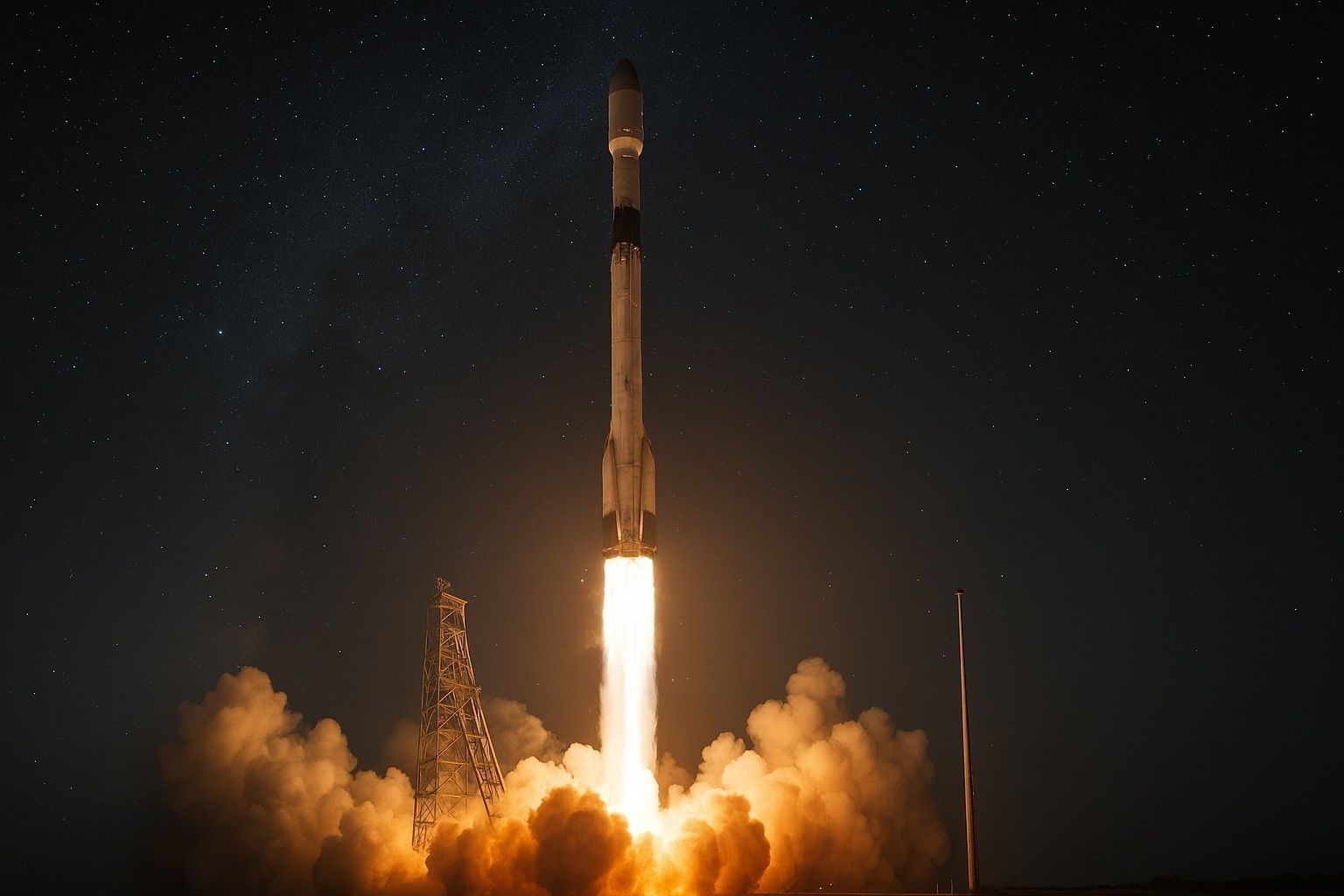
On the technical side, SpaceX is marking another milestone today with the Starlink 15‑11 mission from Vandenberg Space Force Base in California. Spaceflight Now reports that the company is targeting a pre‑dawn liftoff at 3:40 a.m. Pacific (6:40 a.m. Eastern / 11:40 UTC) from Space Launch Complex 4E.Spaceflight Now
Key details of the mission:
- Vehicle: Falcon 9
- Booster: B1082, flying for the 18th time
- Payload: 27 Starlink satellites to low‑Earth orbit
- Landing attempt: Droneship “Of Course I Still Love You” in the Pacific
- If successful, this will be the 169th landing on OCISLY and the 548th booster landing overall.Spaceflight Now
The launch is set to be the 160th Falcon 9 mission of 2025, underscoring just how quickly “routine” orbital launches have become for SpaceX.
A hectic week in orbit: NROL‑77 and the 3,000th Starlink of 2025
Today’s flight caps an intense run of missions over the last few days.
NROL‑77: Wrapping up a big year for US spy launches
On December 9, SpaceX and the U.S. Space Force launched NROL‑77, a classified spacecraft for the National Reconnaissance Office, from Cape Canaveral Space Force Station. Aviation Week reports that the Falcon 9 lifted off at 2:16 p.m. EST, marking the 159th Falcon 9 flight of 2025 and the 10th and final NRO mission of the year.Aviation Week
Roughly eight and a half minutes after liftoff, the first stage returned to Landing Zone 2 at Cape Canaveral, reinforcing the pattern of rapid, reusable operations that underpin SpaceX’s cost advantage.Aviation Week
3,000 Starlink satellites in 2025 alone
Two days earlier, on December 7, SpaceX reached a remarkable Starlink milestone. A Falcon 9 launch from Florida—mission Starlink 6‑92—carried 29 satellites and pushed the tally to 3,000 Starlink satellites launched in 2025 alone, according to Spaceflight Now’s mission coverage.Spaceflight Now
That mission used booster B1067 on its 32nd flight, setting a new reuse record for the Falcon 9 fleet.Spaceflight Now
On the same day, another Falcon 9 from Vandenberg lofted 28 Starlink satellites on the Starlink 11‑15 mission, bringing the year’s dedicated Starlink launch count to at least 115 flights and notching yet another successful booster landing on a droneship.Spaceflight Now
These launches feed directly into a Starlink constellation that already consists of over 7,600 small satellites, making up about 65% of all active satellites in orbit, with approvals in place for thousands more.Wikipedia
Chasing 170 launches: December’s Starlink launch queue
SpaceX executives have repeatedly mentioned a target of around 170 Falcon 9 launches in 2025, up from a record 134 orbital missions in 2024.Space+1
As of the NROL‑77 mission on December 9, the company had completed 159 Falcon 9 flights, leaving 11 more neededto reach that goal.Aviation Week+1
Public launch schedules compiled by RocketLaunch show a dense line‑up of Starlink missions in the coming days, including:RocketLaunch.org
- Starlink Group 15‑11 – Dec 10, Vandenberg SFB, 27 satellites
- Starlink Group 6‑90 – Dec 11, Cape Canaveral, 29 satellites
- Starlink Group 15‑12 – Dec 14, Vandenberg, 27 satellites
- Starlink Group 6‑82 – Dec 15, Cape Canaveral, 29 satellites
- Starlink Group 6‑99 – Dec 15, Kennedy Space Center, 29 satellites
- Starlink Group 15‑13 – Dec 16, Vandenberg (satellite count TBD)
- Starlink Group 6‑88 – Dec 19, Cape Canaveral (satellite count TBD)
Even if some of these slip, this Starlink‑heavy manifest shows how close the company is to turning a “launch every other day” goal into reality.
India: Starlink pricing, licences and a crucial ministerial meeting
India—one of the world’s largest and most price‑sensitive broadband markets—is emerging as a key front in Starlink’s expansion.
Pricing tug‑of‑war
Business Standard reports that Starlink is planning retail satellite internet plans in India in the ₹2,500–3,500 per‑month range, targeting rural users as well as maritime, aviation, retail and enterprise customers.Business Standard+1
That guidance followed a brief stir earlier this week when Starlink’s website showed a much higher monthly price of around ₹8,600 (about $95) before removing it and describing the figure as a “technical glitch.”Business Standard+1
Crucially, Starlink has yet to publish final pricing, which the company says will only happen after it receives complete regulatory and spectrum clearances from India’s Department of Telecommunications (DoT).Business Standard+1
Licences in place, spectrum still pending
Starlink has obtained India’s Global Mobile Personal Communication by Satellite (GMPCS) licence, allowing it to offer satellite‑based communication services, along with a VSAT licence and authorisation for in‑flight and maritime connectivity.Business Standard+2The Economic Times+2
The remaining hurdles are spectrum allocation and final security clearances, after which Starlink would compete with domestic satellite joint ventures such as Jio‑SES and Bharti‑backed Eutelsat OneWeb.Business Standard+1
Business Standard notes that India’s existing telecom operators offer entry‑level fiber and fixed wireless plans starting around ₹500–1,000 per month, meaning Starlink’s service is likely to be roughly three to five times more expensive, and therefore positioned as a complement for underserved areas rather than a direct replacement in cities.Business Standard
Scindia–Starlink talks on “last‑mile” connectivity
Against this backdrop, India’s telecom minister Jyotiraditya Scindia met Lauren Dreyer, SpaceX vice‑president and head of Starlink global subsidiaries, for talks described as focusing on satellite‑based last‑mile internet access across the country.ETTelecom.com+1
Coverage in the Economic Times’ telecom vertical says the discussion centered on how Starlink could plug gaps in connectivity in remote and rural regions once regulatory approvals are complete.ETTelecom.com+1
Put together, today’s developments suggest India is edging closer to a formal Starlink launch, but with careful positioning to avoid a direct price war with domestic telcos while still addressing glaring coverage gaps.
South Korea: Starlink enters a hyper‑connected market
If India is about underserved areas, South Korea is about proving that Starlink can win customers even in countries with some of the world’s fastest terrestrial broadband.
On December 4, 2025, Starlink officially launched nationwide service in South Korea, following regulatory changes that opened the market to foreign satellite broadband operators.Drive Tesla+1
According to coverage in the Korea JoongAng Daily and other outlets:Korea Joongang Daily+2BTCC+2
- The residential plan is priced at 87,000 won (about $59) per month for unlimited data.
- The standard hardware kit costs 550,000 won and includes the dish, router, cabling and power supply.
- Business plans start around 90,000 won per month, with similar hardware costs.
- Local partners such as SK Telink and KT Sat are handling sales, support and specialized services, particularly in maritime and aviation connectivity.Korea Joongang Daily+2BTCC+2
Analysts quoted in local and crypto/tech media expect the fastest growth in Korea to come from ships, aircraft, emergency services and remote industrial sites, where Starlink’s low‑latency LEO network can complement existing fiber and 5G rather than replace them.BTCC+1
For SpaceX, a successful rollout in such a mature market strengthens the case that Starlink isn’t just a solution for places with weak infrastructure—it can also compete on quality and reliability where expectations are already high.
Namibia: Connectivity versus digital sovereignty
On the African continent, Namibia is wrestling with a different set of questions about Starlink.
Extensia, citing local regulatory filings, reports that the Communications Regulatory Authority of Namibia (CRAN)formally published Starlink’s licence application in the Government Gazette on November 28, 2025, triggering a 14‑day public consultation period that runs until December 12.Extensia Ltd
In media comments, Lauren Dreyer said Starlink is ready to switch on service immediately once licences are cleared, arguing that low‑orbit satellite broadband could quickly bring affordable high‑speed internet to even the most remote parts of the country. She also noted that a local entity has been established and is “ready to pay all required fees and taxes.”Extensia Ltd
Those promises come against bleak connectivity metrics: Namibia ranks 149th out of 156 countries in median download speed, with fixed‑broadband penetration below 5%, according to figures cited in the same report.Extensia Ltd
But critics quoted in Namibian coverage warn that outsourcing critical digital infrastructure to a foreign private operator could erode digital sovereignty and limit local economic benefits if Starlink relies mainly on offshore infrastructure while extracting subscription revenue.Extensia Ltd
The debate mirrors wider concerns seen in other countries, where Starlink’s ability to rapidly bypass weak or politicized domestic infrastructure is both a selling point and a source of strategic anxiety.Rest of World+1
Disaster relief, airlines and sheer scale: how Starlink is being used today
Free service for Indonesia and Sri Lanka flood victims
Starlink’s official help center has quietly announced that, in response to severe flooding in Indonesia and Sri Lanka after Cyclone Ditwah, the company is providing free service to new and existing customers in the affected areas through the end of December 2025.Starlink
The notice explains that:Starlink
- Active customers in impacted regions automatically receive service credits and do not need to take any action.
- Suspended or paused accounts are being credited so users can reactivate and use the service during the relief window.
- New customers who purchase and activate hardware can also receive free service if they open a support ticket referencing “Indonesia Flood Support” or “Sri Lanka Flood Support.”
- The offer does not extend to enterprise customers.
This is the latest in a series of emergency‑response deployments, following similar efforts during hurricanes, wildfires and other disasters in recent years.Starlink+1
23 airlines and counting
In the skies, Starlink is rapidly becoming a preferred provider for in‑flight connectivity. Business Insider reports that 23 airlines have now committed to installing Starlink Wi‑Fi, including carriers such as Korean Air, Qatar Airways, Emirates, British Airways and Air France.Business Insider
Tests on early deployments found connection speeds of over 200 Mbps, fast enough for multiple passengers to stream video or hold high‑quality video calls, often outperforming ground‑based cable connections.Business Insider+1
Most airlines using Starlink are choosing to offer the service free of charge, sometimes gated behind loyalty‑program sign‑ups, reinforcing the idea that decent connectivity is now part of the baseline passenger experience.Business Insider
How big is the network now?
Public data from SpaceX and independent compilations put the Starlink constellation at over 7,600 satellites as of mid‑2025, with regulatory approvals for up to 12,000 initially and potential expansion to around 34,400.Wikipedia
A July 2025 “Starlink Network Update” from the company itself said that, over the preceding year, Starlink:Starlink+1
- Expanded into 42 new countries, territories and markets
- Added more than 2.7 million customers, for over 6 million active users at that time
- Launched over 100 Starlink missions, adding 2,300+ satellites to the constellation
Subsequent subscriber updates now put that figure at around 8 million users globally, reinforcing the idea that the service is scaling as fast as the launch cadence.Wikipedia+1
Rest of World’s recent feature notes that in 2025 a SpaceX rocket has, on average, placed Starlink satellites into orbit roughly every three days, a cadence that today’s launch schedule and manifest continue to bear out.Rest of World+1
What today’s news signals for SpaceX and Starlink
Taken together, the news flow on December 10, 2025 paints a clear picture:
- Financially, SpaceX is preparing to test public‑market appetite for a trillion‑dollar‑plus listing, backed by a maturing Starlink revenue stream and a launch business that is, by volume, leaving all competitors behind.Wikipedia+3Reuters+3Reuters+3
- Operationally, the company is maintaining an unprecedented launch tempo—160 Falcon 9 missions already this year, with a realistic shot at hitting its 170‑launch target.RocketLaunch.org+3Spaceflight Now+3Aviatio…
- Commercially, Starlink is transitioning from early‑adopter status to mainstream utility, moving into major markets like India and South Korea while also powering aircraft, ships, mines, farms and remote communities.Wikipedia+3Business Standard+3Korea Joonga…
- Politically and socially, regulators and civil‑society groups—from India’s DoT and security agencies to Namibia’s CRAN—are grappling with how to harness Starlink’s benefits without surrendering too much control over critical digital infrastructure.Rest of World+3Business Standard+3ETTeleco…
As SpaceX moves toward a possible 2026 IPO, today’s mixture of launch milestones, regulatory negotiations and humanitarian deployments shows how deeply intertwined Starlink has become with global connectivity, national policy and even disaster response.
For investors, policymakers and ordinary users, the next year will reveal whether that story can scale smoothly into life as a public company—without losing the agility that got it here.