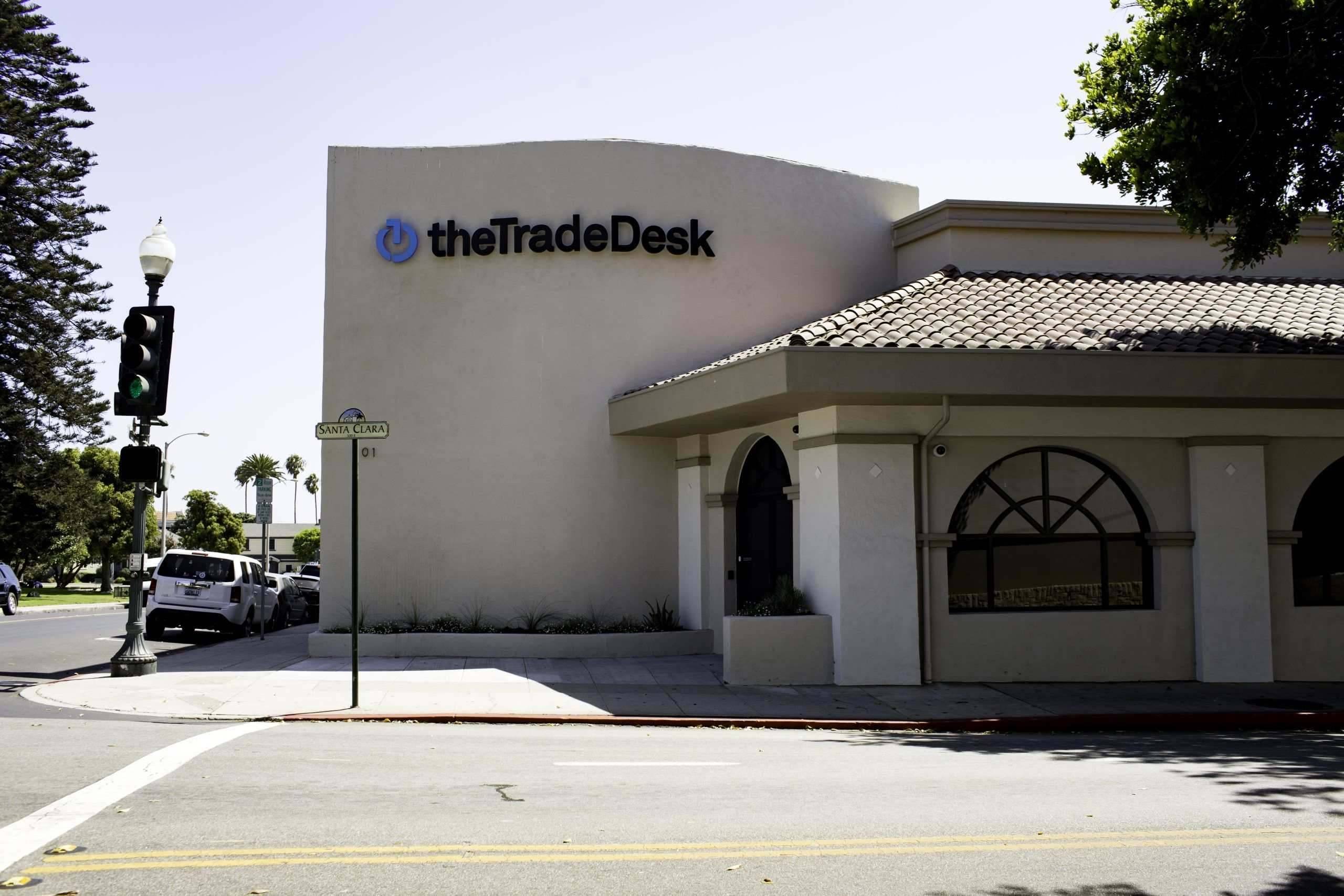
(SEO): The Trade Desk (TTD) stock is hovering near fresh 52-week lows in December 2025. Here’s the latest news, Wall Street price targets, and the key catalysts for 2026.
NEW YORK — December 12, 2025 — The Trade Desk, Inc. (NASDAQ: TTD) is ending the week under intense investor scrutiny after sliding to new 52-week lows and prompting another round of analyst target resets. Yet beneath the headline volatility, the ad-tech leader is still posting double-digit growth, expanding its product stack, and leaning on share repurchases—setting up a high-stakes debate: Is TTD a rebound candidate for 2026, or a value trap in a market that’s repricing digital advertising risk? MarketBeat+2The Trade Desk+2
Below is a complete, publication-ready roundup of the current news (as of 12/12/2025), the most relevant forecasts, and the leading bull vs. bear arguments shaping The Trade Desk stock right now.
TTD stock today: trading near a fresh low as volatility persists
As of Friday, December 12, 2025 (15:30 UTC), The Trade Desk shares were trading around $37.35, after touching an intraday low near $37.02 and an intraday high around $37.81. Volume was roughly 3.1 million shares at that timestamp—active trading for a name that has become a focal point in the ad-tech space.
The move follows Thursday’s sharp drop, when multiple market trackers flagged TTD setting (or revisiting) new 52-week lows near the $37–$38 zone. MarketBeat, for instance, reported a 52-week-low print around $37.27 during Thursday’s session. MarketBeat
Why this matters: In Google Discover terms, “52-week low” headlines are often the start of a broader narrative—because they force a market-wide reassessment of the stock’s base case, not just the next quarter.
The headline drivers on 12/12/2025: what’s moving The Trade Desk narrative now
1) Wall Street is trimming targets again—Jefferies cuts to $40
A key item in the latest news cycle: Jefferies lowered its price target to $40 from $50 and kept a Hold rating. In the note, Jefferies emphasized staying selective in internet stocks, pointing to the risk that incremental investments may constrain margin expansion and that AI “disintermediation” concerns could limit valuation multiple upside. TipRanks+1
This call matters less for the $10 cut itself and more because it echoes a wider theme across 2025: analysts still see The Trade Desk as strategically important, but are increasingly cautious about the timing of margin leverage and the competitive intensity around DSP economics.
2) Fee pressure is no longer hypothetical—agencies are negotiating
One of the most important “under-the-surface” developments: EMARKETER reported that agencies have been hearing signs The Trade Desk is softening its long-held stance on pricing, opening the door to fee negotiations as Amazon DSP gains traction with a lower-cost pitch. EMARKETER+1
In a separate EMARKETER analysis, the firm described a “dual-sided pressure” moment: intensifying competition from Amazon’s DSP and growing friction around the Kokai transition for some agency workflows during peak season. EMARKETER
Why investors care: The Trade Desk’s long-term model is built on scale + performance + trust. If fee compression accelerates at the same time that agencies are diversifying spend, the market will demand clearer proof that growth can remain durable and profitable.
3) Broader market context: tech wobble as “AI bubble” chatter resurfaces
On Dec. 12, broader U.S. equities saw renewed debate around AI trade valuations after major tech-related headlines, even as market breadth remained relatively constructive. This matters because ad-tech names like TTD can get caught in risk rotations—even when their fundamentals are not directly tied to AI hardware margins. Reuters+1
What The Trade Desk is actually delivering: Q3 results, guidance, and buybacks
Investors aren’t only trading headlines—there’s also a substantial fundamental base to work from.
In its Q3 2025 results (released Nov. 6, 2025), The Trade Desk reported:
- Revenue of $739 million, up 18% year over year
- Non-GAAP diluted EPS of $0.45
- Customer retention over 95% (noted as consistent for 11 consecutive years) The Trade Desk+1
Guidance: The company’s Q4 2025 outlook called for:
- Revenue of at least $840 million
- Adjusted EBITDA of approximately $375 million The Trade Desk+1
Shareholder returns: The company disclosed it used $310 million to repurchase shares in Q3 and announced an additional $500 million repurchase authorization approved by the board. The Trade Desk+2The Trade Desk+2
The market tension: These are not “broken company” metrics. But the stock is trading like investors believe either (a) margins and pricing power are structurally resetting, or (b) the growth algorithm is at risk because the DSP market is entering a more aggressive, Amazon-influenced phase.
Forecasts and price targets: what analysts expect for 2026 (and why it’s so split)
The consensus is still “Buy”—but dispersion is wide
According to StockAnalysis’ compiled analyst data, 34 analysts tracking TTD show a consensus rating of “Buy” with an average price target around $80.85, with targets spanning from $40 (low) to $145 (high). StockAnalysis
That wide range tells you something important: the Street is not debating whether programmatic and CTV matter—it’s debating how much economic value The Trade Desk can capture in a more crowded, fee-sensitive landscape.
A “bull target” example: 150% upside framing
A Nasdaq/Motley Fool piece published Dec. 12, 2025 noted the stock is far below its highs and cited a street-high target that implies very large upside from depressed levels, while acknowledging that competition—especially Amazon—has become a dominant investor concern. nasdaq.com
The “cautious target” example: Jefferies at $40
At the other end, Jefferies’ move to $40 illustrates the bear argument: even if The Trade Desk remains strategically relevant, investment intensity + competition + AI narrative risk could keep valuation multiples capped. TipRanks+1
The bull case for TTD stock: why some investors see a 2026 setup
1) Kokai is becoming the default—and performance claims are meaningful
In December 2025 analysis published on Nasdaq, The Trade Desk emphasized Kokai’s adoption and performance lift versus its prior platform (Solimar), reporting strong relative improvements in cost and efficiency metrics and noting 85% of clients use Kokai as their default experience. nasdaq.com+1
If those gains continue to show up in customer outcomes, the bull case is that The Trade Desk can defend pricing (or at least defend share) even in a tougher fee environment.
2) A strong financial profile + buybacks can cushion downside
The Q3 report highlighted continued cash generation and significant repurchases. In a market that has become more sensitive to profitability and capital discipline, buybacks can signal management confidence and reduce dilution—especially in stock-comp-heavy tech models. The Trade Desk+1
3) Identity and data collaboration are still strategic differentiators
The company continues to push UID2 and privacy-forward identity tooling. A notable recent example: Databricks announced an integration supporting UID2 in Databricks Data Clean Rooms, positioning the workflow for privacy-conscious identity resolution and activation without moving data to external systems. Databricks
In theory, these integrations can strengthen The Trade Desk’s role as the “pipes” for measurable open-internet advertising—particularly as advertisers demand better governance and interoperability.
The bear case for TTD stock: why the market is pricing in a tougher regime
1) Amazon DSP is forcing a pricing conversation
Multiple industry analyses point to Amazon’s ability to undercut DSP economics and bundle inventory advantages, with agencies increasingly forced to compare platform take-rates and performance. EMARKETER described Amazon’s low-fee posture as a credible competitive challenge to The Trade Desk—especially during the high-stakes Q4 buying season. EMARKETER+1
Even if The Trade Desk “wins” on neutrality and transparency, the market is asking whether it can do so without sacrificing economics.
2) Margin expansion may be delayed by investment cycles
Jefferies’ framing—incremental investments limiting margin expansion—captures a broader 2025 concern: growth may remain solid, but the shape of profits could be less attractive in the near term. TipRanks
3) Macro sensitivity: large-brand exposure can amplify shocks
Earlier in 2025, Reuters highlighted how macro uncertainty (including tariffs) can pressure large advertisers and ripple through The Trade Desk’s demand base. While that story is not “today’s” catalyst, it still informs how investors model downside scenarios during uncertain policy cycles. Reuters+1
What to watch next: the checklist investors are using into 2026
Here are the specific items likely to drive the next major move in TTD stock:
- Q4 2025 execution vs. guidance
The company guided to at least $840 million revenue and ~$375 million adjusted EBITDA for Q4. Any deviation—especially on margins—could dominate the next re-rating. The Trade Desk+1 - Signals on fee structure and agency negotiations
If fee flexibility becomes widespread, investors will look for proof that The Trade Desk can offset take-rate pressure via (a) share gains, (b) performance improvements, or (c) operating efficiency. EMARKETER+1 - Competitive data points vs. Amazon DSP
Expect more headlines around inventory access, CTV partnerships, and measurable budget shifts. The “Amazon vs. independent DSP” battle is quickly becoming the central narrative in the category. EMARKETER+1 - The next earnings date (not yet fully consistent across calendars)
Public calendars currently cluster around mid-February 2026, but published estimates vary by source (some cite Feb. 11; others cite Feb. 17–18). Investors should treat these as estimates until the company confirms. Zacks+4TipRanks+4MarketBeat+4
Bottom line: TTD is at an inflection point—cheap for a reason, but not without catalysts
On December 12, 2025, The Trade Desk stock sits at the intersection of two powerful forces:
- Strategic strength: a scaled independent DSP, strong retention, continued innovation (Kokai/UID2), active repurchases, and Q4 guidance that implies ongoing growth. The Trade Desk+2Databricks+2
- Market pressure: a visible reset in pricing power, louder competition from Amazon DSP, and an analyst community that still leans bullish in the long run but is increasingly cautious on the path to margin expansion. TipRanks+2EMARKETER+2
For Google News/Discover readers, that’s the story: a high-quality business in a suddenly more contested market, with the stock pricing in a tougher future—while forecasts remain sharply divided.