When a magnitude 8.8 megathrust earthquake struck off Russia’s Kamchatka Peninsula on July 29, 2025, it sent a tsunami racing across almost the entire Pacific. Now, scientists have revealed something just as extraordinary as the quake itself: for the first time, a satellite has captured a giant Pacific tsunami in high-resolution detail from space, forcing a rethink of how these waves behave and how we forecast them.
New analyses of data from NASA and CNES’s Surface Water and Ocean Topography (SWOT) satellite – published in The Seismic Record at the end of November – show a surprisingly intricate tsunami wavefield that challenges long‑held assumptions in tsunami science. On December 3, 2025, that breakthrough is rippling through Google News and Discover, with fresh coverage from ScienceAlert, SURFER/Yahoo News and others helping bring the story to a global audience.
A megaquake that shook the Pacific – but not the world
The 2025 Kamchatka earthquake struck at 23:24:52 UTC on July 29 (11:24:52 a.m. local time on July 30), along the Kuril–Kamchatka Trench, a major subduction zone where the Pacific Plate dives beneath the Okhotsk Plate. The event clocked in at magnitude 8.8 and lasted about four and a half minutes, making it the most powerful earthquake worldwide since Japan’s 2011 Tōhoku disaster and tying for the sixth‑strongest ever instrumentally recorded.
Despite its size, damage on land was far less catastrophic than many feared. Shaking caused moderate damage and dozens of injuries in Kamchatka Krai and Sakhalin Oblast, but the Pacific‑wide tsunami it generated was weaker than expected: in most places, wave heights were around 1 meter (3 feet) or less, though a narrow valley near Russia’s Vestnik Bay recorded a local run‑up of about 33 meters (109 feet).
In other words, this was the sort of “lucky” megaquake that gives scientists an enormous dataset – and humanity a second chance to get ready for the next one.
SWOT’s lucky flyover: a tsunami framed from orbit
SWOT is a joint mission between NASA and the French space agency CNES, launched in December 2022 to map Earth’s rivers, lakes and ocean surface in unprecedented detail using wide‑swath radar altimetry. Instead of measuring sea level along a single narrow track, SWOT paints a ~120‑kilometer‑wide (75‑mile) swath of sea-surface height with each pass.
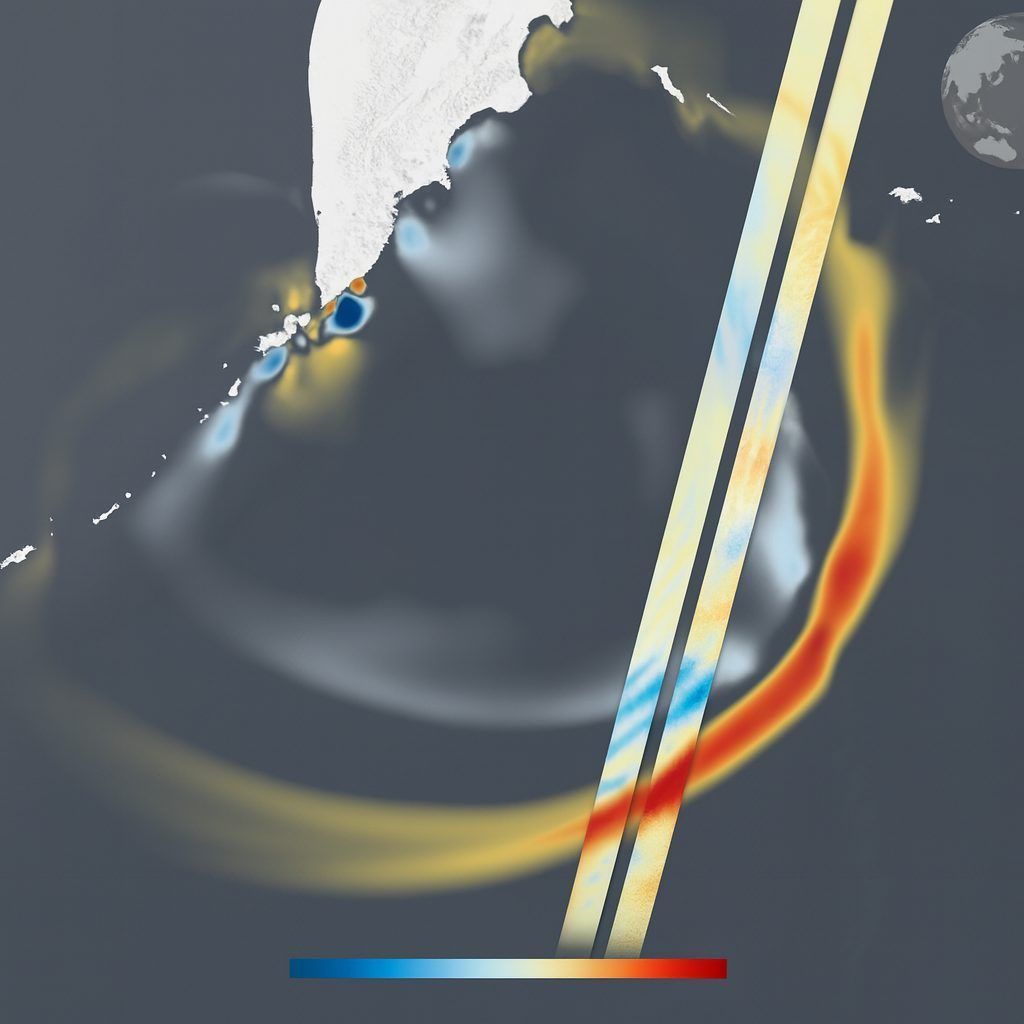
On July 30 local time, just about 70 minutes after the earthquake, the satellite happened to cross the Pacific as the tsunami wave train rolled beneath it. According to NASA, SWOT captured the leading edge of the tsunami spawned by the 8.8 quake off Kamchatka at around 11:25 a.m. local time. The data showed a broad crest more than 45 centimeters (about 1.5 feet) high east of Japan – a modest bump in the open ocean that could translate to towering walls of water in shallower coastal waters.
NASA scientists used SWOT’s measurements to compare the real tsunami with NOAA’s operational forecast model, confirming that the model’s predicted wave heights and arrival times closely matched what the satellite observed. That kind of “reality check” is exactly what forecasters have wanted from space‑based measurements since the devastating 2004 Sumatra tsunami. NASA+1
From snapshot to science: The Seismic Record study
The new paper, titled “SWOT Satellite Altimetry Observations and Source Model for the Tsunami from the 2025 M 8.8 Kamchatka Earthquake,” is led by physical oceanographer Angel Ruiz‑Angulo (University of Iceland) and colleagues. ResearchGate+1
The team combined three key ingredients:
- SWOT’s swath of sea-surface height along the tsunami’s path
- Data from three nearby DART (Deep‑ocean Assessment and Reporting of Tsunamis) buoys
- Detailed numerical tsunami models
Using an inversion technique with “Gaussian unit sources” – essentially building the tsunami backward from the observations – they reconstructed how the seafloor moved during the quake. Their results show:
- The rupture likely extended roughly 400 kilometers along strike, longer than earlier finite‑fault models that put it closer to 300 km.
- Peak seafloor uplift reached about 4 meters, with limited slip very near the trench.
Comparisons with reconstructions of the 1952 magnitude 9.0 Kamchatka earthquake suggest the 2025 rupture re‑activated much of the same megathrust segment, but farther down‑dip (deeper) and with less shallow slip, which helps explain why the 2025 tsunami was far less destructive across the Pacific than the 1952 event.
The surprise: a “braided” tsunami that breaks the rules
For decades, tsunami scientists have treated large, basin‑spanning tsunamis as “non‑dispersive” shallow‑water waves. Because their wavelength is much longer than ocean depth, the standard assumption is that they propagate as a relatively simple, coherent wave packet rather than splitting into different components. SciTechDaily+1
SWOT’s bird’s‑eye view tells a more complicated story.
The satellite track and accompanying models reveal a complex, braided pattern of crests and troughs radiating from the source region, with evidence of dispersion and scattering as the wavefield interacts with seafloor topography and Earth’s curvature. Instead of a single clean hump, the tsunami appears as a dominant leading wave followed by a train of smaller trailing waves, a structure that doesn’t line up with classic non‑dispersive expectations.
When the researchers ran their models with dispersive physics switched on, the simulated pattern matched SWOT’s observations far better than traditional non‑dispersive simulations. That’s a big clue that dispersion matters more for giant tsunamis than textbooks have generally assumed.
Why does this matter? Because dispersion affects how energy is reshuffled within the wave train. Trailing waves can steal or add energy from the leading crest, potentially altering how high water runs up when it finally hits the shore. As Ruiz‑Angulo and colleagues point out, that extra “wiggle” in the wavefield is a sign that something important has been missing from standard tsunami models – and may need to be incorporated into future hazard assessments. SciTechDaily+1
What this means for tsunami forecasting
Modern tsunami-warning systems rely heavily on DART buoys and coastal tide gauges, combined with pre‑computed scenarios and real-time earthquake parameters. DART sensors are exquisitely sensitive but sparse: each one gives a time series at a single point in the open ocean. SWOT, by contrast, delivers a two‑dimensional snapshot of sea-surface height over a wide swath, capturing the geometry of the tsunami at once instead of waiting for it to pass over multiple instruments.
In the near term, SWOT and similar satellites have several key roles:
- Validating and improving forecast models
- NASA and NOAA scientists have already used the July 2025 event to check NOAA’s tsunami forecast, and SWOT’s observations confirmed the model’s accuracy for this case.
- Refining earthquake source models after the fact
- By blending SWOT data with DART buoy records, scientists constrained the rupture’s size and slip distribution more tightly than using seismic and geodetic data alone.
- Testing how much dispersion changes hazard estimates
- The new study hints that some long‑term risk maps, which assume non‑dispersive behavior, might underestimate how energy is redistributed in the far field for certain events.
There are limitations. SWOT’s orbit doesn’t guarantee it will always be in the right place at the right time, and it provides snapshots rather than continuous coverage, so it’s not a silver-bullet real‑time tool on its own. But the Kamchatka event is a proof of concept: if future missions or constellations are designed with tsunami monitoring in mind, space‑based altimetry could become a powerful complement to in‑ocean sensors.
A milestone for space‑based disaster monitoring
The Seismological Society of America describes SWOT’s pass over the July 2025 tsunami as the first high‑resolution, spaceborne track of a great subduction‑zone tsunami – exactly the kind of dataset disaster scientists have hoped to capture since satellites first started measuring the oceans.
Beyond tsunamis, the mission is already transforming:
- Studies of fine‑scale ocean currents and eddies
- Measurements of lake and reservoir levels
- Monitoring of river discharge and flooding
The Kamchatka tsunami shows that extreme events – once thought too fast or too rare to catch – can now be sampled in remarkable detail from orbit.
How the story is being covered today (3 December 2025)
As of December 3, 2025, the tsunami‑from‑space breakthrough is surging through science and general‑interest media:
- ScienceAlert
- Publishes “First Detailed Look at a Tsunami From Space Reveals Unexpected Feature,” highlighting the unexpected dispersive wave pattern and the potential to improve warning systems using SWOT and DART data. ScienceAlert+1
- SciTechDaily
- Carries a Seismological Society of America piece titled “NASA Satellite Captures First‑Ever High‑Res View of a Giant Pacific Tsunami,” emphasizing the first‑of‑its‑kind satellite track and the finding that the rupture was longer than earlier models suggested. SciTechDaily+1
- SURFER (syndicated via Yardbarker and Yahoo News)
- Frames the discovery for a broader lifestyle and sports audience as “Tsunami Wave Seen From Space in First‑Ever Satellite Image (Video),” stressing that the July tsunami caused relatively little damage while giving scientists a “brand‑new view” of these rare, dangerous waves. Yardbarker+1
- Seismological Society of America & Phys.org / Earth.com
- Provide more technical and Earth‑science‑focused coverage that explains how the event challenges long‑standing models and underlines the value of satellite altimetry for hazard assessment.
Taken together, today’s news cycle is doing something unusual: it’s pushing a fairly technical advance – dispersive tsunami dynamics seen from space – into mainstream feeds, from science outlets to surfing magazines. That visibility may help build public understanding of why “boring” things like DART buoys, altimetry satellites and physics‑heavy models matter when the ocean suddenly rises.
Looking ahead: from rare fluke to routine capability?
The 2025 Kamchatka tsunami was a rare alignment of timing and technology: a great subduction‑zone earthquake, a Pacific‑wide tsunami, and a cutting‑edge altimetry mission flying almost directly overhead at just the right moment.
Researchers now want to turn that lucky moment into systematic capability by:
- Integrating satellite altimetry into operational tsunami workflows whenever data are available
- Designing future missions with rapid data turnaround and coverage tailored to hazard monitoring
- Updating hazard models and design standards to incorporate insights about rupture style, dispersion and complex wavefields
As Ruiz‑Angulo put it in comments re‑quoted across several outlets, SWOT is like a “new pair of glasses” for the ocean– and for tsunamis in particular. ScienceAlert+2Earth.com+2
The July 2025 event may ultimately be remembered not for the destruction it caused – mercifully limited – but for the way it reshaped our view of tsunamis, quite literally, from space.