
NEW YORK, August 5, 2026, 06:08 EDT
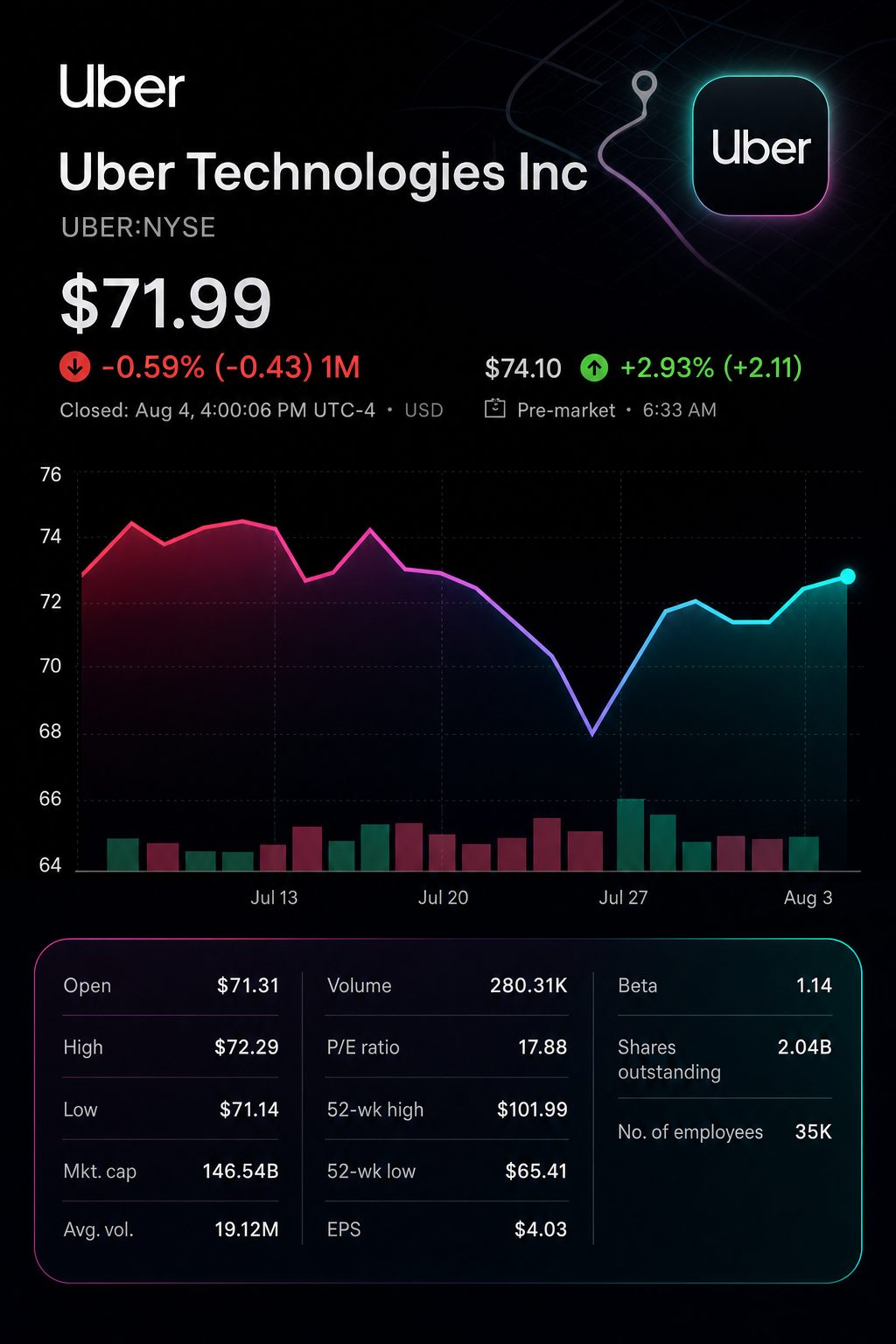
- Uber last showed a price of $71.99, a gain of 0.5% compared to its previous close.
- The midpoint of Q2 guidance indicates bookings growth of 21.9% and an increase in adjusted EBITDA of 29.8%.
- The most recently reported buyback capacity and the Delivery Hero proposal each represent around 10% of Uber’s market capitalization.
Uber Technologies, Inc. NYSE:UBER is under pressure to show evidence that increased bookings are being converted into cash at a stronger pace, making the earnings test about more than just demand.
This is significant as Uber readies a major takeover. The company’s $14.8 billion bid for Delivery Hero SE ETR:DHER will be financed through both available cash and fresh debt.
The U.S. cash market remained closed. Uber’s earnings call was set for 8:00 a.m. EDT, with results expected before the market opened. S&P 500 futures rose 0.25%, while Nasdaq 100 futures edged down 0.07%.
Uber’s operating benchmark is established by its Q2 forecast and the previous year’s results.
| Q2 operating measure | Q2 2025 actual | Q2 2026 company guidance | Midpoint change |
|---|---|---|---|
| Gross bookings | $46.756 billion | $56.25 billion–$57.75 billion | up 21.9% |
| Adjusted EBITDA | $2.119 billion | $2.70 billion–$2.80 billion | increased by 29.8% |
| EBITDA/bookings | 4.53% | 4.82% midpoint | rise of 29 basis points |
Midpoint figures for Q2 2026 reflect provisional estimates based on company guidance.
At the midpoint, Uber would generate $4.82 in adjusted EBITDA for every $100 booked, which is an increase of about 29 cents compared to a year ago.
Cash flow growth eased further in Q1. Gross bookings climbed 25% and non-GAAP operating income was up 42%. Free cash flow advanced only 2%.
| Q1 measure | 2025 | 2026 | Change |
|---|---|---|---|
| Gross bookings | $42.818 billion | $53.720 billion | +25% |
| Non-GAAP operating income | $1.326 billion | $1.883 billion | +42% |
| Free cash flow | $2.250 billion | $2.286 billion | +2% |
| Share repurchases | $1.8 billion | $3.0 billion | +67% |
The buybacks represented 131% of the company’s free cash flow for the quarter. Uber covered the shortfall using additional resources from its overall balance sheet.
Chief Financial Officer Balaji Krishnamurthy stated that earnings are “scaling at more than twice our topline.” Wednesday’s release will indicate if cash is keeping pace. Uber Investor Relations
Capital requirements are now concentrated at similar levels. As of March 31, Uber reported $16.2 billion in remaining repurchase authorization.
| Capital measure | Amount | Share of Uber’s $149.1 billion market value |
|---|---|---|
| Repurchase capacity remaining | $16.2 billion | 10.9% |
| Value of Delivery Hero holdings | $14.8 billion | 9.9% |
| Offer value after earlier stake buys | $13.7 billion | 9.2% |
| Unrestricted cash and investments as of March 31 | $6.1 billion | 4.1% |
| Free cash flow, Q1 | $2.286 billion | 1.5% |
Market-value ratios are determined based on Uber’s most recently reported market capitalisation.
Uber has secured a bridge facility of approximately €14 billion. The firm anticipates that gross leverage will stay under two times. The deal is expected to close in the second half of 2027, pending approvals.
Cross-platform usage is at the core of the strategic argument. According to Uber, the acquisition would increase the number of markets where ride-hailing and delivery are both available from 34 to 58. Users who access both services now deliver about triple the bookings and earnings compared to those using just one offering.
Adam Ballantyne, senior analyst at Cambiar Investors, a shareholder, described Uber’s forecast in May as showing “durable demand.” The following issue is durable conversion. Reuters
Other related stocks also rose in the most recent available quotes. Lyft, Inc. NASDAQ:LYFT was up 2.2%, and DoorDash, Inc. NASDAQ:DASH increased by 0.9%.
| Company | Most recent price | Change | Market capitalisation |
|---|---|---|---|
| Uber Technologies | $71.99 | +0.5% | $149.1 billion |
| Lyft | $16.73 | +2.2% | $6.7 billion |
| DoorDash | $202.37 | +0.9% | $89.5 billion |
Uber’s valuation is approximately 1.7 times that of DoorDash and about 22 times larger than Lyft’s. This scale heightens the challenge of execution.
Risks: Lower bookings or reduced cash flow may limit share repurchases. Increased debt expenses have the potential to reduce returns from acquisitions. Regulatory scrutiny might postpone the anticipated advantages for Delivery Hero.
The most robust outcome would combine bookings toward the upper end with a return to cash growth. A revenue beat alone, without improved conversion, would be less significant.
Related articles: NYSE:UBER