A New Energy Story Out of Central Asia
While much of the global debate on energy still revolves around fossil fuels, one landlocked Central Asian country has started to quietly redraw the map.
In the first week of December 2025, Uzbekistan unveiled a sweeping package of renewable energy and grid projects, deepened partnerships with Saudi and other foreign investors, and disclosed new figures showing that small-scale solar panels alone have already generated nearly 2 billion kWh of electricity this year.qazinform.com+1
The scale and speed of these changes have drawn international attention. A widely shared analysis on CleanTechnica goes as far as calling Uzbekistan “proof of the folly” of continued US fossil fuel expansion, arguing that Tashkent is demonstrating in real time how a developing country can move aggressively into solar, wind, storage and modern grids while others cling to hydrocarbons.CleanTechnica
Here’s what is actually happening on the ground – and why it matters for global energy politics.
42 New Projects, €9.46 Billion – and Enough Green Power for Every Home
On 5 December 2025, President Shavkat Mirziyoyev opened the forum “Powering the Future – Sustainable Energy for New Uzbekistan” in Tashkent and formally launched 42 new energy and infrastructure projects.euronews+1
According to official reports and international coverage:
- The 42 projects are valued at €9.46 billion (around $10.3 billion).euronews
- They include 16 solar, wind, thermal and hydropower plants with a combined capacity of 3,500 MW.euronews+1
- 10 utility‑scale energy storage systems will provide 1,245 MW of capacity, capable of injecting up to 1.5 billion kWh of electricity into the grid during peak hours.euronews+1
- 11 new substations and 420 km of high‑voltage transmission lines will strengthen the national grid.euronews+1
Once fully operational, these new generation facilities are expected to deliver around 15 billion kWh of electricity annually. Government projections say that by 2026, green energy production will reach 23 billion kWh, which officials describe as enough to cover the entire annual electricity consumption of Uzbekistan’s population.qazinform.com+1
This is not a one‑off announcement. Mirziyoyev told the forum that in recent years Uzbekistan has already:
- Attracted $35 billion in foreign investment into the energy sector,
- Commissioned 9,000 MW of new capacity, and
- Increased electricity generation from 60 billion kWh in 2017 to 85 billion kWh this year.qazinform.com+1
Green power is no longer a sideshow: solar, wind and hydro already account for about 30% of total electricity generation in 2025, according to the president’s figures.qazinform.com
Looking ahead to 2030, the plan is even more ambitious:
- Add 17,000 MW of new renewable capacity,
- Push the share of green energy to 54% of total generation, and
- Build 6,000 km of additional high‑voltage networks, including 1,000 km scheduled just for next year.qazinform.com+1
For a country whose economy and grid were historically built around natural gas, this is a radical shift.
Rooftop Revolution: 2,000 MW of Small Solar, 2 Billion kWh of Power
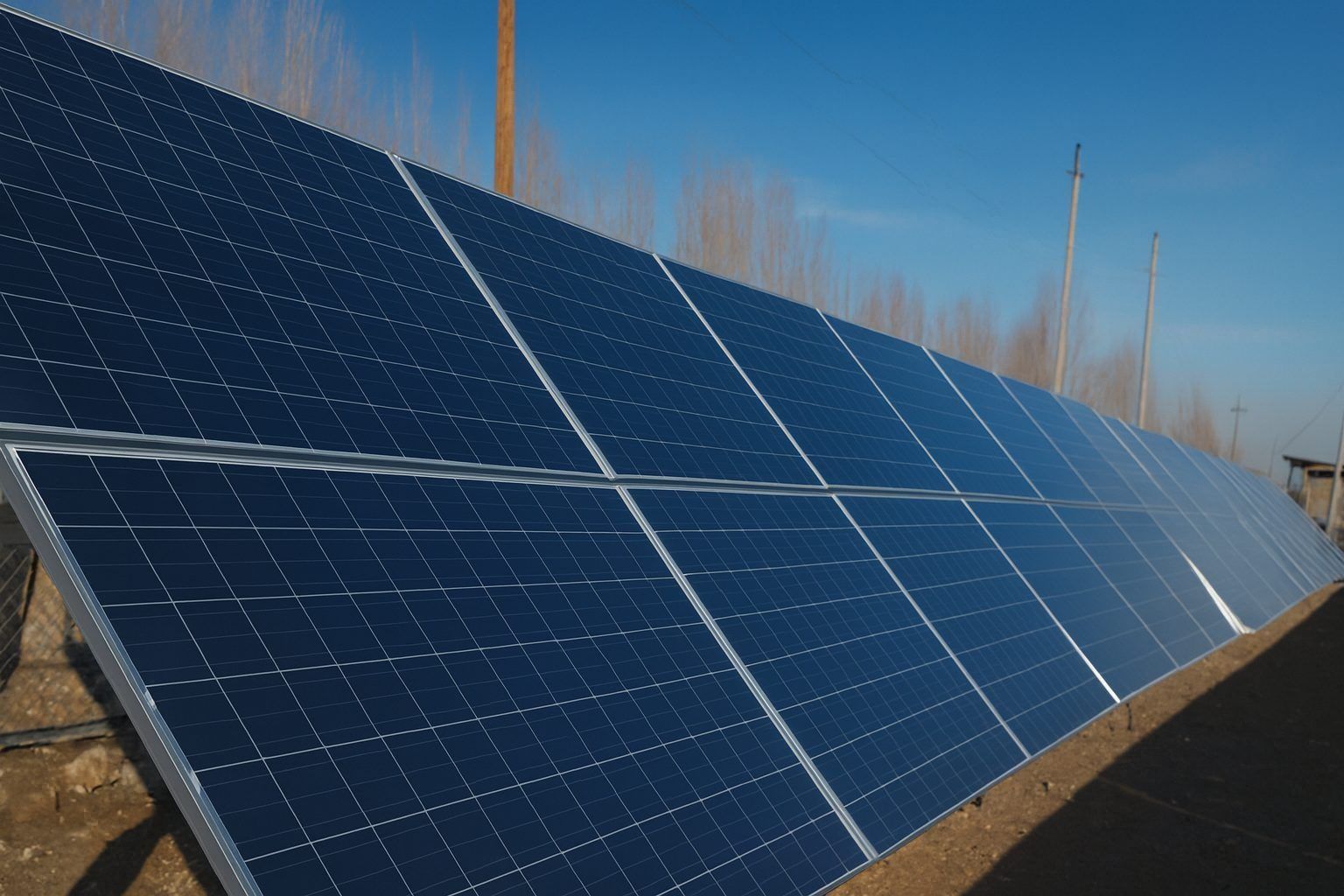
The mega‑projects may grab the headlines, but a quieter transformation is happening on rooftops, farms and public buildings across Uzbekistan.
According to a detailed report on the presidential address published by Uzbek media, around 2,000 MW of small‑scale solar panels have already been installed in:
- The private sector,
- Residential homes, and
- Social institutions such as schools and hospitals.Zamin.uz+1
Since the beginning of 2025, these distributed systems have generated nearly 2 billion kWh of clean electricity, easing pressure on the centralized grid and reducing gas consumption.Zamin.uz+1
The rooftop rollout is part of a broader infrastructure upgrade:
- 69,000 km of power lines have been modernised,
- Around 14,000 transformer stations and high‑voltage substations have been upgraded, and
- Local companies have supplied roughly $700 million worth of cables, construction materials, and electrical equipment for new power facilities.Zamin.uz+1
Uzbekistan is also trying to build local industrial capacity behind the energy transition. Two flagship examples highlighted by officials:
- Angren Energo, a plant designed to produce 15,000 transformers per year, and
- Uzhydropower, which can manufacture 155 hydropower units annually.Zamin.uz+1
On the generation side, the first hydropower station of the Naryn cascade (38 MW) was built using domestically produced equipment – a symbolic step toward a home‑grown green-tech ecosystem.Zamin.uz+1
Community‑Scale Renewables: Mahallas, Micro‑Hydro and Energy Poverty
Uzbekistan’s strategy explicitly links clean energy with social policy.
The government plans in 2026 to deploy 107 MW of additional solar installations in 300 mahallas (neighbourhood communities), providing 30,000 low‑income families with access to “green” electricity and the ability to sell surplus power back to the grid.qazinform.com+1
At the same time:
- Entrepreneurs have built 40 MW of micro‑hydropower plants this year, producing about 120 million kWh of electricity.
- Another 65 MW of small and micro‑hydro is set to come online next year.qazinform.com+1
These community‑scale systems are designed to cut bills, reduce outages in remote regions and create local income streams – a clear attempt to ensure the energy transition is felt beyond Tashkent and the industrial heartlands.
Saudi Arabia and ACWA Power: Strategic Partners in “Green” and Grid
A key subplot in Uzbekistan’s energy story is the growing partnership with Saudi Arabia, particularly through ACWA Power.
On 5 December, Mirziyoyev received a delegation of Saudi companies led by Muhammad Abunayyan, ACWA Power’s CEO and co‑chair of the Uzbek–Saudi Business Council.UzDaily.uz
According to an official summary of that meeting:
- Four wind power plants with a combined capacity of 752 MW were connected to the grid.
- Construction started on five new power plants totalling 2.3 GW.
- A 300 MW energy storage system was launched in the Karakalpakstan and Bukhara regions.
- Work began on a 500 kV transmission line stretching 1,790 km, linking Samarkand–Tashkent and Karakalpakstan–Bukhara, boosting national grid reliability.UzDaily.uz+1
The talks also covered cooperation in transport and logistics infrastructure, ICT, healthcare and agriculture – signalling that energy deals are increasingly embedded in a wider economic partnership.UzDaily.uz
The Saudi relationship is being driven not only at presidential level. A separate meeting in Tashkent between Saida Mirziyoyeva, head of the Presidential Administration, and Abunayyan focused on new directions of cooperation with ACWA Power. The discussion highlighted:
- Transformational projects in Karakalpakstan,
- The goal of using clean energy and infrastructure to raise living standards, and
- Joint work on digital technologies, healthcare and human capital development.Zamin.uz
ACWA Power, for its part, sees Uzbekistan as a flagship market. At the Tashkent forum, the company’s country head Jon Zaidi noted that ACWA added more than 2,500 MW to the Uzbek grid this year alone and tied its strategy to the national target of reaching 54% renewables by 2030.euronews+1
China, Europe and a New Industrial Energy Hub
Saudi Arabia is far from the only major player in Uzbekistan’s energy build‑out.
CleanTechnica’s analysis, drawing on regional sources, notes that China is expected to supply more than $15 billion in direct investment, bringing the total value of joint Sino‑Uzbek projects close to $90 billion, many of them in the energy sector.CleanTechnica
Among the deals highlighted:
- More than 30 energy projects with nearly 10 GW of combined capacity under development with Chinese companies.
- New or expanded partnerships with China Datang, China Energy Engineering Corporation, Sinoma Energy, Universal Energy and China General Technology, covering everything from photovoltaic plants and storage to wind‑turbine blade factories and waste‑treatment technologies.CleanTechnica
European firms are also heavily involved:
- Voltalia (France) recently signed an agreement for a 200 MW hybrid wind‑plus‑storage project, and is preparing a 500 MW storage project known as Turan, slated to begin construction in 2026.euronews+1
- EDF (France), together with partners from Japan, Qatar and Germany, is building two large gas‑fired power plants to support grid stability as renewables expand.euronews+1
- Siemens Energy, TotalEnergies, Masdar, Aksa Enerji, Cengiz Enerji and Nebras Power are all listed among the companies backing new Uzbek projects.qazinform.com+1
Regionally, Uzbekistan is positioning itself as part of a “green corridor” for exporting electricity to Europe through cooperation with Azerbaijan and Kazakhstan, while also working with Kyrgyzstan and Kazakhstan on the Kambarata‑1 hydropower project to better use Central Asia’s shared water resources.qazinform.com+1
Digital Economy Meets Green Energy: DataVolt and Supercomputing
Energy policy in Tashkent is increasingly tied to digital ambitions.
Uzbek officials plan to attract more than $150 billion in foreign investment over the next five years to build 1,000 industrial and infrastructure facilities, including data centers and supercomputing clusters.qazinform.com
A headline project is a 500 MW data center worth around $3 billion, being developed by Saudi company DataVolt. The facility is intended to host AI and high‑performance computing workloads and will rely heavily on the green electricity coming from the new projects.qazinform.com+1
That combination – abundant renewables plus modern data infrastructure – is central to Uzbekistan’s pitch to investors looking for low‑carbon digital capacity in Eurasia.
Oil and Gas Are Not Disappearing – Yet
Despite the flurry of solar, wind and hydropower announcements, Uzbekistan is not turning its back on fossil fuels overnight.
On 5 December, Reuters reported that a subsidiary of state oil and gas company Uzbekneftegaz signed a cooperation agreement with agribusiness giant Cargill. The deal aims to attract up to $3 billion in long‑term financing, with the possibility of raising that ceiling to $5 billion.Reuters+1
According to the company’s statement, the investments will be directed to:
- Household and industrial energy projects,
- Broader infrastructure development, and
- Water management initiatives.Reuters
Meanwhile, the gas‑fired plants being built with EDF and other partners underscore that natural gas remains a core part of Uzbekistan’s generation mix, at least through the 2030s, even as the government talks about cutting greenhouse gas emissions by 50% by 2035 and selling carbon credits under the World Bank‑supported iCRAFT project.qazinform.com
In other words: Uzbekistan’s transition is pragmatic, not purist – but the direction of travel is unmistakably toward cleaner energy.
Why CleanTechnica Says Uzbekistan “Exposes” US Fossil Fuel Politics
CleanTechnica’s article about Uzbekistan’s latest moves uses deliberately sharp language to contrast Tashkent’s strategy with the current direction of US federal energy policy. In its view, the Uzbek example undermines two recurring arguments from fossil‑fuel advocates in Washington:CleanTechnica
- “Renewables are unreliable”
– Uzbekistan is pairing large amounts of solar and wind with 1,245 MW of battery storage, new transmission lines, community‑level solar, hydropower and demand‑side measures, showing that intermittency can be managed with modern grids and storage technology.euronews+2qazinform.com+2 - “Developing countries can’t afford to go green”
– Uzbekistan, a lower‑middle‑income country, has pulled in tens of billions of dollars in foreign investment by making renewables and grid upgrades the centerpiece of its growth model, attracting partners from Saudi Arabia, China, the EU and international financial institutions.qazinform.com+2euronews+2
The article also criticizes how some US political rhetoric has demeaned countries like Uzbekistan while focusing on military or fossil‑fuel exports instead of long‑term clean‑energy partnerships. Rather than endorse that rhetoric, Uzbekistan is quietly building a coalition of investors and technology partners around a different vision: a grid dominated by low‑carbon power, backed by storage and regional interconnections.
Whether or not one agrees with CleanTechnica’s political framing, the factual contrast is striking: while US debates over gas export terminals and fossil subsidies continue, Uzbekistan is using renewables, batteries and grid modernization as its primary tools for energy security.
Climate and Economic Impact in Numbers
From the government’s own projections and independent reporting, the near‑term climate and economic impacts of Uzbekistan’s current package look like this:qazinform.com+1
- Gas savings: Around 7 billion cubic meters of natural gas per year once the new green capacity is fully online.
- Emissions cuts: About 11 million tons of greenhouse gases avoided annually.
- Green share of generation: ~30% in 2025, targeted to reach 54% by 2030.
- New capacity: 9,000 MW already added in recent years; a further 17,000 MW of renewables planned by 2030.
- Foreign investment: $35 billion attracted so far into the energy sector, with more than $150 billion targeted across energy‑linked industrial projects over the next five years.
- Social programmes: 30,000 low‑income families to gain dedicated solar supply; 80,000 households to benefit from new micro‑hydro stations by 2026.qazinform.com+1
For a country of around 36 million people, those are economy‑shaping numbers.
What to Watch Next
As of 7 December 2025, Uzbekistan’s energy transition has passed a symbolic turning point but is far from complete. Key questions for 2026 and beyond include:
- Delivery risk: How quickly will the 42 projects move from groundbreaking to full operation, and will they hit the promised 15 billion kWh of annual output?
- Grid reliability: Can the planned 1,245 MW of storage and the new 500 kV transmission line eliminate winter and summer power shortages that have plagued parts of the country in the past?
- Social impact: Will community‑level solar in mahallas and micro‑hydro in rural areas meaningfully reduce energy poverty and improve resilience in remote regions?
- Investment mix: As Cargill and gas‑fired projects enter the picture, can Uzbekistan keep fossil investments from crowding out green ones, or will it manage a disciplined transition where gas plays a supporting role?
- Regional leadership: How far will the “green corridor” to Europe and cooperation with neighbours on hydropower and grids go in redefining Central Asia’s role in Eurasian energy markets?
For now, the signal from Tashkent is clear: Uzbekistan is betting that a renewables‑first, grid‑modernisation‑heavy strategy is the fastest route to energy security, foreign investment and industrial growth. In doing so, it is forcing a rethink of old assumptions about what developing economies can – and cannot – do on climate and clean energy.