

NEW YORK, July 30, 2026, 04:23 EDT
- Visa plans to eliminate around 2,600 positions—roughly 7% of its workforce—with most reductions affecting technology and product roles.
- Severance accounted for 79% of the year-over-year rise in quarterly personnel expenses.
- Personnel cost without severance increased by 8.3%, trailing revenue growth of 14%.
Visa’s upcoming cuts come after the company took on $563 million in severance expenses during the previous quarter. This charge accounted for the majority of the uptick in personnel costs. Despite these charges, demand stayed robust.
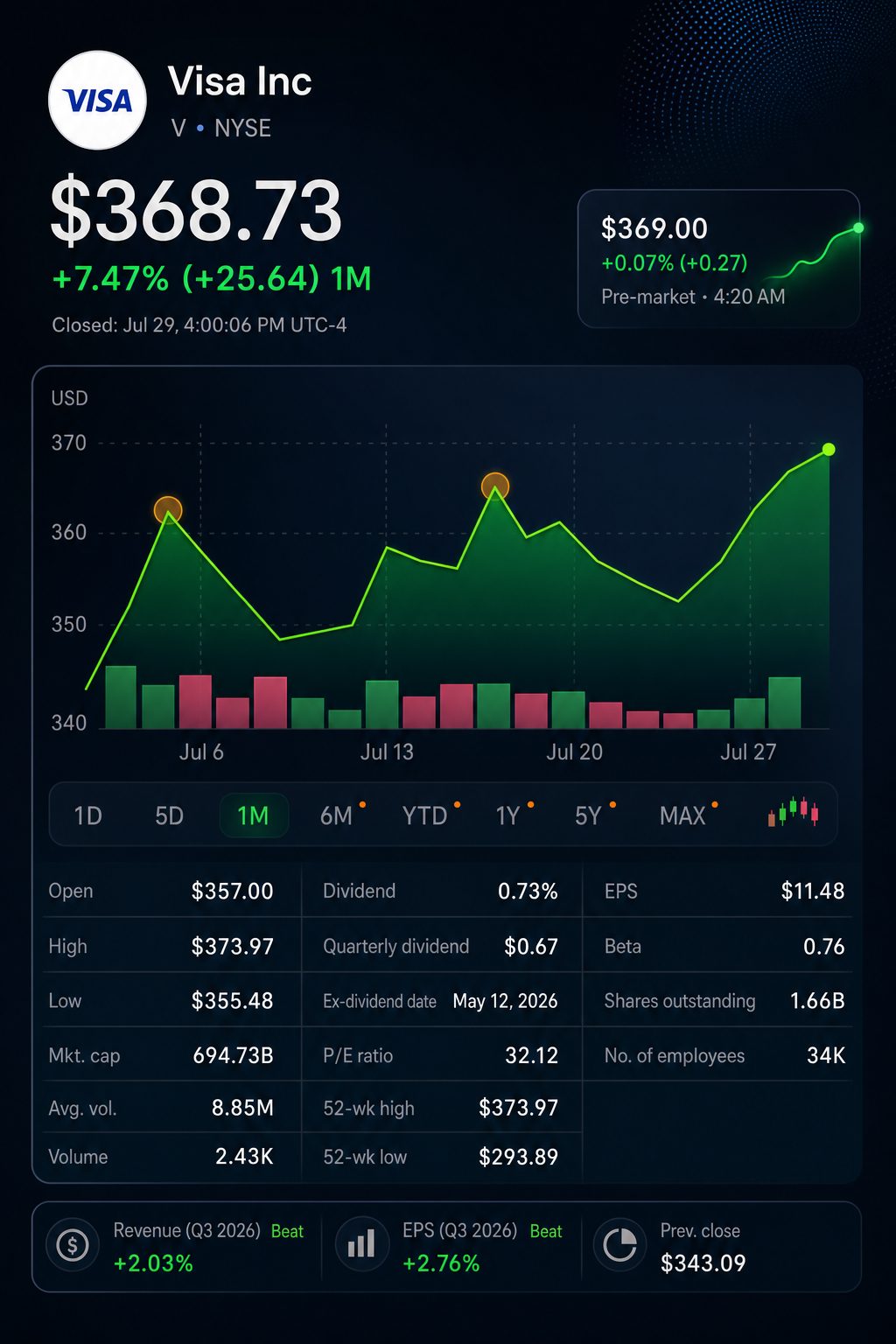
U.S. regular trading had ended at the time of reporting, with premarket activity ongoing. Visa finished Wednesday at $368.73, gaining 0.58%, as the S&P 500 declined by 1.52%.
The company plans to cut around 2,600 positions, mainly within its technology and product divisions. CEO Ryan McInerney attributed the decision to the pursuit of greater efficiency and reinvestment. “I have deep conviction that we are doing what is right for Visa,” he stated. Visa has not specified the number of impacted roles located in California. Reuters
McInerney stated that AI is speeding up the operational transition. According to Reuters, AI was not the only reason for the move.
The rounded numbers indicate that Visa’s headcount increased significantly after fiscal 2025. They further suggest that employment following the cuts is close to the level seen last year.
| Workforce measure | Employees | Change versus FY2025 |
|---|---|---|
| FY2025 reported | 34,100 | — |
| Implied before cuts | about 37,100 | increase of about 3,000, or 8.9% |
| Implied after cuts | about 34,500 | increase of about 400, or 1.3% |
Initial calculation: 2,600 divided by 7%. The figures provided have both been rounded.
The calculation presents the move as a headcount reset following growth. It does not detail when each person left.
| Q3 cost bridge | 2026 | 2025 | Change |
|---|---|---|---|
| Net revenue | $11.633 billion | $10.172 billion | up 14% |
| Personnel expense, reported | $2.458 billion | $1.749 billion | increase of 40% |
| Severance costs | $563 million | — | Not meaningful |
| Personnel expense, excluding severance | $1.895 billion | $1.749 billion | growth of 8.3% |
| Reported operating expense | $4.756 billion | $3.995 billion | up 19% |
| Adjusted operating expense | $3.878 billion | $3.307 billion | increase of 17% |
Based on Visa’s filing with the SEC.
The main takeaway for investors is clear: personnel expenses, excluding severance, increased by roughly 8.3%, which was almost six percentage points less than the growth in revenue.
Visa reported that increased personnel expense was due to greater headcount and compensation, factoring in acquisitions. According to the filing, severance is generally associated with efficiency steps. The filing does not attribute the entire charge to the previously disclosed 2,600 job reductions.
There was no indication of a pullback in demand from business activity. Payment volume increased by 10%, surpassing $4 trillion. Cross-border payments grew 13%, and processed transactions were up 10%.
| Operating test | Q3 result | Investor comparison |
|---|---|---|
| Payments volume | Over $4 trillion | +10% |
| Processed transactions | — | +10% |
| Cross-border volume | — | +13% |
| Net revenue | $11.63 billion | 2.1% above consensus |
| Adjusted EPS | $3.32 | 2.8% above consensus |
Reuters compiles consensus comparisons using reported estimates.
Adjusted EPS was roughly 2.8% above consensus, and revenue surpassed projections by 2.1%. “The beat wasn’t a fluke or an accounting trick,” said David Wagner of Aptus Capital. Reuters
Visa accounted for the severance charge as having an after-tax impact of $438 million. This item added $0.23 per share in the reconciliation from reported to adjusted EPS. Most of the accounting impact was reflected in the June quarter.
Visa’s reduction surpasses Mastercard’s NYSE:MA January announcement, which aimed for a staff cut of around 4%. Mastercard projected an estimated $200 million restructuring charge. Reuters calculated that over 1,400 positions would be impacted.
| Payments restructuring | Workforce cut | Stated focus | Efficiency-related severance or charge |
|---|---|---|---|
| Visa | approximately 2,600 jobs, or 7% | Emphasis on technology, product, efficiency and reinvestment | $563 million recognized in Q3 severance expenses |
| Mastercard | over 1,400 positions, or 4% | Redirecting investment priorities | around $200 million |
Visa has not indicated that the full charge corresponds specifically to the 2,600 job reductions it has planned.
Visa’s cut as a percentage is 1.75 times greater than Mastercard’s. The two firms characterized the measures as reallocations of resources rather than reactions to weaker transaction volumes.
Visa advanced 4.3% over five sessions ending Wednesday, hitting a new 52-week high. The session’s highest level was $373.97. The stock outpaced a notable drop in the broader market on Wednesday.
Mastercard will report results and hold a conference call at 9:00 a.m. ET on Thursday, marking the next peer test. Investors are set to assess developments in volume growth, restructuring efforts and spending patterns.
Risks: Most reductions are focused on technology and product teams. Performance may be impacted if exits hinder product delivery. Margin improvements could be postponed if funds are reinvested, and softer travel or lower consumer spending would dampen volume growth.
Investors can now quantify the challenge. After restructuring charges subside, headcount expansion must stay under revenue growth. Mastercard’s results will indicate if this cost shift is turning into a sector trend.
Related articles: NYSE:V