
NEW YORK, August 19, 2026, 13:56 EDT — U.S. cash markets traded open.
- The Nasdaq gained 0.59% while long-term Treasury yields pulled back.
- The rebound managed to claw back just 44% of the 1.33% drop seen on Tuesday.
- The incremental buyback support amounts to 0.04% of the Treasury market.
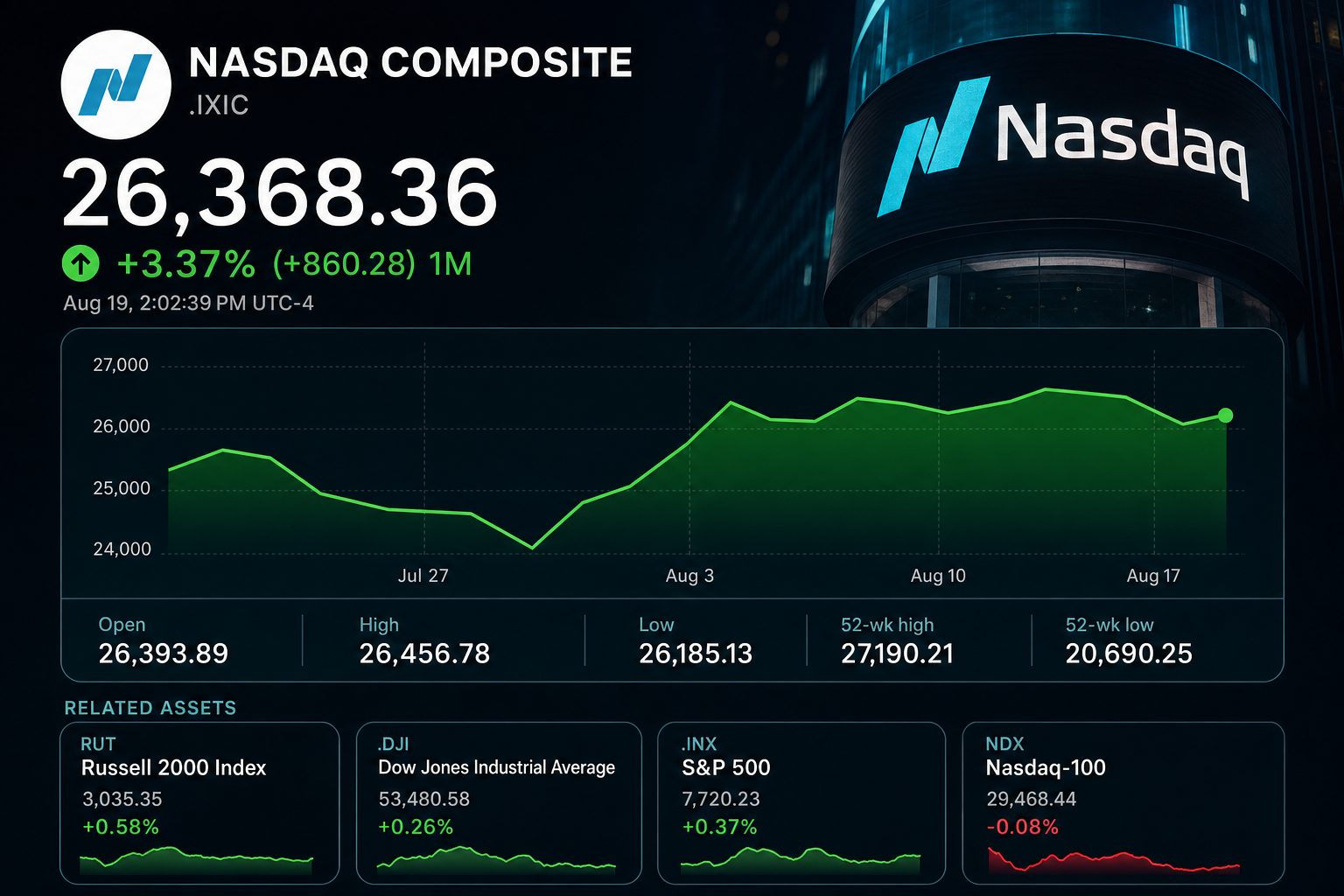
The Nasdaq Composite gained 0.59%, closing at 26,445.73 on Wednesday. Easing long-term Treasury yields supported a rebound in growth stocks following a downturn on Tuesday. Nevertheless, the recovery accounted for just 44% of the previous session’s loss.
The U.S. Treasury increased its scheduled buybacks of 10- to 30-year bonds, raising the amount per operation to a minimum of $4 billion from $2 billion. This adjustment brings a minimum of $14 billion in added liquidity to markets each quarter.
While that figure appears significant, it is relatively modest, representing roughly 0.04% of the $32.2 trillion Treasury market. Investors gained a helpful liquidity indicator rather than a remedy for increasing debt issuance.
| Market measure | August 19 | Change |
|---|---|---|
| Nasdaq Composite | 26,445.73 | up 0.59% |
| S&P 500 | 7,737.65 | gained 0.60% |
| Dow Jones Industrial Average | 53,564.38 | rose 0.41% |
| Philadelphia Semiconductor Index | — | dropped 1.30% |
| 10-year Treasury yield | 4.655% | fell 4.9 basis points |
| 30-year Treasury yield | 5.203% | declined nearly 14 basis points from Tuesday’s peak |
The 30-year yield reached 5.34% on Tuesday, marking its peak since 2007. By midday Wednesday, it hovered around 5.203%. The pullback of about 14 basis points eased discount-rate pressure on long-duration stocks.
Robert Pavlik from Dakota Wealth stated that increased rates lower the present value of projected tech earnings. That pattern reversed on Wednesday. Nonetheless, the semiconductor index slipped 1.3%, underperforming the Nasdaq by 1.89 points.
| Nasdaq signal | August 18 | August 19 | Reading |
|---|---|---|---|
| Index return | -1.33% | +0.59% | The two-day return stands around -0.75% |
| Semiconductor index | -5.00% | -1.30% | Semiconductors continued to lag |
| Market breadth | 1.67 decliners per advancer | 1.74 advancers per decliner | Breadth shifted direction |
| New highs / new lows | 75 / 121 | 94 / 66 | The ratio strengthened from 0.62 to 1.42 |
Market breadth strengthened below the index. On the Nasdaq, advancing stocks led decliners by a ratio of 1.74 to one. The number of stocks hitting new highs stood at 94, outpacing the 66 posting new lows. Both indicators contrasted Tuesday’s softer readings.
The Treasury will start its operation on September 9 and continue until November 4. Total buybacks for all maturities could total up to $83 billion for the quarter. This accounts for just 0.26% of the overall Treasury market.
| Treasury measure | Amount | Share of $32.2tn market | Investor meaning |
|---|---|---|---|
| Previous long-dated program | $2 billion | 0.006% | Earlier liquidity assistance |
| Updated minimum operation | $4 billion | 0.012% | Double earlier amount |
| Additional quarterly support | At least $14 billion | 0.043% | Relatively minor vs total market |
| Quarterly buyback ceiling | $83 billion | 0.258% | Serves as liquidity, not for reducing debt |
| Outstanding 20- and 30-year bonds | $5.5 trillion | 17.1% | Main long-end challenge |
Analysts reacted positively to the move, though some expressed doubts about how long it would last. Gennadiy Goldberg at Toronto-Dominion Bank (TSE:TD) described it as the “first of many possible actions.” According to him, consistent reductions in long-end auction sizes could deliver a lasting solution. Reuters
Analysts at Evercore Inc. NYSE:EVR commended the move as a tactical surprise, though they highlighted significant refinancing requirements. Jefferies Financial Group’s NYSE:JEF Thomas Simons cautioned that an unforeseen adjustment might undermine the Treasury’s framework for predictable issuance.
| Analyst or institution | Recommendation / stance | What would strengthen the Nasdaq signal |
|---|---|---|
| Gennadiy Goldberg, TD Securities | Maintains cautious optimism | Decreasing long-term auction volumes would aid prolonged stability |
| Evercore ISI | Short-term positive, long-term watchful | Demonstrate buybacks’ ability to counteract refinancing stress |
| Thomas Simons, Jefferies | Warns about credibility issues | Return to steady, consistent updates |
| Robert Pavlik, Dakota Wealth | Interest rates continue as valuation driver | Prevent another climb in longer-dated yields |
| Sam Stovall, CFRA Research | Advises vigilance on inflation | Limit oil’s impact on price increases |
Oil continues to pose a challenge. Brent crude gained around 1% amid ongoing tensions in the Middle East. According to Sam Stovall of CFRA Research, high oil prices sustain worries over inflation. This could push long-term yields up once more.
Federal Reserve meeting minutes were expected following the midday snapshot on Wednesday. LSEG data referenced by Reuters showed that traders anticipated at least one 25-basis-point rate hike before the end of the year. A hawkish message could disrupt the relief rally.
Risks: While buybacks boost liquidity, they do not reduce funding requirements. A fresh wave of bond sales, a rise in oil prices or more hawkish remarks from the Fed could undo Wednesday’s yield decline. Continued softness in semiconductors would shift the Nasdaq rally’s reliance to different sectors.
The investor’s assessment is straightforward. While Nasdaq breadth has improved, chip sector leadership remains absent. Sustained gains require falling yields and no recurring Treasury action.
Related articles: Stock Market





Rate relief, not an all-clear
The Nasdaq rebounded as long yields fell. Yet chips stayed weak, the two-day return remained negative, and the Treasury’s extra liquidity support is tiny beside the bond market.
12:18–12:36 EDT
18:18–18:36 CEST
Long yields fell; semiconductor leadership did not return
The surprise was meaningful; the dollars remain small
The bar enlarges the 0.043% share by 100× for visibility. Buybacks support trading liquidity; they do not remove the government’s financing need.
Breadth flipped, chips lagged
One yield, two messages
Lower yields raise the present value of distant earnings. A renewed move above 5.3% would put that pressure back on high-duration shares.
Liquidity relief won the day; durability remains disputed
| Voice | Stance | Investor test |
|---|---|---|
| Gennadiy Goldberg TD Securities | Cautious positive | Smaller long-end auctions would be more durable. |
| Evercore ISI | Tactical support | Refinancing and deficits still dominate supply. |
| Thomas Simons Jefferies | Credibility concern | Treasury must restore predictable communication. |
| Robert Pavlik Dakota Wealth | Rates drive tech value | Keep long yields from resuming their climb. |
| Sam Stovall CFRA | Inflation caution | Higher oil can revive bond selling. |
Three checks for a durable Nasdaq rebound
The snapshot predates the release. Hawkish language would challenge rate relief.
A stable 30-year yield near 5.2% matters more than one intraday drop.
The rally needs semiconductor breadth, not merely gains elsewhere in the index.