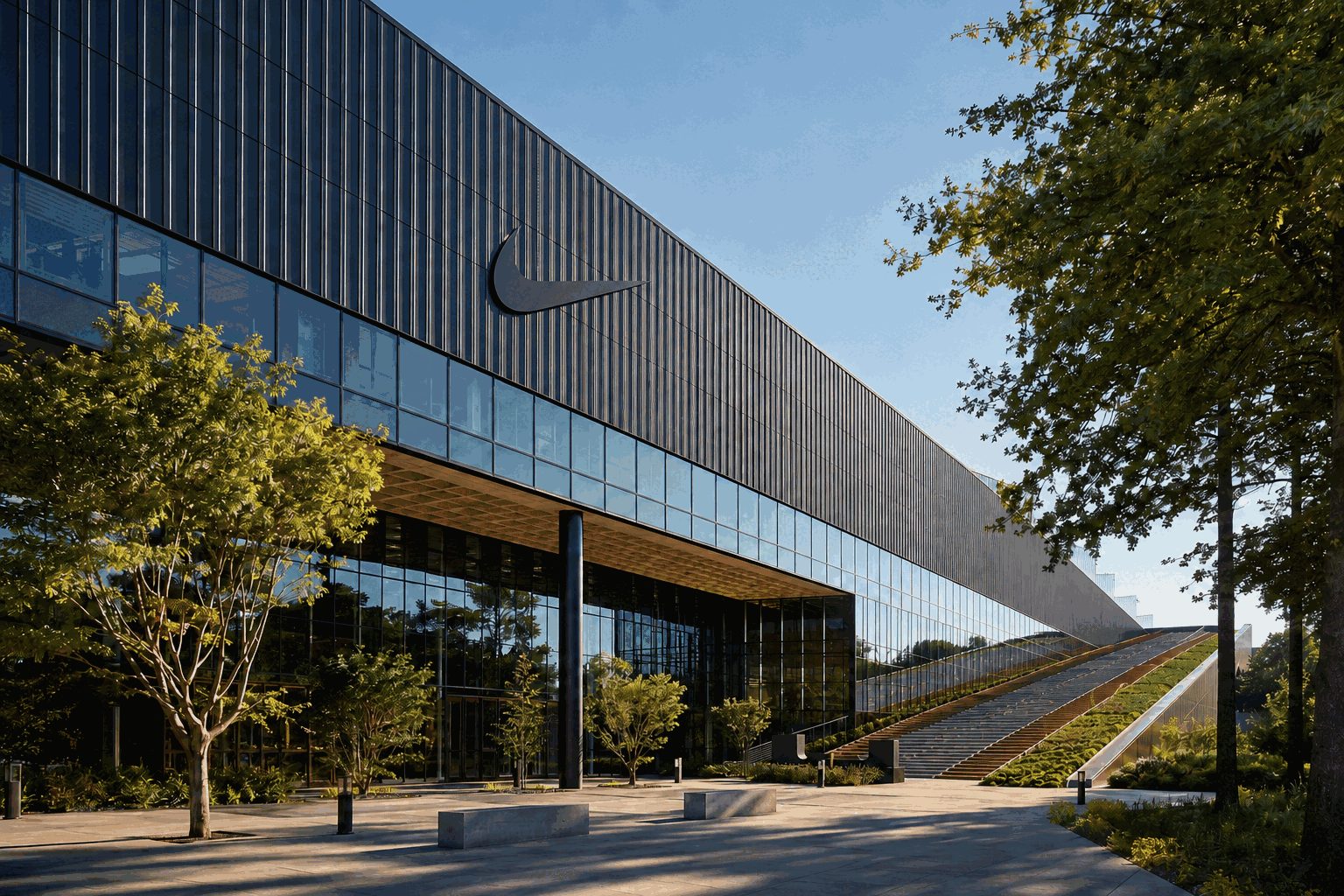

BEAVERTON, Oregon, August 19, 2026, 08:55 EDT — U.S. cash markets remained shut with index futures trading narrowly ahead of Wednesday’s open.
- Nike ended Tuesday at $40.06, rising 2.48%, following its lowest close in 12 years on Monday.
- The rebound offset approximately 57% of the $1.69 drop in share price seen on Monday.
- Twenty-four out of 39 analysts have a Hold rating on Nike, with an average price target of $50.66.
NIKE, Inc. NYSE:NKE recouped a portion of Monday’s drop, gaining $0.97 on Tuesday after a $1.69 decline the previous session. The stock closed 1.6% lower than it did on Friday.
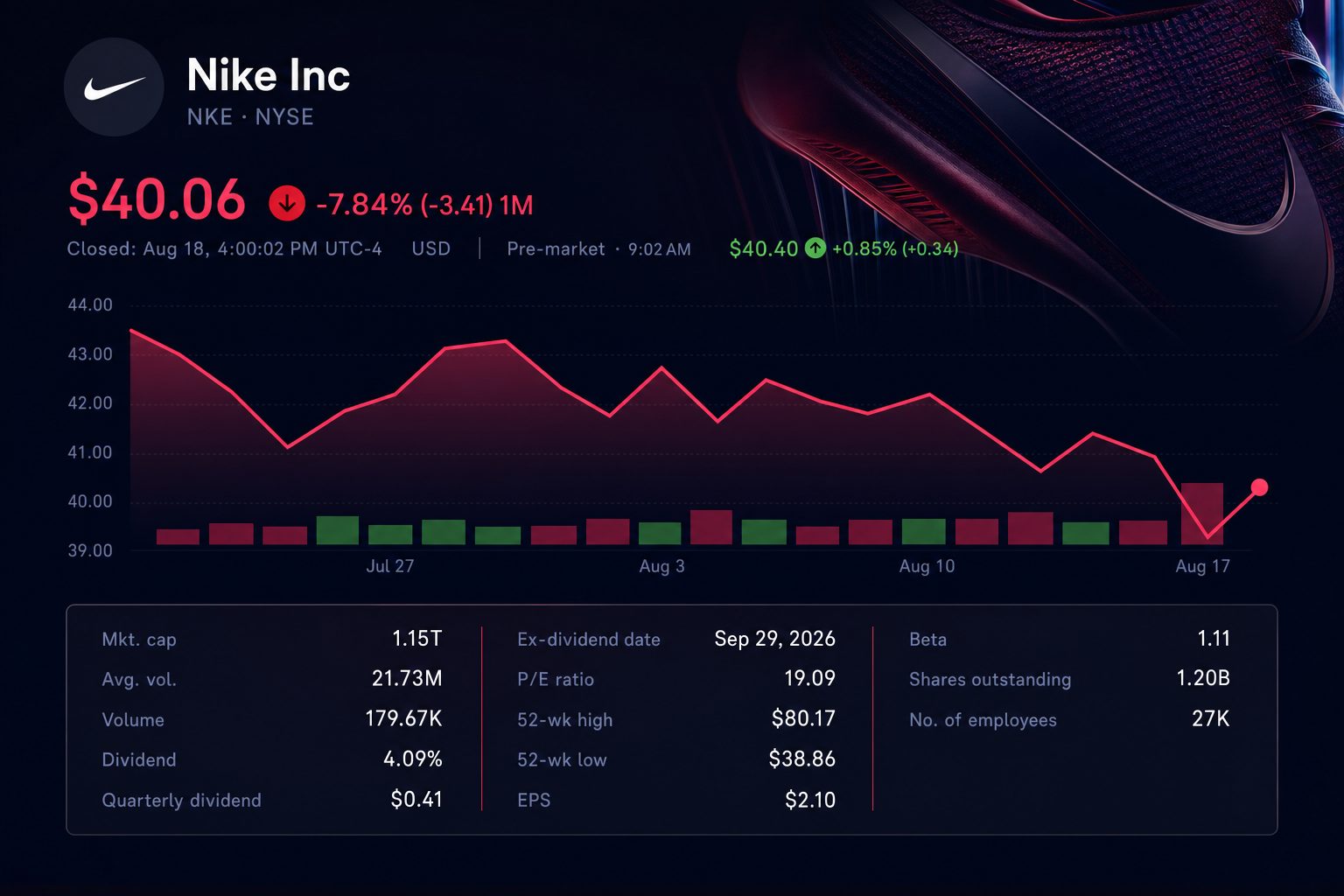
The partial recovery is significant. It increased the distance from Wall Street’s consensus target while the operational outlook remained unchanged. Nike was trading at $40.43 in premarket activity at 08:46 EDT, gaining 0.92%.
| Nike price bridge | Price | Move |
|---|---|---|
| Close on Friday, Aug. 14 | $40.73 | -1.21% |
| Close on Monday, Aug. 17 | $39.09 | -4.03% |
| Close on Tuesday, Aug. 18 | $40.06 | +2.48% |
| Wednesday, Aug. 19 premarket, 08:46 EDT | $40.43 | +0.92% |
The stock’s recent jump appears to be more of a relief reaction than a fundamental rerating. On Monday, it finished at its lowest level in 12 years. Based on Dow Jones market data, shares were trading around 78% lower than their all-time peak from November 2021.
Sportswear stocks also recovered on Tuesday. Lululemon Athletica Inc. NASDAQ:LULU rose a bit more than Nike, while VF Corporation NYSE:VFC and Under Armour, Inc. NYSE:UAA declined. The S&P 500 slipped 0.69%.
| Aug. 18 peer tape | Close | Daily move |
|---|---|---|
| Lululemon NASDAQ:LULU | $119.01 | up 2.83% |
| Nike NYSE:NKE | $40.06 | up 2.48% |
| VF Corp. NYSE:VFC | $14.31 | down 1.17% |
| Under Armour Class C (NYSE:UA) | $4.94 | down 4.82% |
| S&P 500 | 7,691.76 | down 0.69% |
The disparity in price targets stands out. The mean estimate from 39 analysts is $50.66, which is 26.5% higher than Tuesday’s closing level. However, 24 analysts rate the stock as Hold, while 12 are positive and three advise selling. The overall consensus rating remains Hold.
| August analyst ratings | Number | Percentage of 39 |
|---|---|---|
| Strong Buy | 11 | 28.2% |
| Buy | 1 | 2.6% |
| Hold | 24 | 61.5% |
| Sell | 2 | 5.1% |
| Strong Sell | 1 | 2.6% |
The newest recommendations are more cautious. Matthew Boss at J.P. Morgan downgraded Nike to Sell and reduced his price target to $40 on August 4. Ike Boruchow of Wells Fargo maintains a Hold rating with an identical $40 target. Both are close to where shares finished on Tuesday.
The operational landscape is more challenging. Nike posted fiscal 2026 revenue of $46.4 billion with diluted earnings per share at $2.10. Free cash flow declined to $1.89 billion. Analysts project a 1.6% drop in fiscal 2027 revenue, even as adjusted EPS is expected to climb.
| Operating scorecard | FY2026 actual | FY2027 consensus | Change |
|---|---|---|---|
| Revenue | $46.40bn | $45.67bn | -1.6% |
| Adjusted EPS | $1.58 | $1.71 | +8.4% |
| Gross margin | 43.25% | 41.74% | -151 bp |
| Free cash flow | $1.89bn | $3.06bn | +61.9% |
Nike posted a fourth-quarter gross margin of 49.2%, though an anticipated $986 million tariff recovery contributed roughly 900 basis points. Stripping out this effect, the year-on-year margin improvement appeared much smaller. CEO Elliott Hill stated Nike continued to face “top-line headwinds” despite gains in performance product categories. Nike
China continues to be the primary test case. In the fourth quarter, Nike’s sales in Greater China dropped 17% on a constant-currency basis. The company will limit online sales channels beginning in January in an effort to regain control over pricing and rebuild trust. Cathy Sparks, head of the region, described the market as “fragmented and cluttered.” Reuters
Laurent Vasilescu, an analyst at BNP Paribas, projected that the China reset might result in a sales loss ranging from $500 million up to $1 billion. The higher end of this range would represent approximately 2.2% of the group’s projected revenue for fiscal 2026, surpassing the currently expected 1.6% decrease in revenue for fiscal 2027.
The dividend provides a measure of support. On August 6, Nike announced a $0.41 per share quarterly payout, due on October 1. At Tuesday’s close, the annualized $1.64 payout represents a yield of roughly 4.1%.
The coming week will reveal if buyers maintain support around the $40 mark. Market participants are set to monitor updates from China, U.S. consumer figures, and possible analyst re-ratings following the recent low. No corporate earnings are on the calendar this week.
Risks: A wider recovery in consumer demand may help sustain the recent low. However, another warning on China sales, deeper discounts or lower margins could drive the shares under $40.
Nike's bounce still needs proof
On Tuesday, shares regained 57% of Monday’s decline. Most Wall Street analysts still rate the stock as Hold.
Premarket data: August 19, 2026, 08:46 EDT.
Figures in U.S. dollars.
Price changes over four sessions
Analyst ratings · 39 in total
Consensus: Hold. J.P. Morgan most recently set its price target at $40.
Bridge operations
| Metric | FY2026 actual | FY2027 consensus | Change |
|---|---|---|---|
| Revenue | $46.40bn | $45.67bn | -1.6% |
| Adjusted EPS | $1.58 | $1.71 | +8.4% |
| Gross margin | 43.25% | 41.74% | -151 bp |
| Free cash flow | $1.89bn | $3.06bn | +61.9% |
FY2027 numbers reflect early consensus estimates and are not official guidance from Nike.
What the price indicates
The read-through: Nike’s target gap appears sizable, yet most analysts are not advising to buy the stock. The real test comes if revenue steadies while free cash flow improves. China is the key factor: a $1 billion decline in sales from the online overhaul would represent roughly 2.2% of projected group revenue for fiscal 2026.
Sources: S&P Global market data via StockAnalysis, Nike’s fiscal 2026 report, Reuters, and Nike dividend announcement. Market data may experience delays.