
MIAMI, May 7, 2026, 10:02 (EDT)
Hut 8 Corp. landed a $9.8 billion, 15-year lease deal for phase one of its Beacon Point AI data center campus in Nueces County, Texas, marking a major step as the company moves further into AI-powered infrastructure beyond its bitcoin mining roots. The company didn’t disclose the tenant’s name but described it as a high-investment-grade firm set to tap 352 megawatts of IT capacity—essentially the power available to run servers and associated hardware.
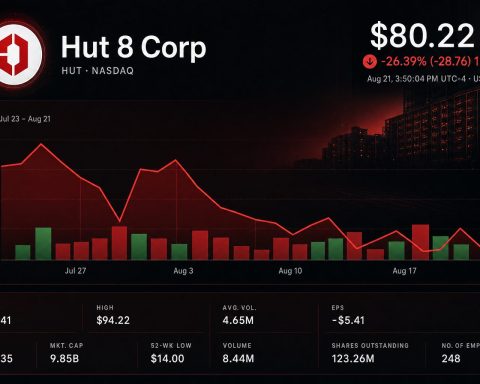
Timing here is key: power infrastructure has turned into one of the toughest challenges in the AI expansion. Investors are shifting focus, rewarding firms with control over land, grid hookups, and heavy-duty facilities—instead of just chasing chipmakers or software providers. Hut 8 shares, which surged more than 25% in early trading Wednesday after a Reuters report, settled back on Thursday, down about 13% at $94.41.
The lease runs as a triple-net arrangement, so the tenant covers rent along with taxes, insurance, and maintenance. It’s also a take-or-pay contract—payment is due whether the customer uses the full capacity or not. Hut 8 noted that with renewal options, the deal’s total value could reach roughly $25.1 billion. The Beacon Point agreement pushes Hut 8’s contracted AI data-center capacity to 597 MW, putting the base-term contract value near $16.8 billion.
Asher Genoot, Chief Executive, told Reuters the agreement is secured by a “15-year obligation from a high-investment-grade counterparty” and contains “no termination for convenience.” In a statement from the company, Genoot framed Beacon Point as evidence that Hut 8 “start[s] with power,” targeting investors increasingly focused on electricity access as a metric alongside computing needs for data-center firms. Reuters
Beacon Point is on track to become a 1-gigawatt campus—1,000 MW of utility capacity. Hut 8 expects to flip the switch in the first quarter of 2027, with a data hall scheduled to follow in the third quarter. For this project, the company has tapped American Electric Power, Vertiv, and Jacobs as partners. Phase one gets built to Nvidia’s DSX reference architecture, targeting large-scale AI infrastructure.
Partner execs cast the project as a challenge in execution. Jacobs CEO Bob Pragada wants to see “speed, safety, and certainty” on delivery. Vertiv’s Giordano Albertazzi, for his part, argued next-gen AI infrastructure is all about converting power to “AI capacity” — fast. Nasdaq
The deal arrived just as Hut 8 reported its first-quarter numbers. Revenue jumped to $71.0 million, up from $21.8 million a year ago, driven largely by $66.0 million in compute operations. Still, the company logged a bigger net loss—$253.1 million, compared with $134.3 million last year—mostly tied to $295.7 million in unrealized losses on digital assets.
Hut 8 outlined its approach to financing expansion in the earnings release. As of March 31, the company reported roughly $1.3 billion in cash and bitcoin on hand. After the quarter wrapped, Hut 8 completed $3.25 billion in senior secured notes to back the River Bend data-center build. The company also reworked a $200 million bitcoin-backed credit line with FalconX, dropping the interest rate to 7.0% from 9.0% and unlocking around 3,300 bitcoin in collateral.
Competitors aren’t standing still. IREN, the bitcoin miner now moving into AI infrastructure, just unveiled a $625 million deal to acquire cloud player Mirantis this week. TeraWulf? They’re backing their own AI and high-performance computing ambitions with a mix of Fluidstack leasing and Google guarantees.
But getting it done is another matter. Hut 8 faces the challenge of securing financing, constructing and powering up big campuses fast—juggling contractors, grid hookups, equipment orders, and local permits along the way. The company has cautioned that cost overruns, project delays, supply bottlenecks, red tape and tech snags could all disrupt its plans.
At this stage, Hut 8 offers something neater than just tracking bitcoin: think AI infrastructure deals, lengthy leases, and limited power resources. But ahead, the real challenge isn’t unveiling more capacity—it’s actually switching Beacon Point and River Bend on by 2027.


![Australia Stock Market Today 28/08/2026 [UPDATE: 12:40 AEST] [WAM Dividend Cut Deepens Selloff as ASX Rebound Fades]](https://ts2.tech/wp-content/uploads/2026/08/AU-market-dashboard-2026-08-28-1237-480x384.jpg "Australia Stock Market Today 28/08/2026 [UPDATE: 12:40 AEST] [WAM Dividend Cut Deepens Selloff as ASX Rebound Fades]")