
Search result

ERITREA

Eritrea’s Digital Desert: Inside the World’s Most Isolated Internet – and the Satellite Lifeline on the Horizon

Eritrea’s Digital Desert: Inside the World’s Most Isolated Internet – and the Satellite Lifeline on the Horizon

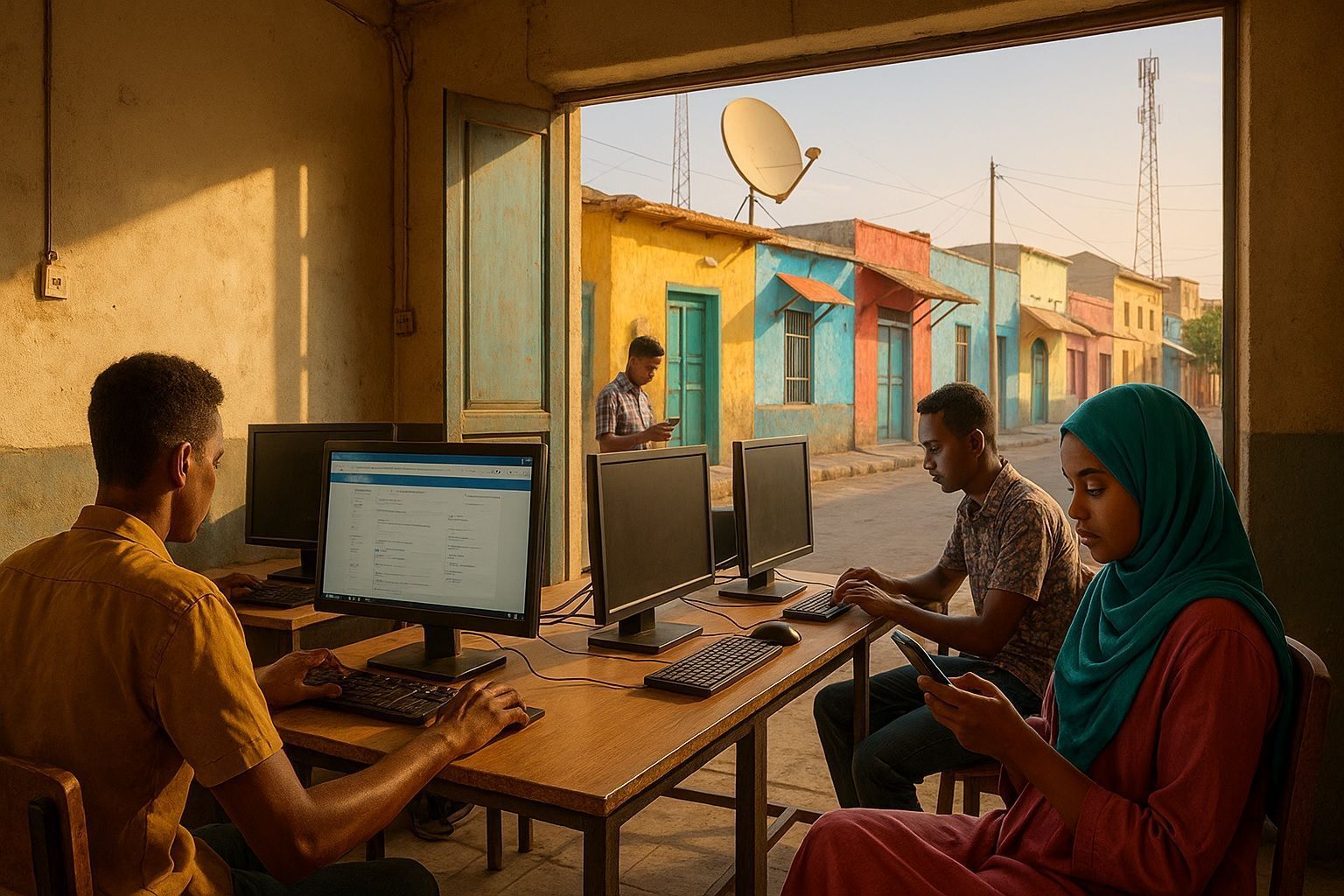
As of early 2024, about 26% of Eritrea’s 3.7 million people were internet users. Eritrea is the only coastal African nation with zero submarine fiber-optic cable landings. The telecom sector is entirely state-owned and monopolized by Eritrean Telecommunication Services Corporation (EriTel), with no private ISPs or competing mobile operators. Public mobile data is essentially unavailable; the mobile network runs on 2G GSM with 3G/4G largely disabled for ordinary users. Fixed broadband remains extremely limited, with fewer than 150 subscriptions in the mid-2010s. Internet cafés are the primary access point, with fewer than 10 in Asmara and roughly 100 nationwide. EriTel’s
12 juin 2025
Inside Djibouti’s Digital Frontier: The Rise of Internet Access and Satellite Connectivity

Inside Djibouti’s Digital Frontier: The Rise of Internet Access and Satellite Connectivity

Djibouti hosts about 10–12 international undersea cables on the Red Sea coast, including SMW3, EIG, SEA-ME-WE-5/6, AAE-1, EASSy, WIOCC, Yemeni, and DARE1, linking to Europe, Asia and East/Southern Africa. Djibouti Telecom invested over $200 million in the last decade in landing stations and a protected submarine corridor, reinforcing Djibouti as a regional internet gateway. Terrestrial fiber links connect Djibouti to Ethiopia and Somalia, and AfriFiber serves thousands of homes in Djibouti City. The Djibouti Data Center (DDC) is the first and only carrier-neutral data center in East Africa, co-locating major cable landing points with Tier-3 colocation, peering, and the DjIX
Insane Internet Speeds: The Fastest Connections on Earth and What’s Coming Next

Insane Internet Speeds: The Fastest Connections on Earth and What’s Coming Next

In June 2024, a team led by Japan’s NICT and Aston University achieved 402 Tbps over a single standard optical fiber using six wavelength bands (O, E, S, C, L, and U). In March 2024, the same international team reached 301 Tbps by extending into E-band and S-band with a custom amplifier for those bands. In July 2021, NICT researchers transmitted 319 Tbps over 3,001 km using a 4-core optical fiber with 552 channels across a 120 nm spectrum. In August 2020, University College London set a then-record of 178 Tbps using geometric shaping constellations. In April 2025, NICT with
17 juin 2025
Internet Access and Satellite Connectivity in Turkmenistan

Internet Access and Satellite Connectivity in Turkmenistan

As of early 2024, Turkmenistan had about 2.59 million internet users, roughly 39.5% of the population—the lowest penetration in Central Asia. Turkmenistan’s telecom market is a state monopoly led by Turkmentelecom (Turkmen Telecom), with TM CELL/Altyn Asyr as the sole mobile operator after MTS exited in 2017–2018. There were about 4.34 million mobile subscriptions in early 2024, representing 66% of the population, with 3G introduced in 2010 and 4G LTE in 2013. In 2023 the government set a minimum broadband speed of 1 Mbps and a top tier of 6 Mbps, though real-world speeds are often far lower. The median
30 juin 2025

Stock Market Today

Micron stock dips after report says Nvidia HBM4 orders may bypass it for SK Hynix, Samsung

L’action Micron chute après un rapport indiquant que les commandes HBM4 de Nvidia pourraient passer outre au profit de SK Hynix et Samsung

7 février 2026
L’action Micron a perdu 0,5 % avant l’ouverture vendredi après que Semianalysis a prédit que la société ne fournirait aucune mémoire HBM4 à Nvidia. Les analystes estiment que SK Hynix détiendra 70 % de la fourniture de HBM4, Samsung 30 %. Nvidia aurait demandé à Samsung d’accélérer les livraisons face à une pénurie de mémoire.
Go toTop