
Manhattan-Sized Visitor: Alien Mothership or Giant Comet?
- 3I/ATLAS is the third interstellar object ever discovered, first seen July 1, 2025 by the ATLAS survey telescope in Chile science.nasa.gov. Its hyperbolic orbit proves it came from outside the Solar System.
- Enormous size and mass: New analyses suggest 3I/ATLAS has a nucleus up to ~3–5 miles across – “far larger than the previous two confirmed interstellar visitors” – with a mass on the order of 33 billion tons chron.com foxweather.com.
- Orbit and timing: 3I/ATLAS will swing closest to the Sun around Oct 30, 2025, just inside Mars’s orbit (~130 million miles or 1.4 AU from the Sun) science.nasa.gov. It poses no threat to Earth, passing no nearer than ~1.8 AU (170 million miles) from our planet science.nasa.gov science.nasa.gov.
- Intensive observations: NASA and international missions (Hubble, Webb, SPHEREx, TESS, etc.) are studying the comet’s coma, tail, and trajectory foxweather.com science.nasa.gov. It will remain visible to telescopes through September 2025, then emerge from the Sun’s glare by December science.nasa.gov science.nasa.gov.
- Science vs. speculation: Harvard astrophysicist Avi Loeb has suggested the object’s peculiar trajectory – “aligned so well with the orbits of the planets” – might hint at an intelligent origin, calling it a potential “reconnaissance mission” hindustantimes.com hindustantimes.com. Most researchers, however, caution that 3I/ATLAS behaves like a comet (with typical ice composition) and stress it’s likely a natural object chron.com abcnews.go.com.
Discovery and Orbit
Astronomers first spotted 3I/ATLAS on July 1, 2025, when the ATLAS asteroid survey telescope in Chile reported a fast-moving fuzzy object science.nasa.gov science.nasa.gov. Archived images quickly confirmed it follows a steep, open-ended (hyperbolic) path – a clear sign it was not born in our Solar System. NASA confirms that 3I/ATLAS is the third known interstellar visitor (after 1I/ʻOumuamua in 2017 and 2I/Borisov in 2019) science.nasa.gov science.nasa.gov. From its inbound direction near the constellation Sagittarius, it likely originated far from the Sun, perhaps even from the galactic center region science.nasa.gov.
This comet will reach perihelion on Oct. 30, 2025, at roughly 1.4 AU (130 million miles) from the Sun, just inside Mars’s orbit science.nasa.gov. After passing the Sun, it will cruise back out, crossing Jupiter’s orbit by March 2026 science.nasa.gov. Importantly, NASA’s trajectory computations show no close approach to Earth – at closest 3I/ATLAS stays about 1.8 AU (170 million miles) away science.nasa.gov. In other words, it’s a remote cosmic flyby with no risk of impact.
Size, Composition and Speed
Early measurements hinted that 3I/ATLAS is unusually massive. Data from space telescopes indicate its nucleus may weigh ≳33 billion tons – 3–5 times the mass of ʻOumuamua or Borisov foxweather.com chron.com. Hubble observations provide a firm limit on its size: the icy core is not larger than about 3.5 miles (5.6 km) across (nor smaller than ~440 meters) science.nasa.gov science.nasa.gov. At that upper bound, the “diameter of the nucleus is not less than 1,444 feet… and not greater than 3.5 miles” science.nasa.gov.
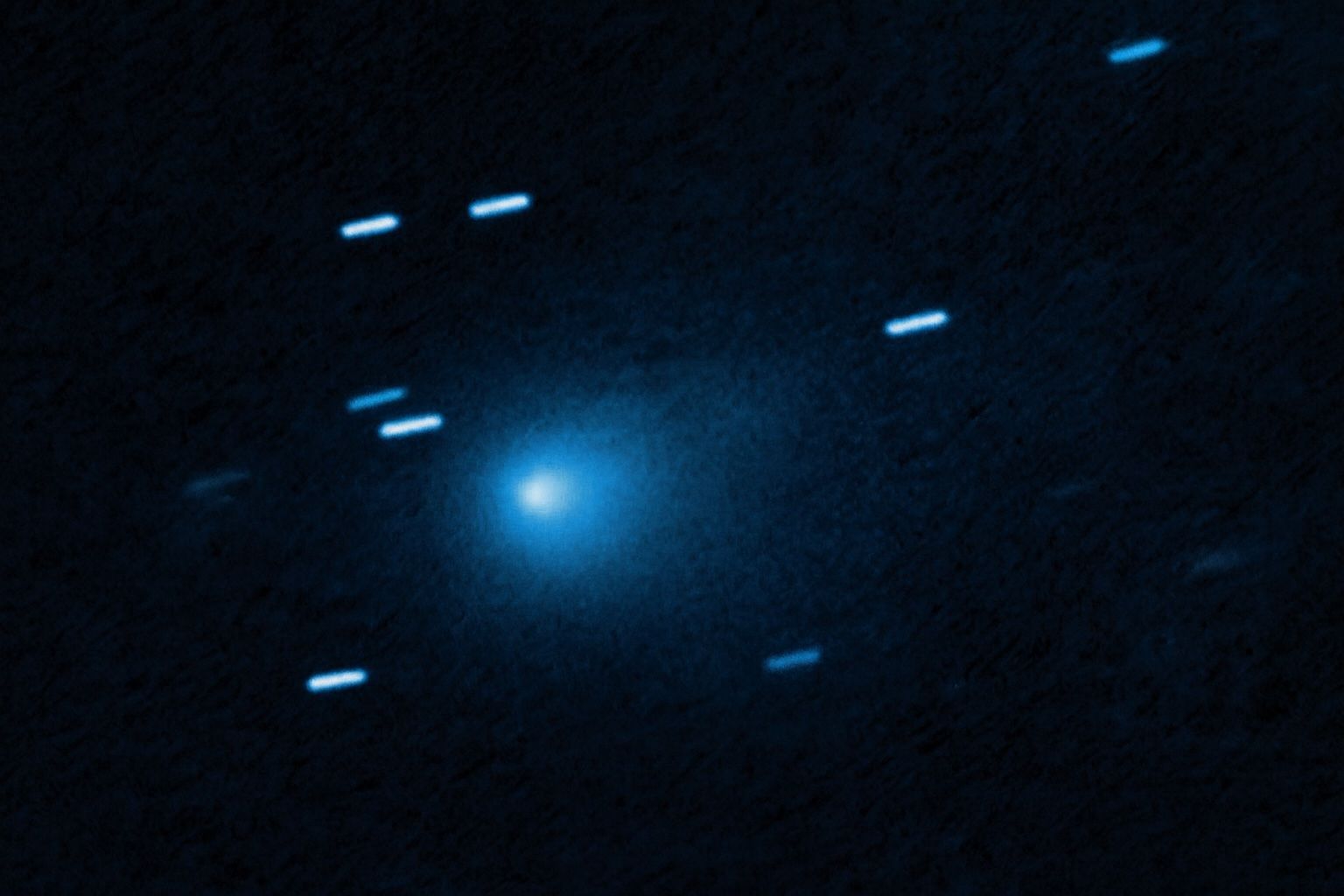
Spectroscopy by JWST and other instruments shows 3I/ATLAS has a typical cometary chemistry. It contains water ice and a high proportion of carbon dioxide – consistent with a frozen comet from another star system abcnews.go.com science.nasa.gov. As it heats up, Hubble even captured a plume of dust streaming off the sunlit side, and a slight dust tail trailing behind. NASA notes that the dust-loss rate is “consistent with comets that are first detected around 300 million miles from the Sun… like the signature of previously seen Sun-bound comets” science.nasa.gov. In short, apart from its interstellar origin and sheer size, 3I/ATLAS behaves like an ordinary comet.
This object is also moving extraordinarily fast. It entered the Solar System at about 61 km/s (137,000 mph), increasing as it falls inward science.nasa.gov. Hubble confirms a speed around 130,000 mph (209,000 km/h) – by far the highest velocity recorded for any solar system visitor science.nasa.gov. Jewitt et al. explain that such a “breathtaking sprint” implies 3I/ATLAS has drifted for billions of years through interstellar space, gaining speed from many stellar flybys science.nasa.gov.
Spacecraft and Telescopic Observations
Scientists worldwide are using every available tool to study 3I/ATLAS. NASA’s James Webb Space Telescope observed it in early August with its infrared spectrograph foxweather.com science.nasa.gov. New SPHEREx data (from Aug. 7–15) are under analysis. In late September, NASA’s Hubble snapped the sharpest images yet, revealing that telltale cocoon of dust and confirming the size limits science.nasa.gov science.nasa.gov. Ground telescopes (like the Vera C. Rubin Observatory) and amateur astronomers are tracking it until it slides behind the Sun at month’s end foxweather.com science.nasa.gov.
Several spacecraft in the inner solar system may get a look. 3I/ATLAS will pass Mars on Oct. 3, 2025 science.nasa.gov – though still millions of miles away – meaning Mars orbiters (Mars Reconnaissance, Curiosity, Perseverance) could attempt observations. Later, in March 2026 it will skim near Jupiter’s orbit, possibly within reach of NASA’s Juno or future Europa missions. All such encounters are being planned as opportunities to sample this interstellar comet from different angles foxweather.com science.nasa.gov.
Experts Weigh In: Aliens vs. Comet
Speculation exploded when Harvard astrophysicist Avi Loeb suggested that 3I/ATLAS’s unusual orbit might be more than coincidence. Loeb pointed out that the chance of a randomly arriving object passing so close to Mars, Venus and Jupiter is extremely low (“one in 20,000”) hindustantimes.com. He noted other oddities – for example, this comet shows a bright coma in front of the nucleus rather than a typical trailing tail, which he calls “quite surprising” hindustantimes.com. In a Fox News interview, Loeb even raised the possibility the trajectory was “designed” for a mission: “Maybe the trajectory was designed,” he said. “If it had an objective… to be on a reconnaissance mission… to monitor those planets… it seems quite anomalous.” hindustantimes.com.
In a blog post Loeb wrote: “Is 3I/ATLAS…an unusually massive comet with an unusual chemical composition on an unusually rare trajectory or alien technology?” He cautioned that composition alone (“the skin”) won’t resolve the question foxweather.com. If 3I/ATLAS were found to be technological, he added, “it would obviously have a big impact on the future of humanity… We have to decide how to respond.” hindustantimes.com.
However, most astronomers urge caution. NASA scientists emphasize that 3I/ATLAS is behaving like a normal comet and “poses no threat to Earth” science.nasa.gov. David Jewitt (UCLA), leader of the Hubble team, put it plainly: “No one knows where the comet came from. It’s like glimpsing a rifle bullet for a thousandth of a second. You can’t project that back with any accuracy” science.nasa.gov. He also noted that 3I/ATLAS is likely part of a larger, previously undetected population of interstellar objects, made visible only now thanks to powerful sky surveys science.nasa.gov.
In short, while Loeb’s provocative claims have grabbed headlines, the evidence so far fits a gigantic icy comet. A Houston Chronicle analysis explains that most astronomers dismiss alien speculation, even as they agree the find is extraordinary chron.com. As ABC News reports, Webb and Hubble data confirm it’s rich in CO₂ and water ice – “behaving like a typical comet in composition” abcnews.go.com – and Loeb’s own blog conceded it will not collide with Mars but pass well outside Mars’s orbit on Oct. 3 abcnews.go.com.
Public Buzz and Next Steps
The idea of an incoming interstellar visitor has even rippled into pop culture. One Maine pub humorously invited patrons to a Halloween “alien costume” party, joking “we want to be stylish when they [visitors] show up!” after reading that 3I/ATLAS will be closest to the Sun on Halloweenpenbaypilot.com. Social media buzz and news sites have dubbed the object everything from a “Manhattan-sized alien probe” to a “mysterious visitor.”
In reality, scientists remain focused on data. Over the next weeks, 3I/ATLAS will sink into the Sun’s glare (becoming unobservable by late September foxweather.com), and then re-emerge in December for one final observing window. Those observations – plus any serendipitous spacecraft encounters – will help pin down its orbit, composition and structure. For now, the verdict is that 3I/ATLAS is a cosmic heavyweight comet, not an alien spaceship. As Jewitt concludes, “This latest interstellar tourist is one of a previously undetected population of objects bursting onto the scene…” science.nasa.gov, a testament to our growing ability to spot strange travelers from the depths of space. Whether it’s a test for SETI or just another big comet, it’s sure to expand our understanding of the galaxy we call home.
Sources: Official NASA releases and FAQs science.nasa.gov science.nasa.gov science.nasa.gov; major news reports foxweather.com chron.com abcnews.go.com hindustantimes.com; and expert commentary hindustantimes.com science.nasa.gov.
Related articles: Space