
Singapore’s stock market opened the week on a firmer footing on Monday, 24 November 2025, as investors cheered a stronger growth outlook, ongoing MAS–SGX reforms and renewed hopes for US interest-rate cuts—while shrugging off a surprise jump in inflation.
The benchmark Straits Times Index (STI) climbed 27.49 points, or 0.62%, to close at 4,496.63, recovering part of last Friday’s 1% slide.
Across the broader market, 336 stocks rose versus 238 decliners, with about 2.1 billion securities worth S$3.2 billion changing hands. The iEdge Singapore Next 50 Index, which tracks large stocks just below the STI, fell 1.2% to 1,438.67, underscoring rotation into blue chips.
Regionally, Singapore’s gains came amid mixed Asian trading: Hong Kong and Sydney advanced, while South Korea’s Kospi eased, as investors digested relief over potential US rate cuts after a bruising week for global tech names.
Market snapshot: Singapore stock market on 24 November 2025
Key numbers at a glance (Monday, 24 Nov 2025)
- STI close: 4,496.63
- Change: +27.49 points (+0.62%)
- Day’s range: 4,459.83 – 4,504.48 Investing.com+1
- Previous close (Fri 21 Nov): 4,469.14 (−1.0% that day) The Straits Times+1
- Market breadth: 336 gainers vs 238 losers
- Turnover: 2.1 billion securities, S$3.2 billion traded The Business Times+1
- iEdge Singapore Next 50 Index: 1,438.67 (−1.2%) The Business Times+1
After Friday’s risk-off session driven by concerns over an AI valuation bubble and turbulence in Japanese bonds, which pulled the STI down 1% to 4,469.14, Monday’s gains clawed back roughly two-thirds of that loss.
Blue chips largely did the heavy lifting, while mid-caps and second-line names, represented by the iEdge Singapore Next 50, took a breather despite policy initiatives aimed squarely at that segment.
Policy tailwinds: MAS–SGX reforms remain in focus
Monday’s session unfolded against a backdrop of sweeping reforms unveiled on 19 November by the Monetary Authority of Singapore (MAS) and Singapore Exchange (SGX) to revitalise the local equity market.
Key elements include:
- SGX–Nasdaq dual‑listing bridge:
A new framework will allow eligible Asian growth companies (market cap ≥ S$2 billion) to list concurrently on SGX and Nasdaq using a single prospectus, cutting duplication and cost. The “dual-listing bridge” is expected to go live around mid‑2026. Reuters+1 - S$5 billion Equity Market Development Programme (EMDP):
MAS named a second batch of six asset managers—including BlackRock, Lion Global Investors, Eastspring and Manulife Investment Management—bringing total allocations to nearly S$4 billion, with S$2.85 billion earmarked in this latest tranche to be deployed into Singapore-listed stocks. - “Value Unlock” and research grants:
A S$30 million fund will support companies in improving strategy and investor-relations efforts, while the Grant for Equity Market Singapore (GEMS) is being enhanced with additional per‑report funding to expand equity research coverage. The Straits Times - Microstructure upgrades:
SGX is cutting board lot sizes from 100 to 10 shares for stocks above S$10 to make blue chips more accessible, and is shifting further towards a disclosure-based regime, consolidating listing functions under SGX RegCo to streamline the process.
According to an ST “Market Insights” piece published early Monday, the measures have already helped lift liquidity and turnover, with average daily trading value on SGX up about 16% year-on-year in Q3 2025, while the STI has climbed from around 3,739 in November 2024 to above 4,500 this month. The Straits Times+1
Investor reaction remains constructive. Phillip Securities’ head of research Paul Chew highlighted the sharp GDP forecast upgrade and MAS fund allocations as “positive news” for Singapore equities, noting that liquidity is now tilting towards small and mid-cap counters—with room for valuations to catch up after years of neglect. The Business Times+2The Business Times+2
Top movers: Jardine Matheson rockets, SGX lags, banks stay mixed
Jardine Matheson steals the show
The standout performer on the STI was Jardine Matheson Holdings, which jumped 8.7% (US$5.41) to US$67.56, making it the index’s top gainer.
The surge extended a re‑rating that began after:
- The group reported that its Q3 2025 performance was “in line with expectations”, maintaining full‑year profit guidance and emphasizing continued de‑leveraging of its balance sheet. The Business Times
- Subsidiaries such as DFI Retail (which runs 7‑Eleven in Singapore) delivered a 48% year‑on‑year rise in underlying profit, while Mandarin Oriental continued to benefit from a post‑pandemic travel rebound.
- Jardine Matheson is pressing on with a US$250 million buyback and a move to fully privatise Mandarin Oriental, sharpening focus on shareholder returns.
With the stock having closed at US$62.15 on Friday, investors appear to be reassessing its conglomerate discount as balance-sheet risks ease and asset‑recycling delivers cash back to shareholders.
Singapore Exchange: policy winner, price laggard
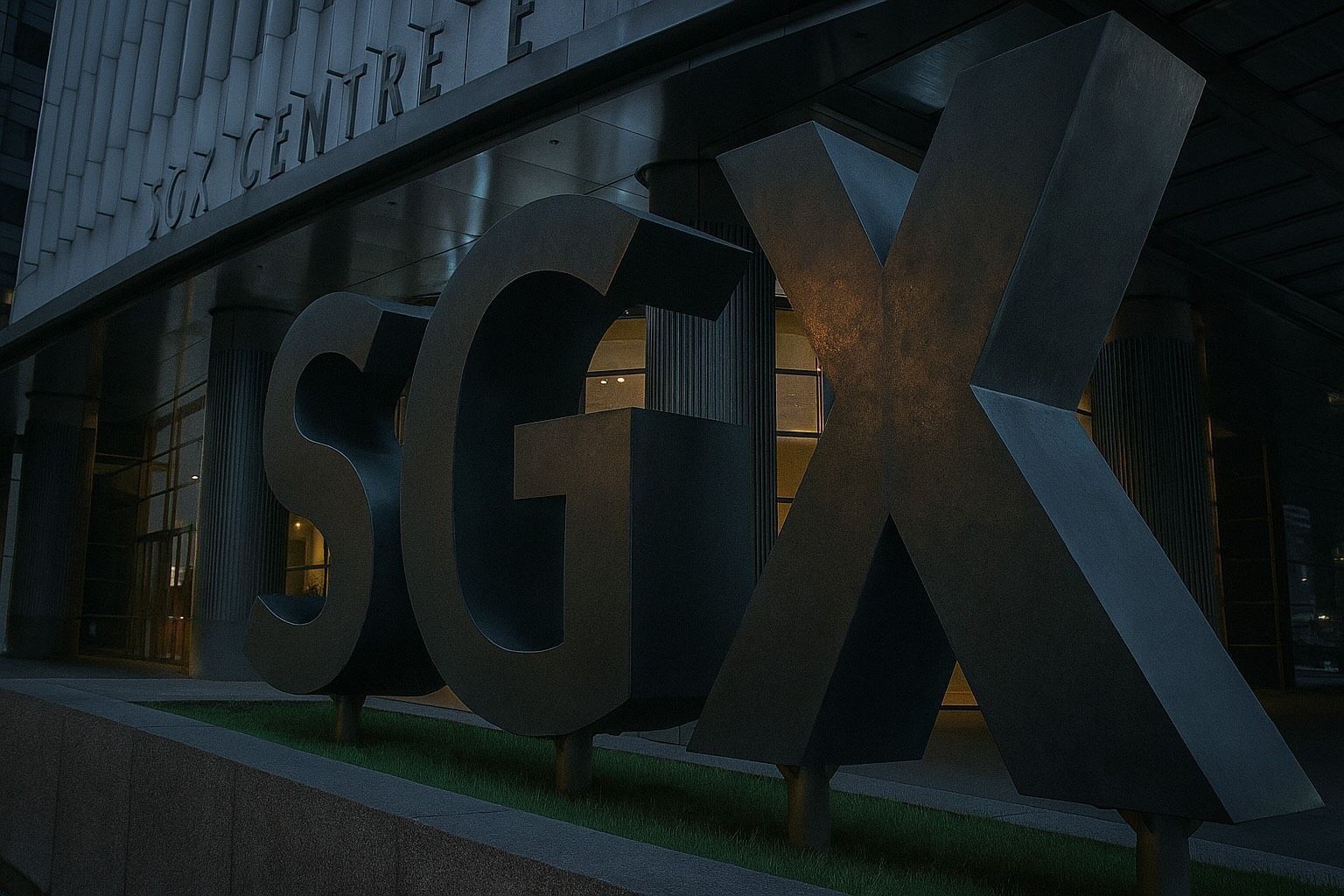
Ironically, Singapore Exchange (SGX) was the worst performer on the STI, slipping 1.1% to S$16.54 despite being at the centre of MAS’s new reform push.
Last week, SGX rallied after MAS announced the dual‑listing bridge and fresh allocations to equity funds, but ST notes that the stock had already climbed from S$16.80 to above S$17 before easing back.
Commentary from independent market write‑ups suggests Monday’s decline looked more like short‑term profit‑taking and “sell‑the‑news” positioning than a verdict on the reforms themselves. A TS2.Tech market wrap pointed out that there was “no obvious crypto effect” yet from SGX’s new Bitcoin and ether derivatives (see below), even though they provide another structural growth lever for the exchange. TS2 Tech+2TS2 Tech+2
Local banks: steady rather than spectacular
The three domestic lenders turned in muted moves:
- OCBC: up 0.1% to S$18.08
- UOB: up 0.1% to S$33.89
- DBS: down 0.5% to S$53.38 The Business Times+1
After last week’s tech‑led wobble in global markets, bank shares appear to be consolidating near multi‑year highs, balancing the tailwind of higher-for-longer loan yields against the prospect of slower global growth into 2026.
Small and mid-caps: selective interest
While the Next 50 index fell, select mid-caps still outperformed. Finimize highlighted:
- BRC Asia, which gained almost 2% despite reporting slimmer half‑year profits.
- Marco Polo Marine and GDS Global, which climbed roughly 3% and 4%, respectively, on turnaround earnings momentum in infrastructure and engineering.
That pattern aligns with MAS’s intent for its Equity Market Development Programme and MAS‑appointed funds (including two new small/mid‑cap vehicles from Amova) to channel more capital into under‑researched mid-sized counters, potentially laying the groundwork for a broader re‑rating over time.
Macro backdrop: US rate‑cut hopes boost Asia
Singapore’s rally was part of a wider Asian equity rebound.
An AFP/Business Times report noted that stocks across Asia and Europe rose on Monday as hopes for US interest-rate cuts helped soothe nerves after a “torrid week” for markets. Hong Kong and Seoul gained more than 1%, while Sydney, Singapore, Wellington and Taipei also advanced; Shanghai and Manila lagged. The Business Times+2netdania.com+2
The backdrop:
- Wall Street staged a sharp rebound late last week, with the S&P 500 up around 1.6% and the Nasdaq surging 2.7% as investors bet the US Federal Reserve could cut rates as early as December.
- Those moves spilled over into Asian risk assets, helping the STI extend a rally that has already pushed it above the 4,500 level for the first time in roughly a decade, according to several market commentaries.
For Singapore, external optimism intersected with domestic tailwinds—namely, upgraded growth forecasts and structural equity‑market reforms—which together provided a supportive backdrop for Monday’s gains.
GDP upgrade vs inflation surprise: what the data say
Growth: 2025 outlook raised to “around 4%”
Just three days before Monday’s session, Singapore released stronger‑than‑expected Q3 2025 GDP numbers:
- Q3 GDP: +4.2% year‑on‑year, up from the 2.9% advance estimate and above economists’ 4.0% consensus.
- On a quarter‑on‑quarter basis, the economy grew 2.4%, signalling broad‑based momentum.
On the back of this, the Ministry of Trade and Industry upgraded its 2025 GDP growth forecast to “around 4.0%”, from a previous range of 1.5–2.5%, citing resilient global demand, especially for AI‑related electronics and biomedical exports. Reuters+2The Straits Times+2
For 2026, growth is now projected in a more modest 1–3% range, with officials flagging risks from trade tensions and a possible slowdown in AI‑driven capital expenditure.
These upgrades have clearly buoyed equity sentiment: ST notes that the STI’s rise from around 3,739 to above 4,500 over the past year reflects both Singapore’s economic “depth and diversity” and improved liquidity and listing activity on SGX. The Straits Times+1
Inflation: core CPI jumps to 1.2% in October
On Monday morning, investors also had to digest hotter‑than‑expected inflation data:
- Core inflation (excluding accommodation and private transport) rose 1.2% year‑on‑year in October, up from 0.4% in September and above economists’ median forecast of 0.7%.
- Headline CPI likewise printed at 1.2%, exceeding consensus expectations of 0.9%.
Channel NewsAsia reported that the jump was driven largely by higher prices for services, food and retail items, along with a smaller decline in electricity and gas tariffs.
Even so, MAS has kept its monetary policy setting unchanged, and still expects core inflation to average around 0.5% for 2025, with headline inflation between 0.5–1.0%.
Market reaction was surprisingly calm. A Finimize note framed Monday’s STI gain as evidence that rate‑cut optimism and solid corporate earnings outweighed discomfort over the uptick in prices, with investors taking comfort that Singapore’s inflation remains low by global standards.
SGX’s new Bitcoin and Ethereum perpetual futures: structural shift, not day‑one fireworks
Another important development sitting in the background of Monday’s trading: SGX Derivatives’ launch of institutional‑grade crypto perpetual futures.
- SGX is introducing Bitcoin and Ethereum perpetual futures, benchmarked to the iEdge CoinDesk Cryptocurrency Indices, aimed at professional and institutional investors.
- The contracts have no expiry, settling through a funding‑rate mechanism and cleared through SGX’s central clearing house—bringing offshore‑style perpetuals into a regulated, exchange‑traded environment in Asia.
- SGX and several commentary pieces pitch the move as part of the “institutionalisation” of crypto trading, offering traditional clearing and margining standards to a market where global perpetual volumes exceed US$180 billion a day. Structured Retail Products+2The Business Times+2
The contracts began trading on 24 November, but as one market write‑up noted, there was no obvious “crypto effect” in Monday’s equity session, with SGX’s own shares actually ending lower on profit‑taking. TS2 Tech+2TS2 Tech+2
Still, for SGX’s longer‑term story, the launch adds another growth avenue in derivatives, aligning the exchange with MAS’s broader ambition to keep Singapore competitive as a regulated digital‑asset hub while maintaining robust investor protection.
IPO pipeline and mid‑cap revival: signs of life beyond the STI
MAS’s equity‑market review isn’t only about the STI. It’s also about re‑energising the lagging mid‑cap space and listing pipeline.
The Straits Times reports that:
- Singapore’s IPO proceeds have already surpassed US$1.6 billion across nine deals in the first 10½ months of 2025, the strongest showing since 2019, making SGX the regional leader in IPO proceeds this year.
- Upcoming listings include UltraGreen.ai, a medical imaging and AI‑surgery company seeking around US$400 million in a mainboard IPO scheduled for early December—one of the largest non‑REIT deals in recent years.
At the same time, a Business Times feature on “making SGX small and mid‑caps great again” points out that roughly 240 smaller counters remain under‑owned despite decent fundamentals, and argues that the nine MAS‑appointed EMDP funds could catalyse a sustained re‑rating if they meaningfully increase liquidity and research coverage. The Business Times+2ShareInvestor+2
Monday’s trading—where large caps led the index while select industrial and marine names like BRC Asia and Marco Polo Marine gained on company‑specific news—offered a glimpse of how policy support and stock‑picking may increasingly interact in the months ahead.
What investors will be watching next
Looking beyond Monday’s close, several themes are likely to guide Singapore’s stock market:
- US data and Fed timing
- Upcoming US releases—such as retail sales and producer price data later this week—will feed into expectations for a December or early‑2026 Fed rate cut, which in turn influence flows into Asian and Singapore assets.
- Whether inflation pressure persists
- If Singapore’s inflation remains around 1–1.5% and within MAS’s projections, markets may continue to view it as manageable. A string of upside surprises, however, could revive talk of tighter policy or delay in easing, which would matter for rate‑sensitive banks and REITs.
- Execution of MAS–SGX reforms
- Investors will track how quickly the EMDP funds deploy capital, how effective the Value Unlock grants are in improving corporate engagement, and whether the dual‑listing bridge actually attracts high‑growth Asian names back to SGX.
- Crypto derivatives traction
- Trading volumes in SGX’s new Bitcoin and Ethereum perpetuals may become a barometer of how successfully the exchange can tap demand for regulated crypto exposure—and whether that spills over into valuations of SGX itself.
- Sector rotation within the STI
- With the STI hovering just below 4,500, some strategists argue the index is shifting from a purely yield‑and‑banks story toward a broader mix including industrial, consumer, tech‑adjacent and digital‑asset proxies. Whether that rotation sticks will depend on incoming earnings and global risk appetite.
Bottom line
For 24 November 2025, Singapore’s stock market story is one of cautious optimism:
- A 0.6% rise in the STI reflects the pull of policy support and a stronger growth trajectory, even as inflation surprises to the upside and global markets remain volatile.
- Jardine Matheson’s surge, the mixed showing from banks, and SGX’s pullback underscore that investors are still discriminating between structural winners and short‑term hype.
- In the background, crypto derivatives, a revived IPO pipeline, and targeted support for small and mid‑caps suggest that the shape of Singapore’s market could look quite different a year from now—if the reforms deliver and global conditions cooperate.
For now, Monday’s session keeps the STI comfortably above the 4,400–4,500 band and reinforces Singapore’s positioning as a steadier, policy‑anchored play in a still‑nervy global equity landscape.
Note: This article is for informational purposes only and does not constitute investment advice. Always do your own research or consult a licensed adviser before making investment decisions.
Related articles: Stock Market