
VANCOUVER, British Columbia, August 10, 2026, 14:21 EDT — Trading on U.S. stock exchanges was still underway.
- AbCellera stock rose 37.5% to $9.53 as of 13:58 EDT.
- After receiving a single dose of ABCL635, hot-flash frequency decreased by 83%, while those given placebo saw a 33% decline.
- The rise in share price raised market capitalization by about $797 million.
Shares of AbCellera Biologics Inc. NASDAQ:ABCL jumped 37.5% after the company announced its menopause therapy met both primary endpoints in a Phase 2 study. The stock was last trading at $9.53 at 13:58 EDT, having earlier reached a session high of $10.01.
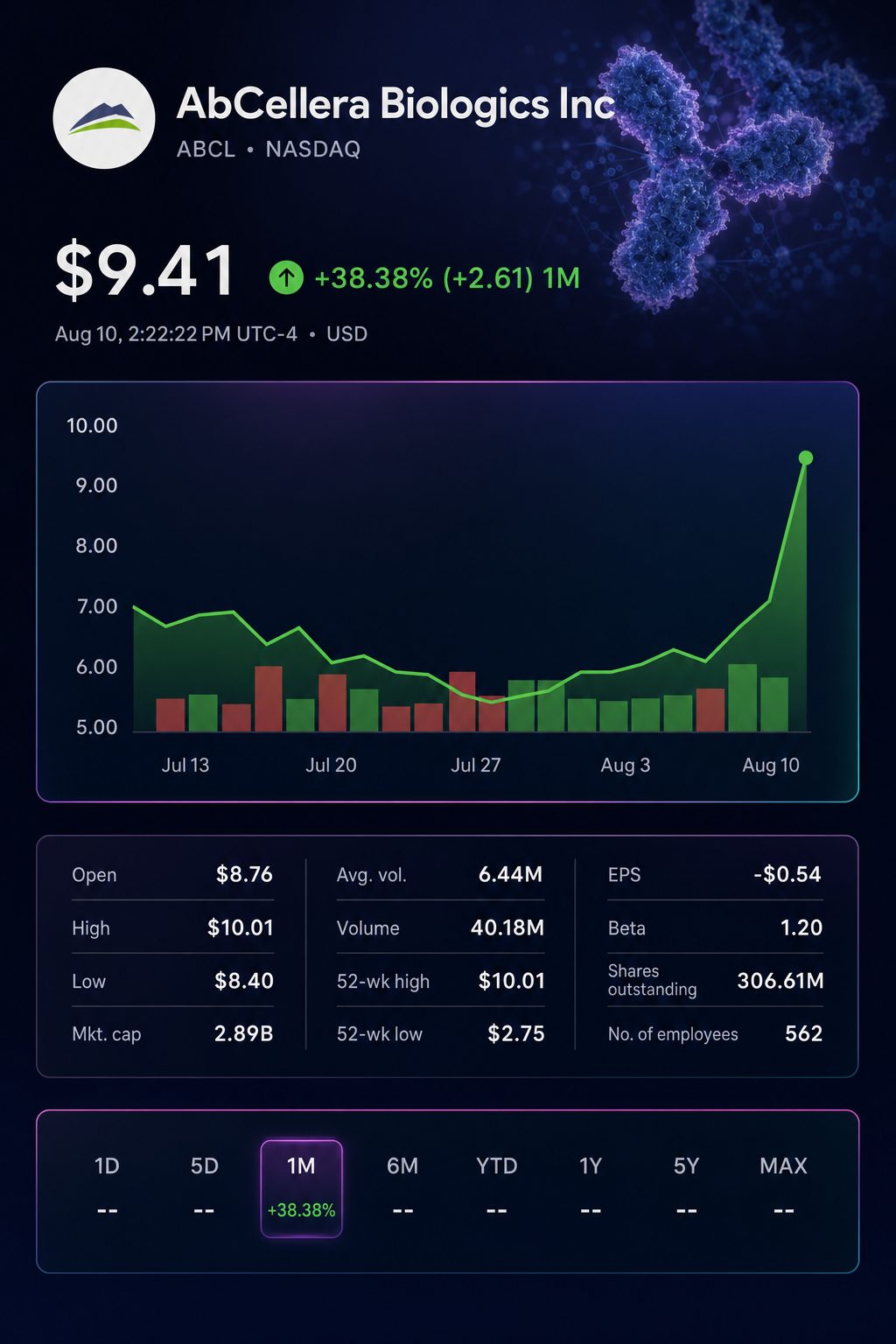
Market reaction saw investors assign notable value to one early-stage asset. With shares rising $2.60 each and 306.61 million shares outstanding, the increase equates to around $797 million—18% above AbCellera’s declared liquidity floor of over $675 million.
| Market and balance-sheet metric | Latest value | Investor context |
|---|---|---|
| Share price at 13:58 EDT | $9.53 | Up $2.60, or 37.52% |
| Intraday high | $10.01 | Set a new 52-week high |
| Market capitalization | $2.94 billion | Roughly 4.4 times the minimum liquidity threshold |
| Trading volume | 38.47 million | Approximately 6.0 times its average volume |
| Calculated value added | $797.2 million | $2.60 gain multiplied by 306.61 million shares |
| Available liquidity | More than $675 million | According to company disclosure as of June 30 |
Market data and share figures are provided by Google Finance’s intraday service. AbCellera reported on August 5 that its available liquidity exceeded $675 million. For the second quarter, the company posted a net loss of $55.4 million and reported revenue of $4.1 million.
The study included 92 postmenopausal women, all experiencing around 10 moderate to severe hot flashes daily on average. Half of the participants, 46 women, received a one-time 600 mg subcutaneous injection, and the other 46 were administered a placebo.
| Week-four Phase 2 measure | ABCL635 | Placebo | Placebo-adjusted result |
|---|---|---|---|
| Daily event reduction | 8.8 | 3.5 | 5.3; p<0.001 |
| Frequency reduction | 83% | 33% | 50 percentage points |
| Severity score reduction | 58% | 12% | 46 percentage points; p<0.001 |
| Symptoms rated much or moderately improved | 84% | 27% | 57 percentage points |
| Adverse event (any) | 67.4% | 52.2% | 14.2 percentage points higher |
| Serious or grade 3-plus adverse event | 0 | One serious; two grade 3 | Top-line, four-week data |
Both primary endpoints achieved statistical significance. According to the company’s SEC presentation, benefits began to appear in the first week and persisted through week four. Sleep scores also increased by 5.5 points over placebo.
BMO Capital Markets analyst Evan Seigerman, from Bank of Montreal NYSE:BMO, called the result “transformational,” Reuters reported. The assessment relies on Seigerman’s forecast, not on head-to-head data or results from a final-stage trial. Reuters
Dr. JoAnn V. Pinkerton of the University of Virginia highlighted an important point. “If validated in Phase 3, ABCL635 could offer a new treatment option with a more convenient dosing regimen and potentially less toxicity.” SEC Exhibit 99.1
User convenience is part of the investment case. ABCL635 demonstrated effects persisting for four weeks after just one injection. Astellas Pharma Inc. (TYO:4503) sells Veozah as a 45 mg pill taken daily. Bayer AG’s (ETR:BAYN) Lynkuet is administered as a 120 mg tablet per day.
These comparisons are drawn from separate trials, not from direct head-to-head studies. The trials differed in terms of their populations, trial phases, and study protocols. AbCellera has also warned that making such comparisons could be misleading.
Stifel Financial Corp. NYSE:SF analyst Stephen Willey previously assigned a $9 price target for the stock—below its afternoon trading value. Willey set this target before the announcement of the Phase 2 results.
Preliminary safety data did not provide definitive results. No serious or severe adverse events occurred among participants administered ABCL635. Headaches were observed in 28.2% of the ABCL635 group, versus 13.0% among those receiving placebo. One participant in the treatment arm experienced a mild rise in liver enzyme levels, which normalized in less than a week. The duration of treatment exposure was four weeks.
| Analyst and firm | Latest action | Rating | Price target |
|---|---|---|---|
| Srikripa Devarakonda, Truist Financial NYSE:TFC | Reaffirmed Aug. 10 | Buy | Not listed |
| Allison Bratzel, Piper Sandler NYSE:PIPR | Reiterated Aug. 7 | Buy | $12 |
| Steven Seedhouse, Cantor Fitzgerald | Reconfirmed Aug. 5 | Buy | $12 |
| Stephen Willey, Stifel Financial NYSE:SF | Reiterated Aug. 6 | Buy | $9 |
| Brendan Smith, TD Cowen, part of Toronto-Dominion Bank NYSE:TD | Maintained Aug. 5 | Buy | Not listed |
| Debanjana Chatterjee, JonesTrading | Reiterated July 29 | Buy | $13 |
| Evan Seigerman, BMO Capital Markets, part of Bank of Montreal NYSE:BMO | Reiterated June 17 | Buy | $7 |
All analysts tracked by Google Finance assigned a Buy rating to the stock. The average price target was $10.60, reflecting an 11.2% upside from the present $9.53 level. Price targets, which range from $7 to $13, reflect a wide range of opinions regarding the firm’s clinical outlook.
Risks: These results are based on preliminary figures from 92 patients after four weeks of double-blind observation. Efficacy could be weaker in Phase 3, new safety concerns could arise, or dosing could prove less convenient. Regulatory reviews may take longer, and higher late-stage costs could lower the current perceived value of the program.
The full 12-week follow-up assessment is upcoming. AbCellera is arranging regulatory discussions regarding late-stage development, and intends to disclose more findings at medical conferences later this year. These disclosures are necessary to support the durability already factored into the share price.