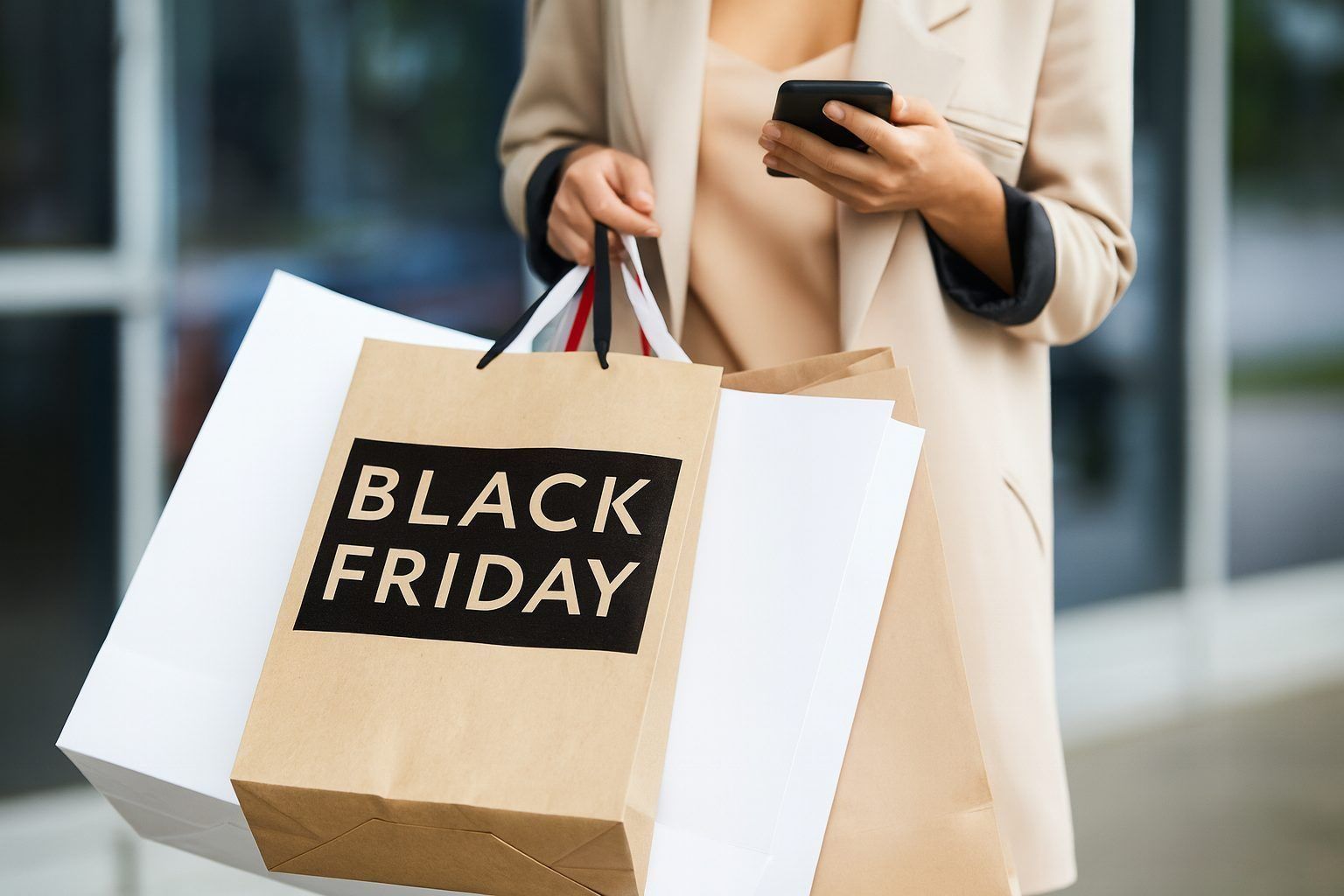

U.S. shoppers just delivered the biggest digital Black Friday on record, spending $11.8 billion online in a single day, even as high prices, weak consumer sentiment and a soft labor market weigh on household budgets.
Early data from Adobe Analytics, Mastercard, Salesforce and the National Retail Federation (NRF) shows a holiday season that looks strong on the surface — but is increasingly powered by AI shopping tools, higher prices, and “buy now, pay later” (BNPL) financing, rather than a broad-based spending boom. AP News+3Reuters+3AP News+3
Below is a breakdown of what we know as of November 30, 2025, and what it signals for Cyber Monday and the wider U.S. economy.
Record Black Friday Online Sales: $11.8 Billion in a Single Day
Final figures from Adobe Analytics show that American consumers spent $11.8 billion online on Black Friday, about 9.1% more than in 2024 – roughly $1 billion of additional spend year over year.
Key “by the numbers” takeaways:
- $11.8 billion in U.S. online sales on Black Friday (record high)
- +9.1% year-on-year digital growth
- $6.4 billion spent online on Thanksgiving Day, also a record AP News+1
- Mobile devices accounted for more than half of online purchases, according to Adobe.
Other analytics firms confirm the surge:
- Salesforce estimates U.S. consumers spent $18 billion online on Black Friday and around $79 billion globally, including groceries and other everyday items.
- Shopify merchants worldwide recorded $6.2 billion in sales, another all‑time high for the platform.
Popular Black Friday categories included electronics, gaming consoles, toys, luxury apparel, accessories, cosmetics and clothing, with brands such as LEGO, Apple and major beauty labels featuring prominently across several datasets.
Stores See Only Modest Gains as Shoppers “Click, Not Queue”
While online spending surged, the brick‑and‑mortar picture is more mixed.
Data from Mastercard SpendingPulse — which tracks both in‑store and online sales — shows that overall Black Friday retail sales excluding autos rose about 4.1% from last year. That’s an improvement on 2024’s roughly 3.4% gain but still suggests modest real growth once inflation is considered.
Mastercard’s breakdown:
- E‑commerce sales: up 10.4%
- In‑store sales: up only 1.7% Reuters+2Axios+2
Foot‑traffic readings tell a nuanced story:
- Pass‑by Analytics found store visits up about 1.2% from last year, indicating that shoppers still came out for deals.
- By contrast, RetailNext’s early data suggested a roughly 3.6% decline in physical visits versus 2024, though the drop was smaller than in the days leading up to Thanksgiving.
Put simply: Main Street isn’t empty, but the real action is online — and total dollars are being propped up more by higher prices than by a flood of extra items flying off shelves.
AI Shopping Assistants Quietly Take Over Black Friday
One of the biggest under‑the‑radar stories of Black Friday 2025 is how AI shopping tools have moved from novelty to infrastructure.
Adobe reports that AI‑driven traffic to U.S. retail websites soared more than 800% compared with last year, as shoppers increasingly relied on chatbots and generative search tools to discover products and compare prices.
Retailers deploying AI‑powered helpers include:
- Walmart, with its “Sparky” shopping assistant
- Amazon, with its generative AI helper “Rufus”
- A growing universe of retailer and brand chatbots layered into apps and websites Reuters+1
Meanwhile, Salesforce estimates that AI agents influenced about $14.2 billion in global online sales on Black Friday, including roughly $3 billion in the U.S. alone.
Analysts say AI is doing three things for Black Friday:
- Shortening the path to purchase – Tools can jump straight from “I need a gift for my teenager who likes Nintendo” to curated product lists. Reuters+1
- Price‑matching at scale – Generative systems can scan multiple sites for the best deal, eroding the advantage of any single retailer’s promo.
- Personalizing promotions – Retailers can target discounts to high‑value shoppers or specific segments, instead of blunt, store‑wide markdowns.
The result: Consumers feel more empowered and efficient, but the same technology also lets retailers keep discounts narrower — which is part of why many shoppers say this year’s deals didn’t feel quite as spectacular as the headlines.
Higher Prices, Tariffs and Inflation Are Doing Much of the “Work”
Behind the record revenue totals is a less festive reality: many Americans are paying more, not buying more.
Salesforce’s transaction‑level data, echoed by several outlets, highlights a telling pattern: Digital Commerce 360+3Reuters+3SAMAA TV+3
- Order volumes fell around 1% year on year
- Average selling prices rose roughly 7%
- Units per transaction dropped about 2%
In other words, people are placing slightly fewer orders and buying fewer items per order, but spending more overall because prices are higher.
Economists and retail analysts point to several drivers:
- Tariffs: New and increased tariffs on imported goods, especially discretionary categories like electronics and apparel, are pushing prices up.
- Stubborn inflation: Grocery price growth has slowed, but food costs are still around 18% higher than in early 2022, leaving less room for holiday splurges.
- Soft labor market: Unemployment is hovering near a four‑year high, and wage growth has cooled, particularly for lower‑income households.
That combination explains a key paradox:
Black Friday 2025 looks strong in dollars, but weaker in real volume.
Some analysts argue that the “real” value of Black Friday deals has eroded, as flat‑to‑slightly higher discount rates collide with higher base prices. Consumers often walk away feeling that promotions are less generous, even when the sale banners look familiar to last year. Reuters+2StreetInsider.com+2
Spending Is Increasingly Split by Income
Several pre‑holiday reports from Bank of America, Visa and Deloitte all pointed to a widening gap between higher‑income households and everyone else:
- Affluent shoppers are still spending aggressively, particularly on luxury apparel, accessories and travel‑adjacent items.
- Middle‑ and lower‑income households are stretching to keep up, trading down to cheaper brands, chasing deeper discounts and leaning harder on credit and BNPL services.
Deloitte’s pre‑Thanksgiving survey even suggested that planned holiday spending could decline year over year for the first time since 2020, a sign of how tight many budgets feel after years of elevated inflation.
So far, the actual sales data has beat those cautious intentions, but in a way that is “top‑heavy” — with wealthier consumers accounting for a disproportionate share of the growth.
The Rise — and Risk — of “Buy Now, Pay Later”
One big pressure valve for strained budgets is “buy now, pay later” (BNPL).
Across the 2025 holiday season, Adobe expects BNPL spending to reach about $20 billion, up roughly 11% from 2024.
Black Friday alone saw:
- Around $747 million in online BNPL purchases, an 8–9% increase versus last year.
BNPL is especially popular with Gen Z and millennials, who use services such as Klarna, Afterpay, PayPal and Affirm to spread payments over weeks or months, often interest‑free.
But financial regulators and credit experts are sounding louder warnings this year:
- A LendingTree survey found about 4 in 10 BNPL users made at least one late payment in the past year.
- FICO has begun incorporating BNPL data into credit scores, meaning missed payments can now directly damage credit profiles, even though on‑time BNPL payments often aren’t reported as positively.
Articles from outlets including Business Insider, Vox and Yahoo Finance caution that BNPL can mask the true cost of purchases, encouraging shoppers to stack multiple plans across different apps and underestimate how much they’ve committed to pay in January.
In short: BNPL is helping fuel record Black Friday sales — but it’s also creating new “hangover” risks for 2026.
What Black Friday 2025 Tells Us About the U.S. Economy
Economists and Wall Street analysts are poring over these early numbers for clues about the broader U.S. economy.
1. The consumer is still spending — for now
- NRF expects total U.S. holiday retail sales to exceed $1 trillion for the first time, with November–December spending forecast between $1.01 and $1.02 trillion, a gain of 3.7%–4.2% from 2024.
- Adobe projects about $253 billion in U.S. online spending over the holiday period, up roughly 5% from last year.
Together, these forecasts suggest that consumer demand remains resilient, even after years of inflation and higher interest rates.
2. Sentiment is much weaker than spending
Surveys from the Conference Board, Axios/Harris and others show consumer confidence stuck near multi‑year lows, even as spending holds up. Many households report feeling worse off, even when their actual purchases suggest otherwise.
CNN Business, among other outlets, has described this as the “dirty secret” of the holiday shopping season: strong headline sales can coexist with deep anxiety about the cost of living, debt and job security. ABC17NEWS+1
3. Inequality and prices are inflating the top‑line numbers
A growing share of holiday retail growth is being driven by:
- High‑income households buying premium goods and experiences
- Price increases across categories rather than surging unit volumes
- Credit expansion and BNPL, rather than rising real disposable income Barron’s+3Axios+3ASU News+3
That matters for the Federal Reserve, which is watching whether consumption can stay strong without reigniting inflation — and for politicians, who face voters that may see robust sales headlines and feel that those numbers don’t match their own reality.
Winners and Losers Among Retailers and Categories
Even with partial data, early winners and laggards are coming into focus.
E‑commerce platforms and large retailers
- Market‑wide online sales growth in the high single digits clearly benefits mega‑retailers and marketplaces like Amazon and Walmart.
- Both companies have leaned hard into AI‑driven recommendations, fast shipping and integrated BNPL options, reinforcing their dominance.
Retail stocks historically get a post‑Black‑Friday bounce, and 2025 is no exception so far, with companies from discount chains to specialty retailers trading higher on the strong online numbers.
Luxury and beauty
Salesforce and AP note particularly strong demand for luxury apparel, accessories and beauty products, reflecting that high‑income consumers have not pulled back.
Brick‑and‑mortar dependent categories
Store‑heavy sectors — such as some department stores and mid‑tier mall retailers — face tougher comparisons:
- Foot‑traffic gains, if any, are small.
- Online competitors are aggressively discounting and offering more convenient fulfillment options.
Analysts caution that final verdicts on winners and losers will depend on Cyber Monday, the remainder of Cyber Week, and last‑minute “Super Saturday” sales in late December.
What Comes Next: Cyber Monday and the Rest of the 2025 Holiday Season
Black Friday may grab the headlines, but Cyber Monday 2025 is now expected to be even bigger.
Adobe forecasts:
- Cyber Monday online sales of about $14.2 billion in the U.S., up roughly 6% from last year
- Some of the deepest discounts of the season on electronics, potentially reaching around 30% off list prices, along with strong markdowns on computers and apparel Newsweek+3Reuters+3Reuters+3
Across the entire holiday period, Adobe expects U.S. online spending to exceed $250 billion, while NRF and several academic economists, including those at Arizona State University, believe total retail sales will clear the $1 trillion mark despite persistent headwinds such as tariffs, high borrowing costs and political uncertainty.
Metrics to watch in December
As the season unfolds, analysts will be watching:
- Returns and cancellations
- High return rates could signal buyer’s remorse and pressure retailer margins.
- Credit card and BNPL delinquencies
- Rising late payments in early 2026 would confirm that some households over‑extended to keep up holiday traditions.
- Discount depth in late December
- If inventory remains high, retailers may need bigger markdowns around “Super Saturday,” potentially eroding profit even as sales volumes look strong. Digital Commerce 360+1
The Bottom Line
As of November 30, 2025, the emerging Black Friday picture is clear:
- Yes, Americans are still spending — and online, they are spending more than ever.
- Yes, AI and BNPL are making it easier to click “buy” — and quietly reshaping how and when people pay.
- But the impressive revenue totals mask higher prices, widening inequality, and growing dependence on credit‑like tools to support holiday traditions.
For retailers and investors, Black Friday 2025 is a reassuring sign that the holiday shopping machine keeps humming, even through economic jitters. For many households, it may also be the most expensive holiday season they’ve ever experienced — in more ways than one.
Related articles: NYSE:SHOP