
NEW YORK, July 30, 2026, 10:07 EDT Arm Holdings NASDAQ:ARM shares surged after the company reported a fourfold increase in the pace of shipments for its AI cores.
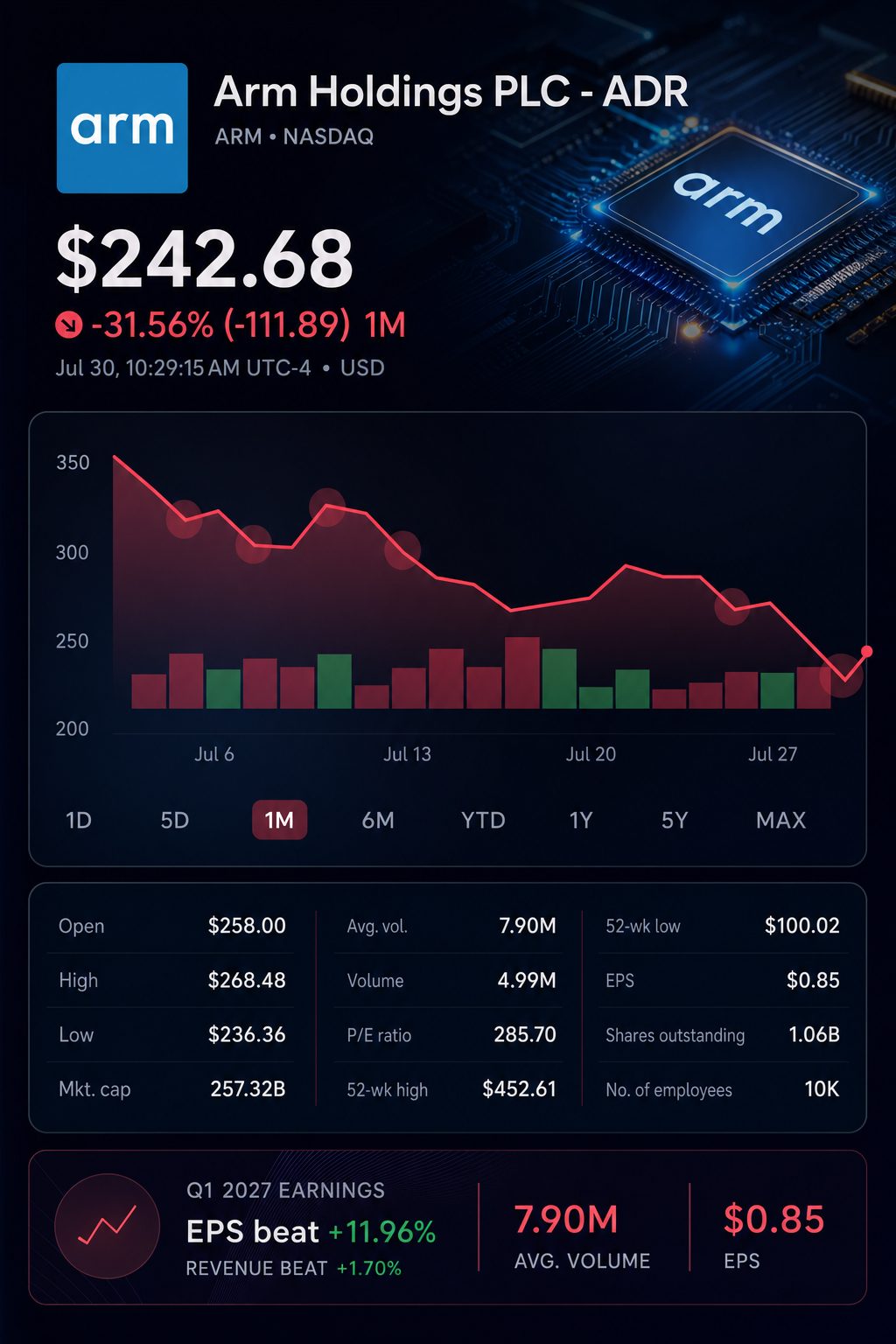
- Shares of Arm climbed roughly 7.1% to $240.96 during early Nasdaq trade.
- Adjusted earnings were 45 cents in the first quarter, with revenue totaling $1.289 billion.
- Arm delivered another 500 million Neoverse cores in just nine months.
Shares of Arm Holdings plc NASDAQ:ARM climbed 7.1% to $240.96 as of 9:52 EDT on Thursday. The stock started the session at $259.79 before giving up part of its advance. It had fallen close to 7% in after-hours trading on Wednesday following its release.
The signal that resonated more with investors was the pace of server shipments rather than the slight earnings outperformance. Arm delivered its most recent 500 million Neoverse cores in just nine months, compared to six years to reach the first billion.
The company’s numbers indicate the annualized shipment rate has quadrupled. Royalty income from data centers more than doubled over the quarter. This growth trend points to a shift in Arm’s revenue dependence away from smartphones.
| Neoverse shipment phase | Cores shipped | Time required | Annualized pace | Relative pace |
|---|---|---|---|---|
| First billion | 1.00 billion | 72 months | 167 million yearly | 1.0x |
| Most recent | 500 million | 9 months | 667 million yearly | 4.0x |
Arm’s disclosures provide the basis for annualized rates, which have been rounded for clarity.
The change is significant as smartphones continue to be the short-term vulnerability. Accelerated server uptake can balance out lower handset shipments and increase the value derived per chip. This also heightens the importance of successful rollout for Arm’s new AGI processor.
Revenue for the quarter to June 30 was $1.289 billion, up 22%. Adjusted earnings rose 29% to 45 cents per share. Both results exceeded the most recent Wall Street consensus estimates.
| First-quarter metric | Arm result | Street consensus | Difference | Beat |
|---|---|---|---|---|
| Revenue | $1.289 billion | $1.260 billion | $29 million | 2.3% |
| Adjusted EPS | $0.45 | $0.40 | $0.05 | 12.5% |
Reuters provided the consensus figures; all percentages represent calculated values.
Profit quality showed more mixed results. The adjusted operating margin increased by 2.1 percentage points to reach 41.2%. According to standard accounting principles, the margin declined by 3.7 points to 7.1%. Research expenditure climbed 29% to $838 million.
| First-quarter metric | Fiscal 2027 | Fiscal 2026 | Change |
|---|---|---|---|
| Total revenue | $1,289 million | $1,053 million | 22% |
| Royalty revenue | $715 million | $585 million | 22% |
| Licensing revenue | $574 million | $468 million | 23% |
| Adjusted operating margin | 41.2% | 39.1% | +2.1 points |
| Standard operating margin | 7.1% | 10.8% | −3.7 points |
| Adjusted free cash flow | $665 million | $150 million | 343% |
Second-quarter forecasts topped consensus as well, but the margins were modest. The revenue midpoint was 3.0% higher than the average analyst forecast. For adjusted earnings, the midpoint was 9.3% above the consensus estimate.
| Second-quarter metric | Arm guidance | Midpoint | Street consensus | Midpoint premium |
|---|---|---|---|---|
| Revenue | $1.33 billion-$1.43 billion | $1.38 billion | $1.34 billion | 3.0% |
| Adjusted EPS | $0.43-$0.51 | $0.47 | $0.43 | 9.3% |
Company midpoints and reported consensus are used to calculate premiums.
Chief Executive Rene Haas stated that as AI inference grows, central processors handle additional tasks. “The more inference workloads you run, that creates work that only CPUs can do,” he told Reuters. Inference refers to the process during which a trained AI system provides responses to questions. Reuters
Arm introduced its AGI CPU in March, marking a shift from design licensing to producing complete chips. Orders have surpassed $2 billion for fiscal years 2027 and 2028. Early shipments have been delivered to multiple clients. Arm has locked in capacity relating to its earlier identified $1 billion opportunity.
Oracle Corporation NYSE:ORCL has committed to purchase the new processor, according to Haas. Analysts at Jefferies Financial Group NYSE:JEF estimate fiscal 2031 sales will reach $18 billion. Arm’s forecast for the same period stands at $15 billion. Both are projections, not actual revenue.
Smartphones continue to be the immediate area of weakness. Arm forecasts a sequential dip in handset royalties for the coming quarter. Finance chief Jason Child pointed to memory shortages as a contributing factor. This caution contributed to the after-hours selloff on Wednesday.
Cash generation remained robust, supported by beneficial collection timing. Adjusted free cash flow increased to $665 million, up from $150 million. Arm pointed to favorable receivable collections and timing around tax payments as contributing factors.
Risks are still elevated. Based on its stated $252.5 billion market capitalization, Arm trades at nearly 49 times annualized sales from the first quarter, according to an initial calculation. This basic metric does not account for seasonality and should not be treated as an outlook. Ongoing smartphone weakness, supply chain challenges and the difference between standard and adjusted earnings may continue to bring significant volatility.
Thursday’s recovery indicates investors prioritized Arm’s progress in server acceleration. The fourfold increase in shipments overshadowed only moderate forecast beats and weaker handset demand. Maintaining this momentum is now crucial.