NEW YORK, July 29, 2026, 18:04 EDT — U.S. cash markets have ended; after-hours trading has commenced.
Arm reported record quarterly revenue of $1.289 billion, representing a 22% increase.
Adjusted earnings and revenue projections for the second quarter exceeded analyst expectations.
Shares dropped roughly 7% in after-hours trading. That figure is still subject to change.
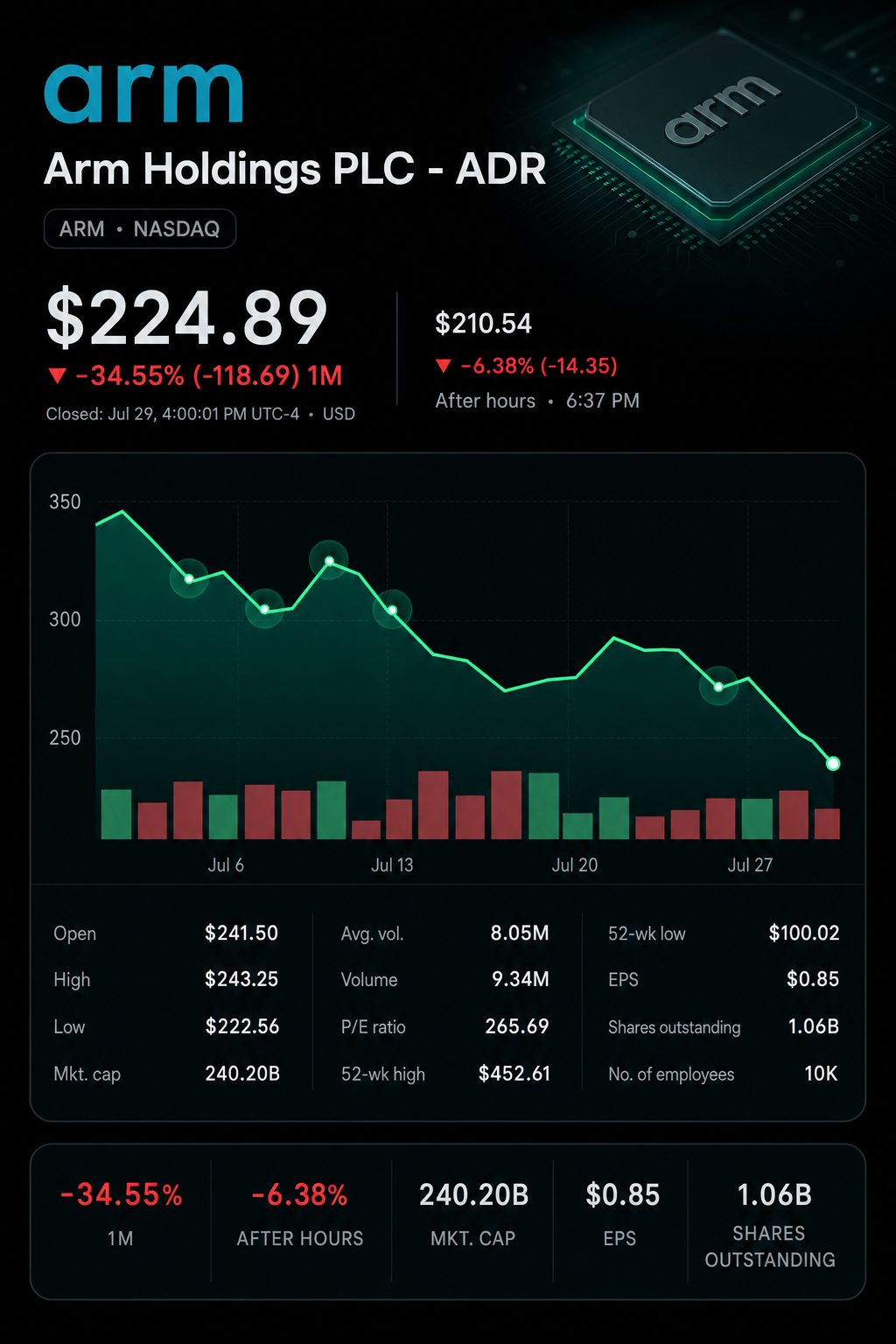
Shares of Arm Holdings NASDAQ:ARM dropped roughly 7% to $209 during after-hours trading on Wednesday. The stock finished regular trading 8.1% lower at $224.89 prior to the earnings release.
The decline came after a headline beat, but the filing revealed a growing gap between statutory and adjusted profitability.
The GAAP operating margin declined to 7.1% compared with 10.8% previously. Adjusted operating margin increased to 41.2% from 39.1%.
Equity-settled stock compensation along with associated employer taxes totaled $433 million, representing a 47% increase from the previous year and accounting for 33.6% of revenue. This compares to a proportion of 28.0% for the same period last year.
The rise in excluded operating expenses, totaling $142 million, represented 60% of the gains in revenue. This figure covers stock-based expenses, associated taxes, and additional operating components.
Arm exceeded expectations on Wall Street. Revenue was around 2% higher than the consensus from LSEG. Adjusted earnings reached 45 cents, surpassing the projection of 40 cents by 12.5%.
The forecast for the upcoming quarter was also above expectations. The revenue midpoint was set at $1.38 billion, surpassing consensus by 3%. The adjusted earnings midpoint was 47 cents, coming in 9% above consensus estimates.
Royalty revenue increased by 22% to $715 million. Licensing and other revenue climbed 23% to $574 million. Royalties from data centers more than doubled.
Annualized contract value increased by 13% to reach $1.732 billion. This was slower than the growth in reported license revenue, which Arm attributed in part to the timing of deals and backlog.
Chief Executive Rene Haas stated, “Growth is accelerating.” Arm has delivered 1.5 billion Neoverse cores in six years, with 500 million shipped in the past nine months. Reuters
Arm reports over $2 billion in demand for its AGI CPU through fiscal 2028, with secured manufacturing capacity covering the first $1 billion in orders. Oracle NYSE:ORCL is listed as a purchaser.
Arm reported operating cash flow of $902 million and adjusted free cash flow of $665 million. The company attributed the strong cash generation to advantageous timing of collections and tax payments.
The stock’s valuation offers scant margin for ambiguity. On Google Finance, the company’s market capitalization was listed at close to $240 billion, with a trailing price-to-earnings ratio of approximately 266.
Risks: The timing of licenses may impact revenue from quarter to quarter. AGI capacity remains below indicated demand. An increase in stock-based compensation expenses would continue to weigh on GAAP margins.
Investors require contract growth and statutory margins to align. Demand stayed robust. The gap in profit quality persisted.
What is the current trading level of ARM shares following its recent earnings announcement?
ARM ended the July 29 session at $224.89, a drop of 8.11%. In after-hours trading at 5:39 p.m. ET, shares were around $211, marking a further 6.18% loss from the closing level. The S&P 500 slipped 1.52%, and technology shares fell 2.93%. ARM's decline far exceeded both benchmarks.
Did Arm surpass forecasts for its fiscal first quarter?
Arm surpassed expectations for both first-quarter revenue and adjusted earnings. The company posted $1.289 billion in revenue, up 22% year-on-year. Adjusted earnings amounted to $0.45 per share, ahead of the $0.40 consensus. Royalty revenue increased 22% to $715 million, and licensing revenue climbed 23%. GAAP earnings came in at $0.25 per diluted share, more than doubling from a year earlier.
Did Arm provide robust enough guidance for the second quarter?
Arm projected second-quarter revenue in the range of $1.33 billion to $1.43 billion, with a midpoint of $1.38 billion, ahead of Wall Street’s expectation of $1.34 billion. Adjusted EPS was forecast between $0.43 and $0.51, with the midpoint at $0.47. Analysts’ expectations before the release were around $0.43 a share. Non-GAAP operating expenses are expected to rise to $780 million from $733 million. The midpoint for revenue surpasses analysts’ previous consensus by about 3%.
What significance does the new Arm AGI CPU hold?
Customer demand has surpassed $2 billion for fiscal 2027 and 2028. Arm has shipped first products to a number of customers. Manufacturing output is sufficient for what was initially a $1 billion opportunity. Efforts to increase capacity to meet the total demand pipeline continue. Oracle is among buyers of the chip, but Arm did not reveal the contract value. Demand remains high, but supply continues to limit fulfilment.
Is growth continuing to speed up in Arm's royalty and licensing segments?
Each main revenue segment saw gains of over 20% for the quarter. Royalty revenue rose by 22%, driven by stronger rates and increased data-center deployments. Royalties from data centers were more than twice those of the same quarter last year. Licensing revenue climbed 23%, as demand and the timing of major contracts provided support. Annualized contract value was up 13%, reaching $1.732 billion. Neoverse shipments topped 1.5 billion cores, with 500 million sent out over a nine-month span.
What do Arm’s cash flow and margins indicate?
Non-GAAP operating margin rose to 41.2%, up from 39.1% a year earlier. In contrast, GAAP operating margin declined to 7.1% from 10.8%. The large difference is due to stock-based compensation and other adjustments not included in non-GAAP figures. Non-GAAP research and development expenses increased 20% to $530 million. Operating cash flow amounted to $902 million, while free cash flow was $665 million. Free cash flow was supported by collections on receivables and the timing of tax payments. Cash and short-term investments stood at $3.888 billion at the end of the quarter.
What caused ARM shares to decline after surpassing earnings expectations?
The exact reason is unclear, as after-hours trading can see significant swings. Market participants likely weighed valuation, partial supply commitments, and increasing costs. Arm has yet to lock in enough capacity to deliver its entire $2 billion backlog. Shares also faced quarterly results during a widespread selloff in technology stocks. The Nasdaq Composite declined 1.74%, with the Nasdaq 100 falling 2.1%. Strong results alone were not sufficient on this occasion.
Following the selloff, does ARM remain pricey?
ARM is currently valued at $211, trading at nearly 97 times its projected FY2027 earnings per share according to FactSet, which lists the consensus at $2.17 per share and this figure may be updated. The stock’s 52-week range spans from $100.02 to $452.70. ARM now trades about 53% beneath its peak, but is still 111% higher than the low point. The stock’s valuation remains steep despite the recent decline in share price. Sustained strong growth will be necessary over the coming years to support this elevated premium.
What are the most recent price targets for ARM set by Wall Street?
FactSet reports an average price target of $311.60 and a median of $300. The published analyst targets span from $125 to $500. Based on the $211 after-hours price, the average target suggests roughly 48% potential upside. The lowest target signals a 41% downside risk, while the highest would mean a 137% upside. Analyst sentiment remains Overweight overall, with 25 Buy ratings. This group of targets may not yet incorporate results from tonight’s earnings report.
What is the current outlook for ARM’s stock price?
My twelve-month base case projection is between $240 and $310 per share, based on revenue rising close to 20% and ongoing supply increases. The downside scenario is $160 to $210 if valuation deteriorates further. The upside range is $330 to $400 should AGI revenue accelerate. In the near term, the stock is likely to experience ongoing volatility in the $200 to $225 zone. There is low conviction due to published price targets ranging from $125 to $500. These are scenario forecasts; a stronger Nasdaq selloff would weigh on all these outcomes.
Michał Rogucki is a senior markets reporter at TS2.tech. His coverage ranges from stocks and technology to economic developments affecting global markets. He graduated from Humboldt University of Berlin and worked in investment research and market analysis before becoming a financial journalist.
Surprising starts and permits data can impact homebuilders, mortgage-sensitive stocks, Treasury yields, and the dollar if results deviate significantly from consensus estimates.
#02
Home Depot Q2
The results and outlook provide key insights into housing turnover, renovation demand, professional customer activity, and U.S. discretionary spending.
#03
09:15 ET industrial production
A robust or disappointing factory or utilities report can shift expectations for economic growth, cyclical stocks, bond yields, and the Federal Reserve’s policy direction.