
As of Sunday, December 21, 2025, Eli Lilly and Company NYSE:LLY heads into a holiday-shortened trading week near recent highs, after a busy stretch of headlines spanning next-generation obesity drugs, potentially accelerated FDA review timelines, price cuts aimed at widening access, and a fast-evolving U.S. drug-pricing agenda.
The stock’s setup for the week ahead is straightforward: fundamentals and pipeline momentum remain the core bull case, while the key overhangs are pricing pressure, policy uncertainty, and headline-driven volatility typical of a late-December tape.
Eli Lilly stock price check: where LLY stands heading into the week
LLY last traded around $1,071 on the most recent trading day (Friday, Dec. 19), as markets were closed over the weekend.
LLY also finished last week with a notable week-over-week gain: from $1,027.51 (Dec. 12) to $1,071.44 (Dec. 19)—about +4.3%.
That strength matters because December trading can amplify moves in large-cap leaders—especially when liquidity thins around holidays. And Lilly is no longer just “big pharma”: Reuters reported in late November that Lilly became the first drugmaker to reach a $1 trillion market value, underscoring how central its obesity franchise has become to equity narratives. Reuters
The headline driver investors keep coming back to: Lilly’s obesity pipeline
Lilly’s stock has increasingly traded like a “platform” story—where the market values not just today’s blockbuster sales, but a multi-year sequence of pipeline upgrades and lifecycle extensions.
1) Orforglipron: maintenance data supports a long-term use case
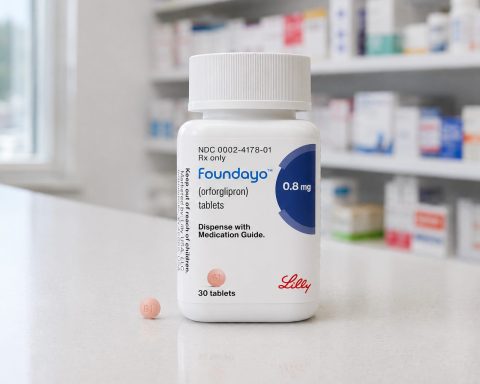
This past week, Reuters highlighted late-stage trial results showing Lilly’s oral GLP-1 candidate orforglipron helped patients maintain weight loss after switching from injectable GLP-1 drugs such as Novo Nordisk’s Wegovy and Lilly’s own Zepbound.
Key details reported by Reuters:
- After an initial period on injectables, patients who took orforglipron for 52 weeks maintained weight loss better than placebo.
- Those switching from Wegovy maintained previously achieved weight loss with an average 0.9 kg difference, and those switching from Zepbound saw an average 5 kg difference versus placebo.
- Side effects were described as mostly mild-to-moderate gastrointestinal, consistent with prior studies.
Why it matters for the stock: the obesity category is increasingly viewed as chronic. If a pill can support maintenance—especially after patients have already achieved meaningful weight loss—Lilly potentially widens the funnel to patients who dislike injections, struggle with adherence, or face access barriers.
2) FDA review timing: reports of internal pressure raise both upside and scrutiny
In a separate Reuters exclusive, the FDA’s leadership was reported to have pushed internally to reduce parts of the review timeline for Lilly’s orforglipron application—raising the possibility of a decision as early as March 28, 2026, ahead of a previously discussed deadline.
This is a double-edged catalyst:
- Bullish angle: faster review could pull forward a major commercial inflection for an oral obesity drug.
- Bearish angle: any perception of politicization, rushed review, or safety tradeoffs could create backlash risk—especially in a drug class already under intense scrutiny.
3) Retatrutide: Phase 3 results reinforce Lilly’s “next wave” narrative
Lilly also released major Phase 3 results for retatrutide, its “triple agonist” (GIP/GLP-1/glucagon). In a PR Newswire release, Lilly reported that in TRIUMPH-4, participants saw up to -28.7% body weight change (12 mg dose), equivalent to -71.2 lbs from an average baseline near 248.5 lbs, alongside substantial improvement in osteoarthritis pain measures. PR Newswire
Reuters separately reported the same broad takeaway: retatrutide produced average weight loss of 28.7% in a late-stage trial, outperforming Zepbound and reinforcing Lilly’s lead in the obesity race.
Why it matters for next week: even if retatrutide isn’t an immediate revenue driver, the market tends to reward Lilly for stacking credible “next-gen” shots on goal—because they can:
- defend share against competitors,
- broaden indications,
- justify premium valuation multiples.
Pricing headlines: access expands, but investors watch the margin trade-off
A major theme in recent weeks is Lilly leaning into affordability and access—partly voluntarily, partly in response to policy pressure.
U.S. price cuts for Zepbound vials
Reuters reported that Lilly lowered prices for single-dose Zepbound vials sold through LillyDirect:
- 2.5 mg: $299/month (down from $349)
- 5 mg: $399/month (down from $499)
- Higher doses: $449/month under a self-pay program (down from $499) Reuters
This move is strategically important for U.S. self-pay demand, but the market will keep asking a simple question: How much volume needs to be unlocked to offset lower realized prices?
Canada: reported cuts of 20%+ for Mounjaro and Zepbound
Reuters also reported that Lilly is reducing Canadian list prices for Mounjaro and Zepbound by 20% or more, with changes taking effect December 29.
That date falls just after the week ahead—but it’s close enough that investors could reposition in advance, especially if additional details emerge about international pricing strategy.
Washington is back in the Lilly stock story: U.S. drug-pricing deals and policy uncertainty
In late 2025, U.S. drug pricing has become a rapid headline cycle—and Lilly is explicitly in the frame.
New deals announced with nine drugmakers; Lilly cited among earlier participants
On Dec. 19, the Associated Press reported President Donald Trump announced drug-pricing deals with nine major pharmaceutical companies, including commitments tied to “most-favored-nation” pricing concepts and Medicaid pricing alignment. The AP also noted that Pfizer, AstraZeneca, EMD Serono, Novo Nordisk and Eli Lilly had struck similar deals earlier. AP News
Reuters reported the broader context as well, noting Lilly among companies that had previously struck deals with the administration.
Fierce Pharma further reported that the new agreements involve tariff relief in exchange for price actions, and indicated additional dealmaking could follow after the holiday.
What to watch next week: With “drug pricing” now a policy centerpiece, Lilly can get caught in market-wide pharma sentiment swings—even on days with no company-specific news.
Manufacturing expansion: supply chain resilience remains part of the bull case
Reuters reported that Lilly plans to invest more than $6 billion in a new active pharmaceutical ingredient facility in Huntsville, Alabama, part of a broader U.S. manufacturing push. The facility is expected to produce small-molecule and peptide medicines, including orforglipron, with construction starting in 2026 and completion targeted for 2032.
For investors, manufacturing matters because obesity drugs can be supply-constrained in ways that directly cap revenue. “Capacity wins” can function as revenue catalysts, even years before full completion, because they signal confidence and reduce perceived bottlenecks.
Legal and safety headlines: a risk bucket the market won’t ignore
Reuters reported that lawsuits alleging certain GLP-1 drugs caused a form of optic neuropathy (potential vision loss) were centralized into a new federal multidistrict litigation in Philadelphia. Reuters noted the suits include drugs such as Novo’s Ozempic/Wegovy and Lilly’s Trulicity.
This is not necessarily a “next week” earnings driver—but litigation headlines can change sentiment quickly in a sector already sensitive to safety narratives and regulatory scrutiny.
Analyst forecasts and valuation: what the street is implying for LLY
A practical way to frame the week ahead is to compare (1) how much upside analysts see, and (2) how much perfection the current price seems to embed.
Consensus price targets suggest modest upside from here
MarketBeat’s compiled analyst data shows:
- Average 12-month price target:$1,141.73
- High / low target range:$1,300 / $900
- Implied upside: about 6.6% from roughly $1,071 MarketBeat
That’s not “no upside”—but it does indicate the street sees Lilly as closer to fairly valued than deeply discounted at current levels.
Valuation remains the fulcrum of the debate
Reuters has described Lilly as trading at one of the richest valuations in big pharma (noting about 50x anticipated earnings in a late-November report).
Meanwhile, a Barron’s analysis (published Dec. 20) argued that even after a multi-year run, the stock could still look attractive given the 2026 setup (pills and expanded coverage), while still acknowledging a very high earnings multiple for 2025.
The market’s week-ahead reality: in a holiday week with fewer macro catalysts and lighter trading, valuation debates can reassert themselves—especially if policy headlines drive broad sector moves.
Week-ahead calendar: what could move Eli Lilly stock next week (Dec. 22–26, 2025)
This is a holiday-shortened week, and that alone can be a catalyst.
Trading hours: expect lighter liquidity
- U.S. stock markets are closed Thursday, Dec. 25 (Christmas Day).
- Markets close early at 1:00 p.m. ET on Wednesday, Dec. 24.
Lower liquidity can amplify moves in mega-caps like Lilly—particularly when news hits.
Macro events that can spill into “high-quality growth” stocks like LLY
Investopedia’s week-ahead calendar highlighted:
- Tuesday, Dec. 23: initial estimate of Q3 GDP, plus durable goods orders and other delayed economic reports; also consumer confidence.
- Wednesday, Dec. 24: weekly jobless claims (before the early close).
Even though Lilly is not a cyclical stock, macro surprises can influence:
- risk appetite,
- rate expectations,
- and the premium investors are willing to pay for high-multiple leaders.
Company-specific catalysts to monitor
In the week ahead, investors will likely watch for:
- any follow-through commentary or analyst notes on orforglipron maintenance data and commercialization pathways, after Reuters’ coverage, Reuters
- any incremental developments tied to the reported FDA review acceleration discussions, Reuters
- policy headlines related to drug-pricing deals and potential knock-on impacts to the broader pharma sector, AP News+2Reuters+2
- positioning ahead of Canada’s reported Dec. 29 price changes.
The bottom line for the week ahead: a “strong story” stock in a headline-driven tape
For the coming week, Eli Lilly stock remains defined by a powerful combination:
Supportive factors
- Obesity franchise durability plus credible “next wave” assets (orforglipron, retatrutide). Reuters+2PR Newswire+2
- Strategic access moves that could widen the treated population (even if they compress near-term pricing).
- Manufacturing investments that speak to long-term supply chain resilience.
Key risks
- Policy and pricing uncertainty tied to U.S. drug-pricing negotiations and tariff discussions.
- Litigation and safety narratives around GLP-1 drugs that can swing sentiment quickly.
- A valuation that leaves less room for disappointment after a historic run.
Related articles: NYSE:LLY