
NEW YORK, May 10, 2026, 08:02 (EDT)
Nvidia shares approach the week just shy of all-time highs, as recent AI infrastructure agreements with IREN and Corning reignite debate about the staying power of demand for Nvidia’s chips, systems, and data-center hardware—and whether it can keep outpacing what investors already have priced in.
Timing is critical here. Nvidia finished Friday at $215.20, adding 1.75%—just shy of its April 27 record close at $216.61. Market cap stood near $5.27 trillion, according to market data. With the next earnings report on May 20 looming, the shares have almost no buffer for disappointment.
This week, markets face a fresh round of data—U.S. consumer prices hit Tuesday, followed by producer prices Wednesday, and retail sales wrapping up Thursday. Investors keep an eye on Iran and the U.S.-China meeting, Reuters said, with tech names like Nvidia especially sensitive to rate moves and China trade news.
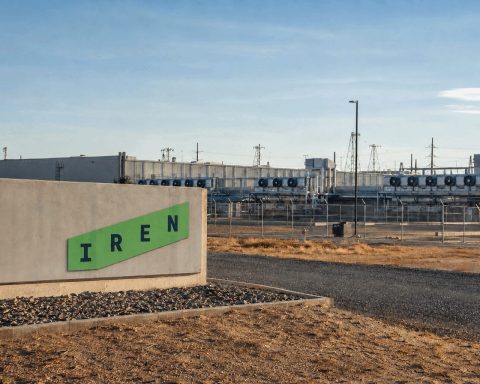
Nvidia and IREN are teaming up to roll out as much as 5 gigawatts of Nvidia-backed AI infrastructure in IREN’s data-center pipeline. As part of the deal, IREN granted Nvidia a five-year option to snap up as many as 30 million shares at $70 apiece—potentially a $2.1 billion investment, though that hinges on several conditions, including regulatory signoff.
The agreement aims to ramp up construction of what Nvidia refers to as “AI factories”—essentially sprawling data centers anchored by GPUs, the processors behind artificial intelligence models. “AI factories are becoming foundational infrastructure,” Nvidia CEO Jensen Huang said. For IREN, co-CEO Daniel Roberts pointed to the mix: Nvidia brings its systems, while IREN supplies power, land, and data center operations. NVIDIA Investor Relations
IREN has landed a five-year AI cloud services deal with Nvidia, pegged at roughly $3.4 billion. Under the agreement, Nvidia will tap Blackwell systems at IREN’s Childress, Texas campus to power its internal AI and research operations, IREN said.
IREN’s announcement came on the heels of another Nvidia supply-chain play. According to Reuters, Nvidia handed Corning a multi-billion-dollar prepayment—plus took an equity stake of as much as $3.2 billion—to back new Corning factories. The move supports Corning’s ramp-up in optical-fiber production, a key connector for computers inside sprawling data centers.
The deals put more weight behind the bull thesis. Still, investors looking ahead to earnings want to know: What share of Nvidia’s growth is truly driven by outside customer demand, and how much comes from Nvidia bolstering its own ecosystem or offering financing? That split takes on new significance with shares hovering near their highs.
Rivalry is heating up. AMD surged to an all-time high last week, buoyed by an upbeat forecast that reinforced bets on AI infrastructure demand. Reuters-quoted analysts put AMD front and center as Nvidia’s top challenger in the AI chip space. As inference — real-world deployment of AI models — ramps up, demand is climbing for both CPUs and GPUs.
Alphabet’s weighing on the market too. Reuters said the Google parent is narrowing the gap with Nvidia in terms of market value, boosted by robust cloud demand and its own AI chips that take on Nvidia’s semiconductors in selected tasks.
Nvidia’s on deck for its fiscal first-quarter results after the April 26 quarter, with the numbers set to drop May 20. Chief Financial Officer Colette Kress is slated to post written commentary ahead of the call, but don’t expect open access—a Q&A is only happening for analysts and institutional investors.
Nvidia’s last quarter was a blowout. On February 25, the company posted fourth-quarter revenue of $68.1 billion, up 73% from a year ago, with data-center revenue jumping 75% to $62.3 billion. Back then, Huang pointed to “skyrocketing” enterprise AI adoption—a promise investors are now lining up against the latest orders, margins, and supply snags. NVIDIA Newsroom
Macro news, policy shifts, or a valuation reckoning could upend the trade ahead of earnings. Kristina Hooper, chief market strategist at Man Group, told Reuters that markets “willed themselves to focus on only the positive,” but warned a much higher core CPI would be “very problematic.” For Nvidia, a jump in inflation or negative China developments might weigh just as heavily as this week’s next AI announcement. Reuters
Related articles: NASDAQ:NVDA