
New York, June 13, 2026, 06:56 (EDT)
- Quantum stocks were mixed on Friday as the boost from government funding started to fade.
- Federal CHIPS incentives are still driving the sector, but planned awards haven’t turned into booked revenue.
- Investors are now watching for details on final funding terms, progress with customer conversion, and D-Wave’s June 18 roadmap event in London.
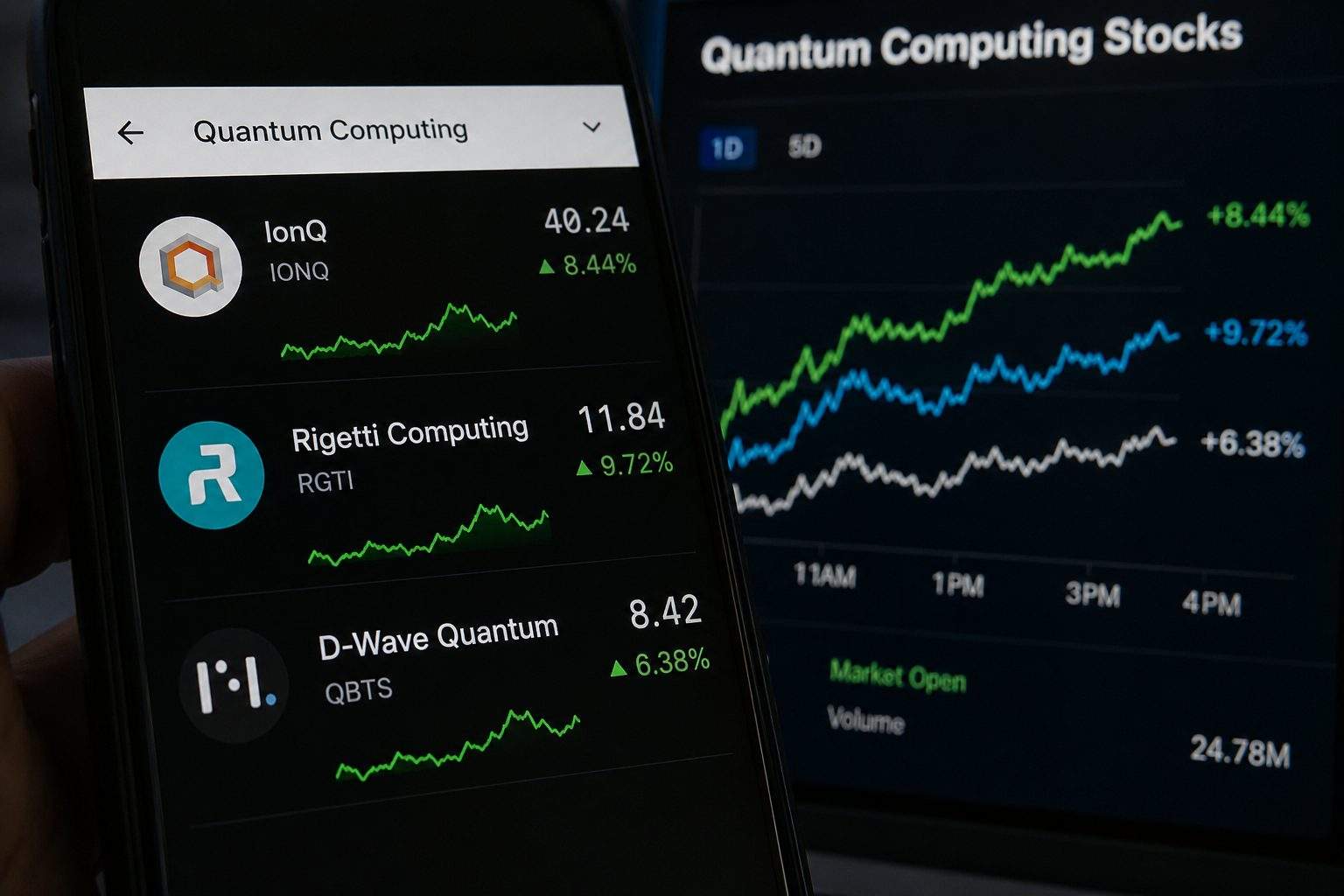
Quantum computing names finished the week with volatile trading and recent gains still in focus. IonQ was last at $57.85, off 0.3%. Rigetti Computing gained 1.7% to $20.98. D-Wave Quantum slipped 2.0% to $23.37 and Quantum Computing Inc. was up 0.2% at $9.93. The group had rallied after a spring run-up—The Motley Fool said Friday IonQ, Rigetti and D-Wave were still up at least 50% from the end of March, even after some weakness this week.
Stocks in the sector got a lift not from earnings, but from a shift in government policy. On May 21, the U.S. Department of Commerce announced it had signed nine letters of intent for $2.013 billion in planned CHIPS and Science Act incentives for quantum companies. IBM gets $1 billion, GlobalFoundries $375 million, D-Wave is set to receive $100 million, and Rigetti up to $100 million. These incentives target utility-scale, fault-tolerant quantum computers, which use qubits—known for being error-prone, but essential for scalable systems. Commerce Secretary Howard Lutnick called the investments the start of “a new era of American innovation.” That line landed with investors who have wanted to see more political support for the industry. NIST
Policy around quantum kept moving this week, with more governments outside the U.S. turning up the pace. On Friday, Barron’s said governments are putting more money into quantum technology. In the U.K., Science Minister Patrick Vallance rolled out a Quantum Growth Alliance, naming HSBC, Barclays, Standard Chartered, GSK, BP, Rolls-Royce, BAE Systems, BT, Vodafone and QinetiQ as some of the first members. Government and big company demand could help answer a key question for quantum stocks: who fronts the money for systems before bigger machines are ready.
Valuation and sentiment explain the pullbacks better than any single operating update. Insider selling turned up on the radar too. D-Wave CFO John M. Markovich sold 51,049 shares on June 8 and June 9, taking in about $1.34 million. That followed a bigger sale—328,752 shares for roughly $9.1 million—on May 22. Insider sales do not always mean insiders are bearish, since they might need cash for taxes or want to diversify. But in speculative stocks, these sales can weigh more when investors are already edgy about prices running hot.
Why the D-Wave trade is still a debate: The company’s Q1 revenue was $2.9 million, down 81% from last year’s quarter, when a big system sale bumped up the numbers. But bookings jumped to $33.4 million. Remaining performance obligations climbed to $42.4 million. CEO Alan Baratz said the quarter showed “expanding commercial adoption.” The numbers cut both ways for the stock — investors see a strong order pipeline, but revenue is choppy and losses are still big. dwavequantum.com
IonQ posted first-quarter revenue of $64.7 million, the largest among pure-play peers. The company raised its full-year guidance to $260 million to $270 million and reported $470 million in remaining performance obligations. Rigetti reported Q1 revenue at $4.4 million and an operating loss of $26.0 million, with $569.0 million in cash. Rigetti said its 108-qubit Cepheus-1-108Q system is now generally available. Quantum Computing Inc. saw about $3.7 million in first-quarter revenue, a net loss of $4.1 million, and held $1.4 billion in cash, cash equivalents and investments following the Luminar Semiconductor and NuCrypt deals.
Quantum stocks have picked up support on federal money, customer deals, better cash levels, and a pipeline of tech goals—turning what was a science story into a national-security, industrial and AI-infrastructure play. Bulls say that gives companies room to run and more time to hit targets. Bears warn useful quantum at scale could be far off, and current valuations already count on big wins. Price-to-sales is still high: The Motley Fool puts it at about 95.7 for IonQ, 645.4 for D-Wave, 632.2 for Rigetti, but says profits aren’t backing share prices yet.
Quantum stocks still look risky today, not broadly attractive or trading at fair value. IonQ is at around $21.5 billion in market cap, D-Wave’s about $8.6 billion, Rigetti at $7.0 billion, and Quantum Computing Inc. around $2.2 billion—all high against their current quarterly revenue. The sector’s next big event is whether Commerce Department letters of intent turn into real, milestone-tied funding. For companies, the next focus is D-Wave’s Qubits Europe event set for June 18 in London. D-Wave says it plans to talk tech roadmap, progress in annealing and gate-models, software, hybrid quantum work, and quantum AI at the event. For shares to hold gains, investors probably need to see bookings lead to revenue and roadmaps met. Delays, dilution, weak orders or a general drop in speculative tech could send stocks down.

![US Stock Market Today 08.21.2026 [UPDATE: 08.21.2026 03:04 EDT] [Dollar Stress Looms as Overnight Stocks Near Premarket Handoff]](https://ts2.tech/wp-content/uploads/2026/08/US-market-dashboard-2026-08-21-0904-480x384.jpg "US Stock Market Today 08.21.2026 [UPDATE: 08.21.2026 03:04 EDT] [Dollar Stress Looms as Overnight Stocks Near Premarket Handoff]")