
PHILADELPHIA, July 12, 2026, 10:08 (EDT)
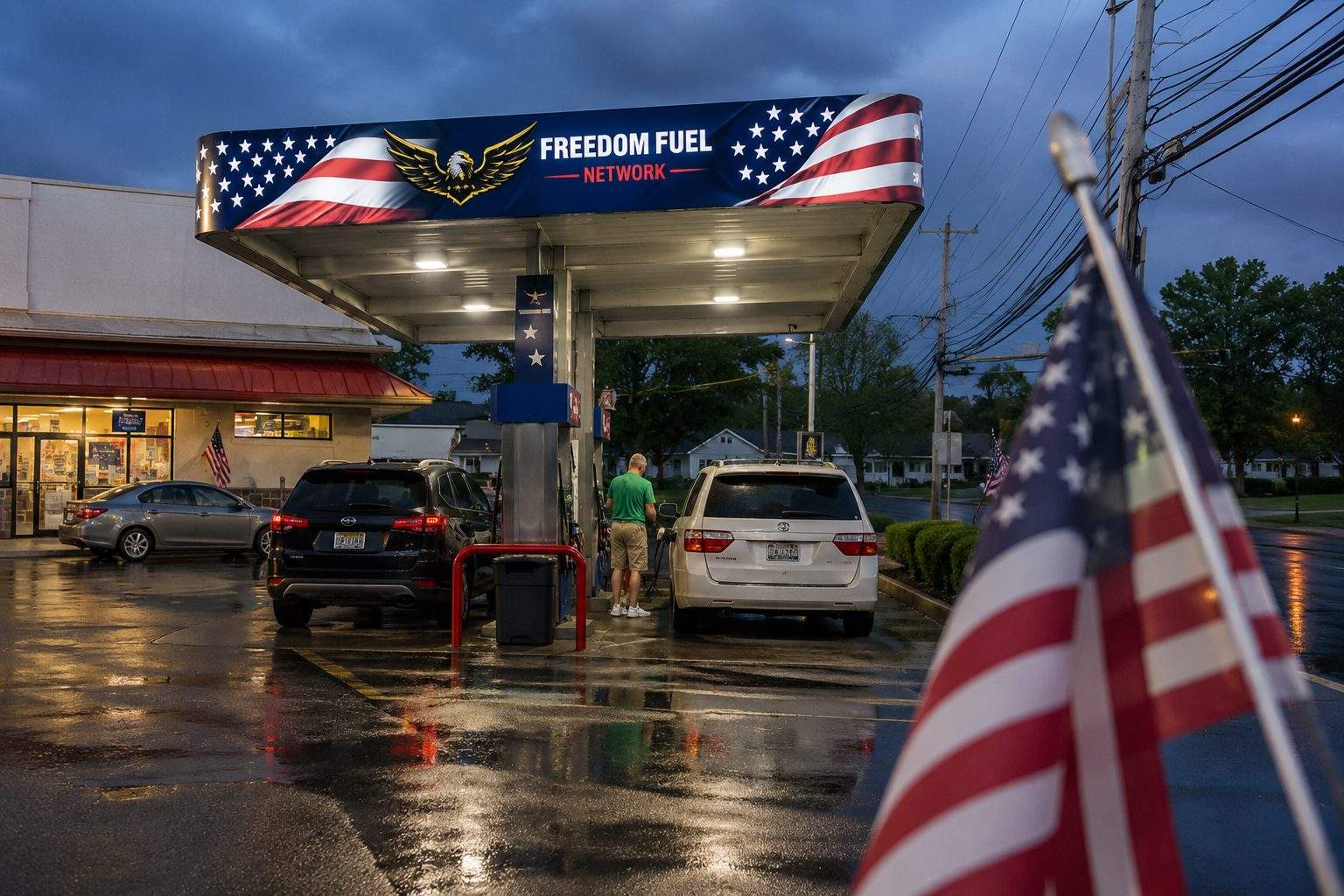
Freedom Fuel Network says gasoline volumes have climbed more than 50%, but that may be hurting its margins. Calculated using Pennsylvania’s July 9 wholesale cost and the launch rack-to-break-even spread, the original $3.47 pump price now puts the fuel-only loss at about 31 cents per gallon. A typical station that started at the 68,000-gallon monthly average Tom Kloza mentioned and kept up with that volume increase would show a modeled shortfall of about $31,600 a month, not including fees, payroll, utilities or rent. The White House has said there is no subsidy on the price from the government or anyone else.
What used to be Freedom Fuel’s main pitch is now the big question for investors. Selling fuel below cost, as a loss leader, only works if people buy enough other stuff to offset it. But the wider market seems to be moving the other way. U.S. gasoline stocks started July at their lowest since 2021, and the 3-2-1 crack spread climbed to a record $64.58 a barrel on July 8.
The average price for regular gas in Pennsylvania was $3.972 on Sunday, according to AAA. New Jersey’s statewide average came in at $3.930. GasBuddy’s Friday data showed most Freedom Fuel stations bumped up to $3.57 or higher, so the discount narrowed but didn’t disappear.
| Price benchmark | Sunday average | Discount at $3.47 | Discount at $3.57 |
|---|---|---|---|
| Pennsylvania | $3.972 | 50.2 cents | 40.2 cents |
| New Jersey | $3.930 | 46.0 cents | 36.0 cents |
State averages don’t match what each station charges. The $3.57 is the average, not the same at every station.
OPIS posted the Pennsylvania rack price at $2.89 on July 3, which is the terminal cost before shipping. Add delivery plus taxes, and the break-even got reported at $3.64 or higher. By July 9, the rack price moved up to $3.03. With the same 75-cent margin, the fuel-only threshold lands near $3.78. That’s a gap of 31 cents at $3.47, 21 cents at $3.57. Gulf Oil chief energy adviser Kloza called the model “jumping off a cliff.” 6abc Philadelphia
Public retailers rarely post negative numbers like these. Murphy USA Inc. NYSE:MUSA said first-quarter retail fuel margin came in at 25.4 cents a gallon. Total gallons rose 2.1%, but same-store volume slipped 0.8%. Casey’s General Stores Inc. NASDAQ:CASY reported fiscal fourth-quarter fuel margin at 46.9 cents, not counting card fees. Comparable-store gallons were up 1.5%. The inside margin, gross profit as a percentage of in-store sales, stood at 42.4%. CEO Darren Rebelez pointed to “balancing gallons sold with fuel margin.” Murphy Oil USA
| Operator or scenario | Per-gallon fuel economics | Latest volume signal |
|---|---|---|
| Freedom Fuel at $3.47 | 31-cent modeled shortfall | Operator says network up more than 50% |
| Freedom Fuel at $3.57 | 21-cent modeled shortfall | Network pricing mixed |
| Murphy USA | 25.4-cent retail margin | Gallons up 2.1% overall, down 0.8% at existing stores |
| Casey’s | 46.9-cent margin, before card fees | Same-store gallons up 1.5% |
Companies use different ways to define margin. Freedom Fuel uses spot-cost numbers, which are not audited results.
If you take the 102,000 gallons a month example, the model shows a shortfall of $31,620 at $3.47 and $21,420 at $3.57. Using Casey’s 42.4% inside margin as a ballpark, the station would have to drive around $74,600 or $50,500 in extra store sales monthly to make up for that — about $2,500 or $1,700 a day. That’s before factoring in the costs of the extra volume.
That could be a tough bar for parts of the network. The Philadelphia Inquirer said it visited one store in the program that wasn’t working and reported others looked small, run-down, or offered little merchandise. “It’s difficult to see how these stations are making money,” said Jeff Lenard at the National Association of Convenience Stores, noting these locations usually lean more on fuel margins. Inquirer.com
The spot-price model doesn’t give a complete profit-and-loss picture. Some stations could have cheaper gas in stock, locked-in supply contracts, rebates, or fixed-budget promotions. Delivery costs, taxes, and in-store sales differ from site to site. The model can work against operators, too — if wholesale prices stay close to July 9 and most sales are just fuel, selling more units means losses add up. At 102,000 gallons, a 10-cent swing in cost shifts monthly gross by $10,200.
U.S. markets were shut Sunday. The national average gasoline price climbed 6 cents to $3.88 over the past week, the biggest jump since mid-May. Gasoline inventories dropped to 212.1 million barrels, which is about 10 million below the five-year average. Brent crude ended Friday at $76.01 a barrel, up around 5.5% on the week. U.S. West Texas Intermediate settled at $71.41, up nearly 4%.
WTI futures start trading again at 6 p.m. EDT Sunday, ahead of the equities open Monday. That’s when traders first react to President Donald Trump’s claim that the Strait of Hormuz is open, while the U.S. and Iran keep up attacks. OPEC’s monthly market report is out Monday. The U.S. Energy Information Administration follows with its inventory report on Wednesday. For now, Freedom Fuel’s 50% volume claim signals strong demand for cheap gas, but with procurement terms and store results still unknown, it doesn’t prove long-term profitability.
Related articles: Energy