Retired 747s range from a $100,000 reef-destined jet to a U.S. support aircraft costing $200 million
27 July 2026
2 mins read

Retired 747s range from a $100,000 reef-destined jet to a U.S. support aircraft costing $200 million

NEW YORK, July 27, 2026, 15:04 EDT

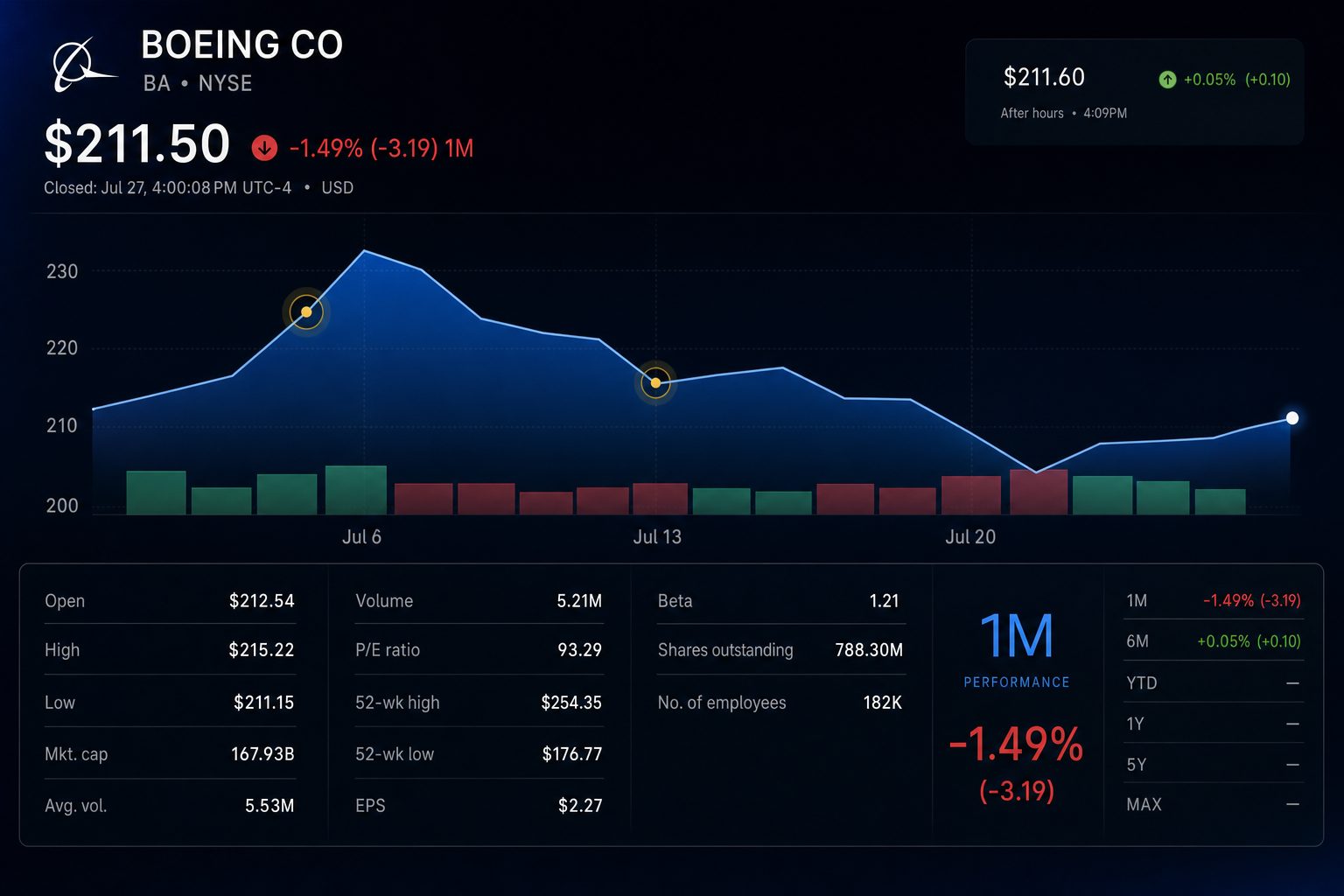
  • U.S. cash markets stayed open. Boeing Co. was last at $211.97, rising 1.2%.
  • Listed prices for decommissioned 747s suggest a nominal value difference by a factor of 2,000.
  • Boeing posted a 18.1% margin in services for the last quarter, while its defense margin stood at 3.1%. The company’s results are expected on Tuesday.

A U.S. deal priced a pair of used 747-8 jets at $200 million apiece. In comparison, Bahrain bought an older 747-200 for an estimated $100,000. The price gap is roughly 2,000 times.

For investors, it is not scarcity by itself that determines an aircraft’s value, but rather its mission, certification, and the specifics of contract terms.
Retired 747s range from a $100,000 reef-destined jet to a U.S. support aircraft costing $200 million

The difference is significant for Boeing. After producing 1,574 units, output stopped in 2023. There are no new 747 sales. Ongoing support and specialized mission projects continue.

747 caseDisclosed economicsCurrent or planned use
Bahrain 747-200$100,000 paid for airframeMain exhibit at a dive park spanning 100,000 square metres
Thai Airways HS-TGP 747-400Financial details undisclosedPlanned to serve as a cafe and restaurant; limited evidence of advancement
Qatar-origin 747-8Donated aircraft; initial list price $400 million, not indicative of resaleTemporary presidential jet
U.S. support pairTotal expense $400 million, equating to $200 million per planeDesignated for crew training and as spares providers
Two VC-25B replacements$3.9 billion agreed in contract; expenses exceed $5 billionSpecially developed replacements for Air Force One

The 747-8, originally from Qatar, entered use for presidential transport on July 1. The expedited conversion was completed by L3Harris Technologies Inc. .

An FAA filing that took effect the same day addressed an AMAC-modified 747-8, introducing enhanced safety requirements for side-facing seats. According to the filing, the maximum capacity is set at 89 passengers along with 14 crew members.

AMAC Aerospace is listed as the applicant in the filing. The aircraft’s owner is not disclosed. As a result, the suggested connection to the Qatar-linked jet remains unverified.

Boeing’s custom-made planes for the U.S. president operate under a separate financial arrangement. The manufacturer agreed to a $3.9 billion fixed-price deal covering two aircraft. Costs for the program have now surpassed $5 billion.

Boeing defense head Steve Parker said this month, “We’re on track for 2028.” He anticipates additional cost increases related to wiring, structural work and certification. Reuters

First-quarter figures shed light on investor unease. The Global Services division delivered an operating margin of 18.1%. Defense, Space & Security recorded a margin of 3.1%.

The services margin increased to 5.8 times its previous level. Limited aircraft availability may drive demand. How much Boeing retains depends on contract structure.

Thai Airways International Pcl (BKK:THAI) is positioned at the opposite extreme. Its HS-TGP 747-400 was placed into storage in 2020 and relocated to a field in 2023 for a planned restaurant.

HS-TGP was put up for sale by Thai Airways alongside nine additional 747-400 aircraft in 2021. The airline subsequently completed its restructuring, having reduced both its workforce and fleet size by 50 percent.

The aircraft at the field appear to be related to legacy disposal, rather than indicating a new decline in operations. Thai has posted operating profits each quarter from 2023 onwards after completing its restructuring.

Bahrain repurposed the jetliner for tourism. The 1982 aircraft was cleaned and sunk in 2019, serving as the centrepiece of a dive park featuring its 70-metre fuselage.

Risks persist. The numbers are not direct comparisons. The Bahrain figure includes just the airframe, whereas U.S. planes fulfill specific mission roles. Expenses for conversion and maintenance may far exceed the initial purchase price.

Boeing is scheduled to announce its second-quarter earnings on Tuesday at 10:30 a.m. ET. Key areas to watch include cash flow, defense-related expenses, and service margin performance. The legacy of the 747 holds potential worth, but realizing that value remains a challenge.

Does a distinct Boeing 747 stock, share price, or index exist?

There is no individual stock, pricing, or index assigned to the Boeing 747. Investors access the program through Boeing’s main shares, listed as BA. A total of 1,574 units were produced before manufacturing concluded, with the last 747 delivered in 2023. Ongoing exposure to the 747 now relates to maintenance and the VC-25B project. Boeing does not break out 747 revenue as a distinct reporting line. Boeing Investors

What is Boeing’s stock price ahead of this week’s earnings announcement?

BA hovered around $211.70 on Monday afternoon, up approximately 1.04%. Shares moved within a range of $211.16 to $215.20 as 3.78 million shares changed hands. At this price, Boeing’s market capitalization was roughly $166.9 billion. The price was recorded during the session and may shift before the market closes on Monday.

What has been the main driver for Boeing stock this week?

Boeing is set to announce its second-quarter earnings on Tuesday, July 28. The company’s management will hold a conference call at 10:30 a.m. Eastern time. FactSet currently projects a quarterly loss of 28 cents. Meanwhile, a separate survey of 20 analysts forecasts a loss of 31 cents with revenue estimated at $24.27 billion. Given the minor differences between these forecasts, investors are advised to consider a consensus range. Boeing Investors

Do second-quarter deliveries indicate potential for a higher earnings outcome?

Boeing reported delivering 171 commercial jets in the second quarter, up 14% from 150 aircraft in the same period last year. Total deliveries for the first half reached 314, compared with 280 in the first half of 2025. The quarterly figures included 129 737s, 25 787s, and zero 747s. These delivery numbers are preliminary and may change when Boeing announces its quarterly results. Boeing Investors

Is Boeing on track to report positive free cash flow?

Boeing posted a first-quarter free cash flow of minus $1.45 billion. Total cash and securities stood at $20.9 billion, with debt at $47.2 billion. The firm still has access to $10 billion in unused credit. Management had earlier set a target for 2026 free cash flow between $1 billion and $3 billion. Cash performance remains critical. A soft second quarter would demand a significantly stronger recovery in the back half of the year. Boeing Investors

Is FAA oversight now less strict regarding Boeing’s manufacturing processes?

On July 16, the FAA reinstated Boeing’s authority to issue certificates. The move applies to newly finished 737 MAX and 787 jets. Boeing previously increased its target monthly output for the 737 from 42 to 47. The Everett facility is set to handle production for 52 units per month in early 2027. The decision does not restart 747 manufacturing. The move is expected to allow quicker deliveries, revenue recognition and cash flow. Federal Aviation Administration

Is ongoing cargo demand enough to keep the Boeing 747 financially viable?

Sales of new 747s have ended, but global cargo requirements remain significant. International freighter capacity increased 5% so far in 2026. Boeing projects annual air-cargo traffic growth of around 3.7% through 2045. The company also anticipates demand for over 2,900 freighters until 2045. Profits are now shifting to support services and newer 777 freighter models. Boeing has not disclosed specific 747 aftermarket revenue. Boeing

Is it possible that the Air Force One 747 project could result in a new charge?

Boeing’s VC-25B contract stands as the company’s most significant 747-specific earnings risk. The deal, valued at $4 billion, is a fixed-price agreement for two upgraded 747-8 jets. Boeing recorded $60 million in anticipated program losses for 2025 and an additional $379 million of losses in 2024. The company’s latest annual report cautions that further losses may still occur. Tuesday’s filing will indicate if another charge was taken. SEC

What factors could cause Tuesday’s Boeing report to be interpreted as bullish or bearish?

A positive outlook would require significantly stronger cash flow and improved commercial-airplane margins. Last quarter, Commercial Airplanes reported a negative 6.1% operating margin. Moving closer to producing 47 737s per month would help reinforce Boeing’s recovery argument. On the downside, a weaker cash outlook or new program charges would weigh on the report. Pressure from VC-25B and other fixed-price defense contracts persists. This analysis relies on baselines from reported results, not on updated company guidance. Boeing Investors

Does Boeing’s present price-to-earnings ratio serve as an effective tool for valuation?

Boeing’s latest quote puts the trailing price-to-earnings ratio close to 83.7, a figure that warrants careful consideration. The company recorded a $9.6 billion gain from its 2025 digital-aviation divestiture, boosting fourth-quarter reported earnings per share by $11.83. More reliable signals for value come from normalized cash flow and segment-level margins. Boeing Investors

Khadija Saeed is a financial markets reporter at TS2.tech, specializing in stocks, technology and emerging industries. She studied economics and finance at the London School of Economics and previously worked in market research before moving into financial journalism. Her coverage focuses on the companies, innovations and economic trends influencing global investors. Follow Khadija Saeed on Google News.

Stock Market Today

  • Profitable Stocks Face Risks: BFAM, WH, NESR Under Scrutiny
    July 27, 2026, 5:02 PM EDT. Bright Horizons (BFAM), Wyndham (WH) and NESR (NESR) are profitable, but present issues including decelerating growth, cost increases and inefficient capital use. BFAM posts 16.3% top-line growth, which trails the sector average; WH posts weaker returns on capital with flat revenue per room figures; NESR confronts elevated spending and narrowing EBITDA margins. With valuations at roughly 14.5-15x forward P/E, these firms call for careful evaluation.
Micron (NASDAQ:MU) Shares Jump 8.5% as Investors Eye Major Tech Spending Update
Previous Story

Micron stock declines as DRAM market feels impact from CXMT expansion

Joby Aviation stock falls as Virgin partnership raises revenue questions
Next Story

Joby Aviation (NYSE:JOBY) Shares Recover 4.8% With Valuation Premium Under Scrutiny as Earnings Approach