NEW YORK, July 27, 2026, 19:45 (EDT) — U.S. market: After Hours
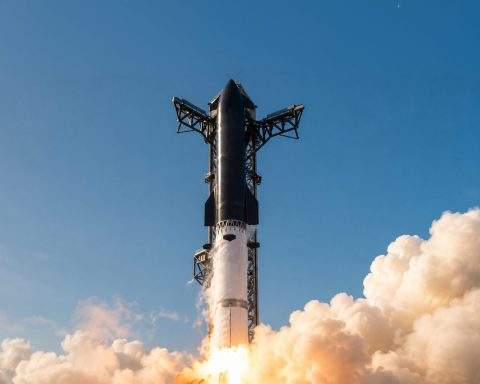
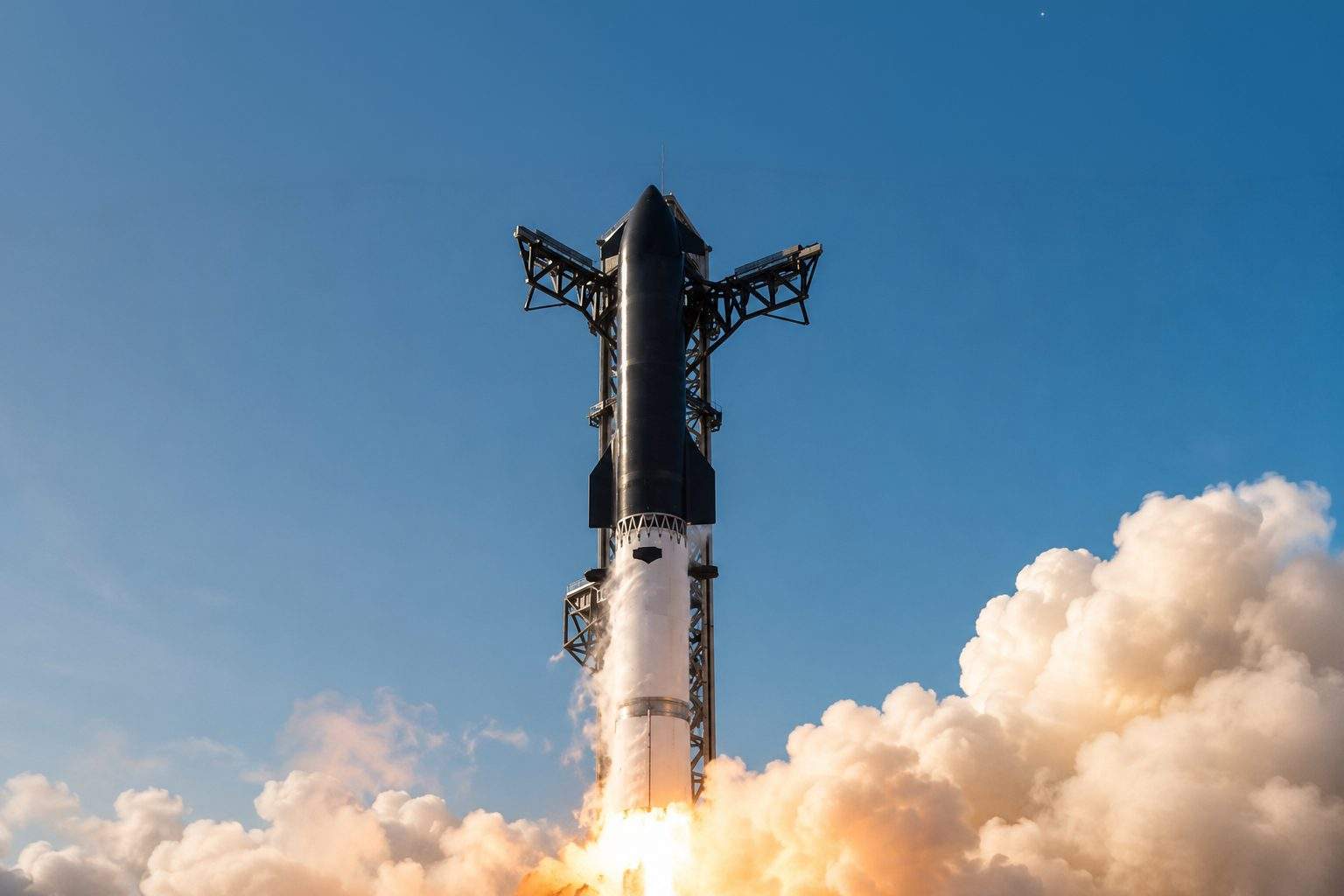
- Flight 13 evaluated thermal-tile attachment performance while subjecting it to intentionally increased acceleration and dynamic pressure.
- The shield was photographed by six out of 20 Starlink V3 satellites. Starship subsequently splashed down intact.
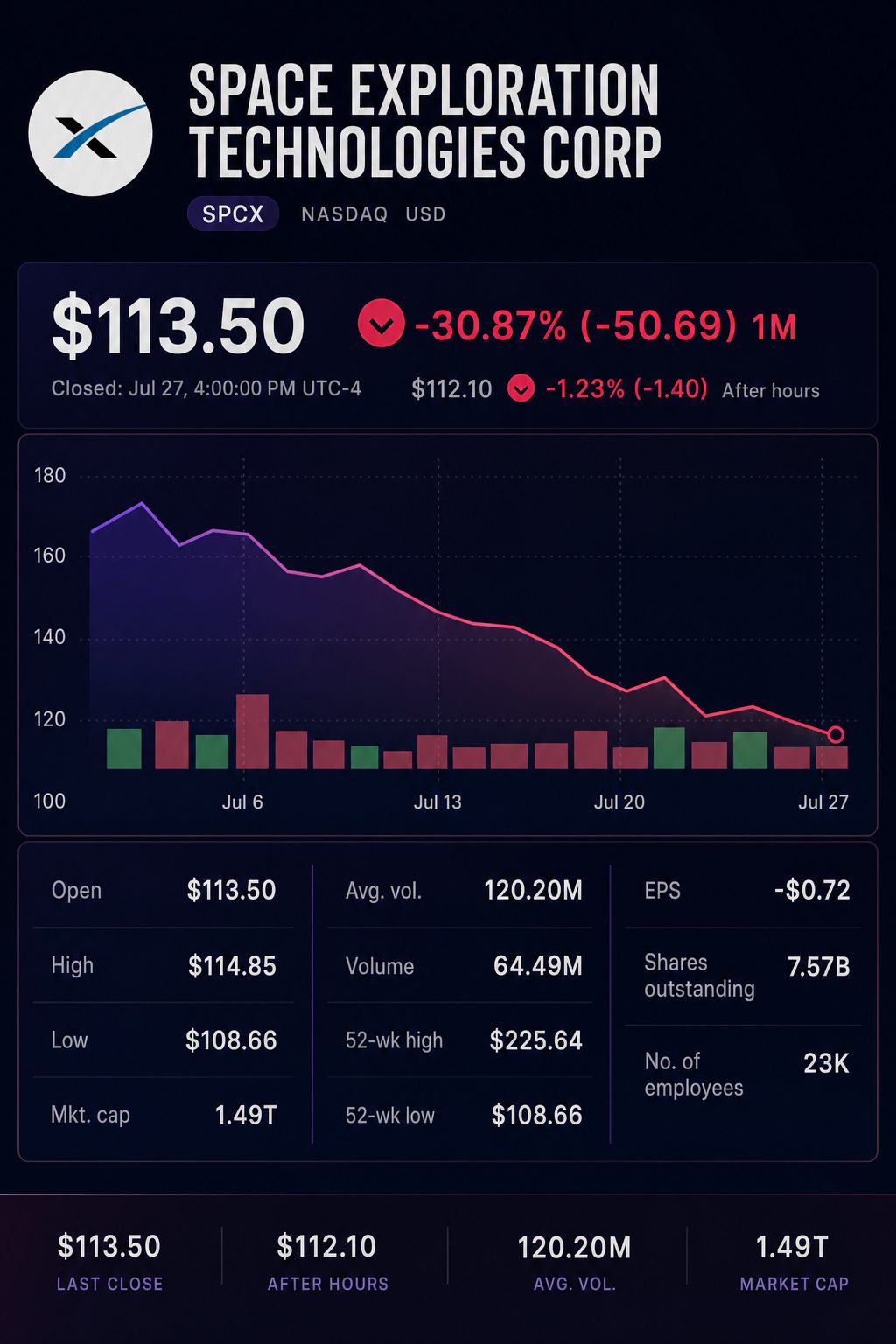
- SpaceX ended the session at $113.50, falling 1.36%. The stock was last at $112.03 in after-hours trading.
SpaceX reported that Starship successfully passed a demanding evaluation of its heat-shield tiles, but investors showed little reaction.
Shares ended Monday at their lowest level since the firm’s listing in June. The move signals a more significant investor challenge. SpaceX has addressed a key engineering risk, but has still to demonstrate rapid reuse.
Flight 13 was intentionally subjected to greater stress on the shield ahead of reentry. Chief Executive Elon Musk stated Starship experienced “much higher acceleration” to evaluate tile attachment under high dynamic pressure.
Musk stated, “Test was successful.” X (formerly Twitter)
The significance of that detail is greater from a financial perspective than just the smooth splashdown. Ahead of liftoff, SpaceX stated that elevated pressure would put more strain on the tile attachments, “in exchange for increased payload to orbit capability.” Spaceflight Now
This test connected two aspects of Starship’s economic model. Improved tile retention may allow for increased payload weights while still enabling reuse of the upper stage.
SpaceX’s Flight 13 update did not specify confirmed refurbishment duration or the number of tiles replaced. The release also omitted per-flight cost details following reuse. Investors remain unable to calculate the result into a margin projection.
Evidence for Flight 13 compared to outstanding proof
| Investor test | Flight 13 evidence | What remains unproved |
|---|---|---|
| Heat-shield retention | Greater acceleration, sensor-equipped tiles, and an unbroken shield after reentry | Continued heat-shield integrity over recurring orbital missions and repeated launches |
| In-flight inspection | Six Starlink units with cameras captured images of the shield; all 20 deployed payloads successfully sent telemetry | A standardized, rapid process for clearance following flights |
| Upper-stage operations | Starlink arrays released, Raptor reignition performed in space, and soft ocean touchdown | Stable orbital insertion, successful tower catch, and recorded turnaround intervals |
| Full-stack reuse | Super Heavy booster completed both its climb and boostback maneuvers | Consistent landing-engine relight following further hard splashdown trials |
| Market validation | Stock finished trading at $113.50, with after-hours activity at $112.03 | Proof of market viability based on revenue expansion, launch frequency, and reduced capital demand |
The upper stage accomplished almost all scheduled demonstrations. It released 20 Starlink V3 satellites, production versions, and established contact with each prior to their expected atmospheric return.
Starship relit a Raptor engine while in space. The vehicle then executed a banking maneuver, a landing flip, and a managed burn above the Indian Ocean.
The spacecraft stayed intact and kept sending telemetry data. SpaceX stated that the landing offered “critical views of an intact heatshield for the first time.” SpaceX
“We got all the heat shield data we needed and then some!” Musk wrote following the flight. AP News
The booster serves as the primary counterweight. Not all of its landing engines reignited, resulting in Super Heavy descending with too much speed prior to impact.
“We were aiming for a gentler splashdown,” SpaceX spokesperson Dan Huot stated on the webcast. An earlier engine-relight issue led to a similar hard landing in May. Reuters
The distinction is significant. Keeping the upper stage intact moves Starship closer to reuse, but it does not yet qualify as a reusable launch system.
Investors reacted quickly. SpaceX shares ended down 1.36% at $113.50, after hitting a new low of $108.66 during the session. The company’s market capitalisation was about $1.49 trillion.
The stock ended the session 15.9% lower than its IPO price of $135 per share. It also finished 49.7% down from its June high of $225.64. SpaceX achieved a $1.77 trillion valuation with its $75 billion raise during that offering.
A peer stock headed the other way. Rocket Lab NASDAQ:RKLB advanced 4.74% following news of a $266 million contract from the U.S. Space Force.
The contract includes 12 suborbital launches, plus an option for an additional six. The initial mission is scheduled no sooner than late 2026.
A single trading session does not represent a valuation model. Nevertheless, the comparison remains informative.
Rocket Lab shares gained as investors focused on the company’s secured revenue. SpaceX’s engineering milestones drew less attention, with markets awaiting evidence of commercial returns.
Morgan Stanley NYSE:MS assigned Flight 13 an “A-” grade, kept its Overweight recommendation, and reiterated a $300 price target, pointing to the satellite deployment, engine relight, and successful splashdown.
The bank highlighted the initial upper-stage tower catch as the upcoming significant catalyst. Musk stated SpaceX plans to attempt this on the next launch, unless the mission review finds issues. A specific date for Flight 14 has yet to be released by SpaceX.
NASA faces timeline risks as well. The agency is targeting a 2027 Artemis III test that will see Orion dock with commercial lunar-lander prototypes. A crewed lunar landing remains scheduled for 2028.
Flight 13 aligns with that schedule but carries out only a portion of the tasks. Key steps such as orbital operations, docking, and propellant-transfer demonstrations are still to come.
Preliminary estimates: SpaceX is expected to announce its second-quarter results on August 4. According to Google Finance, analysts project revenue at $6.82 billion with a forecasted loss of $0.23 per share.
Starship expenditures and the schedule for V3 deployment are expected to draw investor attention. Providing a specific refurbishment target could better connect heat-shield effectiveness to the outlook for future margins.
Risks: Post-flight assessments might reveal tile or flap issues that did not appear in the images sent. Outstanding concerns include booster relight errors, orbital recovery, tower capture, as well as costs related to regulation and refurbishment. The end of a post-earnings lock-up period could further increase selling pressure.
Flight 13 shifted the discussion on heat shields. The outcome for tiles now seems less a matter of simple survival or failure.
The subsequent test focuses on repeatability. An undamaged shield signifies advancement in engineering. A vessel able to return, undergo a brief inspection, and launch once more would generate operational leverage.
Related articles: NASDAQ:RKLB