Microsoft Confronts Cash-Flow Challenge Amid $40 Billion AI Capex Surge

Microsoft Confronts Cash-Flow Challenge Amid $40 Billion AI Capex Surge

NEW YORK, July 28, 2026, 08:04 EDT — U.S. premarket

  • Microsoft projects Q4 capital expenditures to surpass 45.6% of consensus revenue, compared to 38.5% in Q3.
  • Microsoft sets Azure growth guidance at 39%-40% in constant currency, while the Microsoft Cloud gross margin is expected to decline to about 64%.
  • Shares declined 3.1% last week, but recovered 1.9% on Monday. In premarket trading Tuesday, they were up a further 1.5%.

Microsoft Corp. undergoes a cash-flow assessment as it releases results on Wednesday. Investors are watching to see if cash generation matches rising AI investment.

Capital expenditure for the fiscal fourth quarter is set to top $40 billion, with analysts forecasting revenue at roughly $87.7 billion. Based on early calculations, this results in a spending intensity greater than 45.6%.
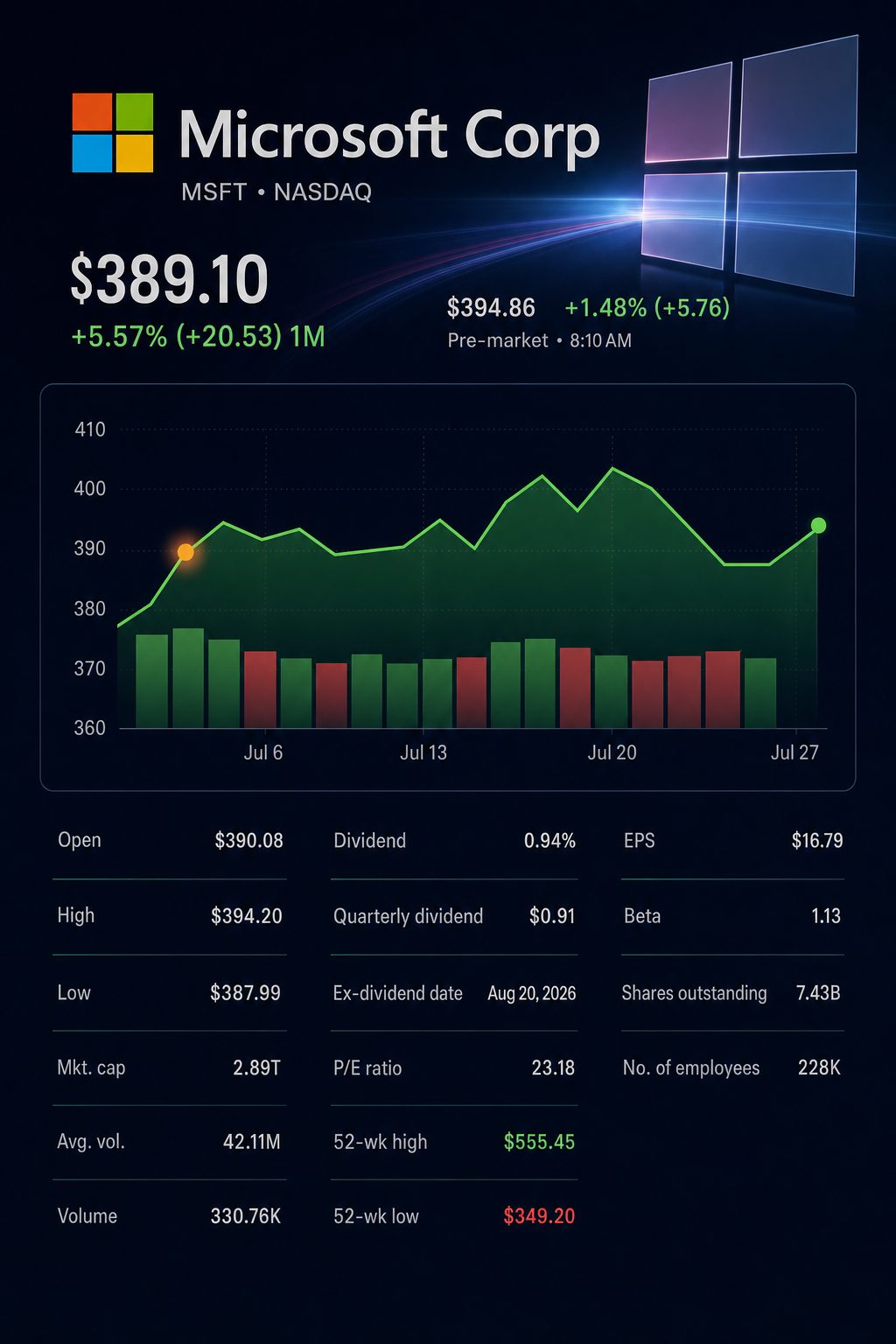
Stock chart for NASDAQ:MSFT

The ratio for the March quarter stood at 38.5%, implying capex will increase by a minimum of 25% on a sequential basis. Revenue is projected to climb roughly 6%. Microsoft Cloud gross margin is forecast to decrease by two points.

MetricFiscal Q3 actualFiscal Q4 barSequential read
Revenue$82.9 billion$87.7 billion estimate+5.8%
Total capex$31.9 billionAbove $40 billionAbove +25.4%
Capex/revenue38.5%Above 45.6%Above +7.1 points
Azure growth, constant currency39%39%-40%Roughly flat
Microsoft Cloud gross margin66%Near 64%2 points lower
Free cash flow$15.8 billionNo forecastMain liquidity indicator

Initial estimate based on a $40 billion minimum capital expenditure and consensus revenue of $87.71 billion. Overall capex figure accounts for finance leases.

Microsoft stock finished Monday at $389.10, rising 1.9%, and hovered around $394.90 in premarket trading Tuesday. Shares are still 19.5% lower for the year. Nasdaq-100 futures dropped roughly 1%.

Microsoft will announce results after the market closes on Wednesday. Analysts project earnings of $4.24 per share, ahead of last year’s $3.65. Options indicate shares could move about 6% by Friday. The Federal Reserve will also deliver a rate decision on Wednesday.

Operating cash flow for the third quarter was $46.7 billion, with spending on property and equipment amounting to $30.9 billion. Free cash flow stood at $15.8 billion. Cash capital expenditures accounted for 66% of operating cash.

An initial sensitivity analysis offers investors a different benchmark. Should the cash portion of capex remain consistent with Q3, operating cash must top $58.6 billion. This would maintain the 66% absorption rate; however, this is not a projection.

Charu Chanana, chief investment strategist at Saxo Markets, outlined the challenge directly. “Investors will increasingly focus on how much of that cash must be reinvested simply to remain competitive,” she stated. She noted AI revenue needs to surpass capex, depreciation and operating expenses. Reuters

The contracted backlog, valued at $627 billion, provides balance, though the composition is significant. The backlog increased by 99% in total and 26% excluding OpenAI. Approximately one-quarter, or around $157 billion, is expected over the next 12 months. Backlog figures do not represent instant cash.

OpenAI made up roughly 45% of the backlog as of December. The April update broke out growth excluding OpenAI, but did not provide an updated figure for concentration. The distinction is significant, since the total backlog almost doubled.

Chief Financial Officer Amy Hood presented a different perspective. “We remain confident in the return on these investments,” she stated in April. Around two-thirds of Q3 capital expenditure was allocated to GPUs and CPUs with short lifespans. This allocation ties most of the spending to capacity available in the near future. Microsoft

Microsoft’s artificial intelligence segment reached an annual revenue run rate of over $37 billion, a 123% increase. The number of paid seats for Microsoft 365 Copilot exceeded 20 million. These figures indicate robust demand, yet they do not address cash payback.

Azure posted a 39% increase in constant currency last quarter. The company projects 39%-40% for Q4 growth, but cloud margin is sliding to about 64%. Microsoft pointed to AI spending and increased GitHub Copilot demand. Consistent gains paired with shrinking margin put added pressure on cash conversion.

Alphabet Inc. reflected volatility in the market last week. The company reported a cash burn of $5.9 billion for Q2, even though Google Cloud posted an 82% increase. Alphabet increased its capital expenditure outlook for 2026 by $15 billion. Shares declined around 6% following the announcement.

Risks are still focused in three areas. Azure may fall short of 39%, cloud margin might dip beneath 64%, or capex could climb once more. If the Fed indicates higher rates, that would bring additional strain. Improved collections or a quicker pace of activating capacity may help offset these risks.

The optimal scenario features Azure performing close to the upper end of guidance, along with strong free cash flow. Investors are also looking for more transparency on backlog diversification and a fiscally disciplined approach to 2027 spending. Revenue by itself might not resolve the discussion.

What is Microsoft’s current trading level, and to what extent has potential downside been factored in?

Microsoft finished Monday at $389.10, up 1.94% on the day. The stock was at $394.67 in delayed premarket trading as of 7:40 a.m. EDT Tuesday. Shares are down 19.54% so far this year and 24.09% over the past twelve months. According to MarketWatch, Monday’s closing price leaves Microsoft with a trailing price-to-earnings ratio of 23.17. The premarket level is roughly 29% below the 12-month high of $555.45. MarketWatch

When is Microsoft’s earnings release, and what profit benchmark does it need to surpass?

Microsoft will announce fiscal fourth-quarter results following the market close on Wednesday, July 29. The company’s conference call will start at 2:30 p.m. Pacific time. Visible Alpha projects revenue at $87.71 billion, up nearly 15% from the previous year. The earnings forecast is $4.24 per share, compared with $3.65 a year ago. Consensus estimates are just $90 million under Microsoft’s upper revenue guidance of $87.8 billion. Source

What level of Azure growth is necessary to support the AI investment case?

Microsoft projected Azure would see constant currency growth between 39% and 40%. For the March quarter, Azure reported 39% growth in constant currency. Visible Alpha projects Intelligent Cloud revenue will reach $38.24 billion, an increase of 28%. According to Microsoft, customer demand continued to outweigh available capacity for several workloads. Missing the 39% mark would fall short of the guidance. Achieving the target may also depend on a robust outlook for the September quarter. Microsoft

Is there justification for Microsoft to increase its artificial-intelligence expenditures again?

Microsoft expects to spend around $40 billion in capital during the fourth quarter, up from $31.9 billion in the March quarter. The tech firm is targeting about $190 billion in capital expenditures for the 2026 calendar year, surpassing analyst forecasts of over $150 billion. Operating cash flow in the March quarter was $46.7 billion, with free cash flow totaling $15.8 billion. Microsoft forecasts cloud gross margin of about 64%, a decline from a year earlier. The company’s Azure unit will need to support increasing depreciation, leases and infrastructure expenses. Reuters

Is Copilot usage now substantial enough to impact earnings?

Microsoft 365 Copilot now has 20 million paid seats, an increase from 15 million. The service is priced at $30 per user each month. According to Microsoft, overall AI-related business has achieved a $37 billion annualized revenue run rate. The company forecast commercial-cloud growth for Microsoft 365 in the fourth quarter between 13% and 14%. After adjusting for past revenue recognition, management projects 15% to 16%. Microsoft does not separately report revenue or profit margins for Copilot, making its profitability unclear. Reuters

What portion of Microsoft’s backlog relies on OpenAI?

Commercial remaining performance obligations stood at $627 billion for the March quarter. Including OpenAI commitments, these climbed 99%; excluding them, growth was just 26%. Around 25% of this total is projected to be recognized as revenue over the next twelve months. The weighted average duration for the backlog is approximately two and a half years. Under its updated agreement, Microsoft keeps a 20% cut of OpenAI revenue until 2030. The change also ends Microsoft’s sole OpenAI resale rights, adding competitive uncertainty. Microsoft

What is the size of the post-earnings move that has been factored in?

Current options prices point to a potential swing of up to 6% in either direction. With Microsoft closing at $389.10 on Monday, this translates to an expected shift of about $23 per share. Options pricing reflects market expectations for volatility, not which way the stock will move. This forecast can adjust as Microsoft’s share price and implied volatility fluctuate. A larger-than-anticipated move would suggest the company’s results surpassed the level of risk the market currently factors in. Investopedia

Might strong cloud performance be counterbalanced by softness in Windows and gaming?

Microsoft projected More Personal Computing revenue of $11.75 billion to $12.25 billion. The company expects Windows OEM and Devices revenue to drop by a mid-to-high teens percentage, while Xbox content and services revenue is set to decrease in the low teens. Management pointed to higher memory expenses, inventory levels in channels, and challenging comparisons in the gaming segment. Microsoft maintained total company guidance in the range of $86.7 billion to $87.8 billion. As a result, cloud and productivity segments are expected to deliver most of the reported growth. Microsoft

Leokadia Głogulska is a financial and technology journalist at TS2.tech, covering stocks, artificial intelligence, space technology and global market developments. She graduated from Wrocław University of Economics and Business and previously worked in financial analysis before moving into business journalism. Her reporting focuses on helping readers understand the market trends, companies and technologies shaping the global economy.

Google Preferred Source

TS2 TECH • AI PORTFOLIO

Top AI Picks Today

A selective model portfolio for the current AI sell-off, focused on proven revenue growth rather than hype.

Today’s stance Scale in
Today’s setup
Demand signal Cloud and AI-chip revenue remain strong.
Confirmed
Market signal Semiconductors are under broad selling pressure.
Weak
Main risk AI capex, debt and customer-financing exposure.
Rising
Staged entry plan
Initial positions 40% Start with the highest-conviction names.
After Microsoft results 30% Add only if cloud growth and spending remain credible.
Reserve for weakness 30% Keep dry powder for another sector-wide decline.
#1 TOP PICK 30%

Alphabet

NASDAQ: GOOGL
BUY ON WEAKNESS

Google Cloud’s acceleration and improving segment profitability outweigh the near-term pressure from record AI investment. The post-earnings reset improves the entry point.

Q2 cloud signal $24.8bn revenue • +82% Cloud operating margin reached 35.6%.
Action

Build the position in three tranches. Do not chase a sharp rebound.

Main risk: Q2 free cash flow turned negative as capex reached $44.9bn.
#2 CORE PLATFORM 25%

Microsoft

NASDAQ: MSFT
BUY IN 2 STEPS

Azure, Microsoft 365 and enterprise distribution offer the most balanced route to monetising AI across infrastructure and software.

Latest reported signal Azure +40% • AI run rate +123% Demand continued to exceed available capacity.
Action

Take a partial position now and reassess after fiscal Q4 results.

Main risk: Higher component costs and AI capex may pressure free cash flow and cloud margins.
#3 CUSTOM SILICON 20%

Broadcom

NASDAQ: AVGO
ACCUMULATE

Broadcom combines custom AI accelerators, Ethernet networking and strong infrastructure-software cash flow. Current growth is exceptional.

Q2 AI semiconductor revenue $10.8bn • +143% Q3 AI revenue guidance is approximately $16.0bn.
Action

Accumulate during sector weakness, preferably across two or three entries.

Main risk: High customer concentration and a valuation sensitive to any guidance miss.
#4 MANUFACTURING 15%

TSMC

NYSE: TSM
CORE BUY

TSMC remains the essential manufacturer behind the leading AI chip designers, with demand strongest at advanced process nodes.

Q2 operating signal Revenue +36% • profit +77% Management now expects 2026 revenue growth above 40%.
Action

Use weakness to build a smaller core position rather than a full-size entry.

Main risk: Taiwan exposure, heavy capex and temporary margin pressure from the 2nm ramp.
#5 STARTER POSITION 10%

Nvidia

NASDAQ: NVDA
HIGH RISK

Nvidia’s operating momentum remains dominant, but fresh buying should stay small until reported customer-financing commitments are clarified.

Latest operating signal Data Center $75.2bn • +92% Q2 revenue guidance is approximately $91.0bn.
Action

Starter position only. Add after financing clarity or the next earnings report.

Main risk: Circular-financing concerns, customer credit exposure and elevated sector volatility.
Target portfolio structure
Cloud platforms 55%
Custom silicon & networking 20%
Advanced manufacturing 15%
AI accelerators 10%
Risk check

This portfolio remains concentrated in one investment theme. A rate shock, capex slowdown, export restriction or credit event could affect several holdings at the same time.

MODEL PORTFOLIO 100% target allocation

Editorial model only. Not personalised investment advice. Target weights assume staged entry, not an immediate full allocation. Data: company earnings releases, S&P Global and Reuters market reporting.

Transocean Ltd. (NYSE:RIG) stock holds near $5.34 as merger spread stays tight
Previous Story

Transocean Ltd. (NYSE:RIG) hovers near $5.30 ahead of Q2 cash conversion focus

Corning (NYSE:GLW) Drops Nearly 17% Premarket as Q3 Revenue Approaches $20 Billion Target
Next Story

Corning (NYSE:GLW) Drops Nearly 17% Premarket as Q3 Revenue Approaches $20 Billion Target