NEW YORK, July 28, 2026, 08:00 EDT — Premarket trading
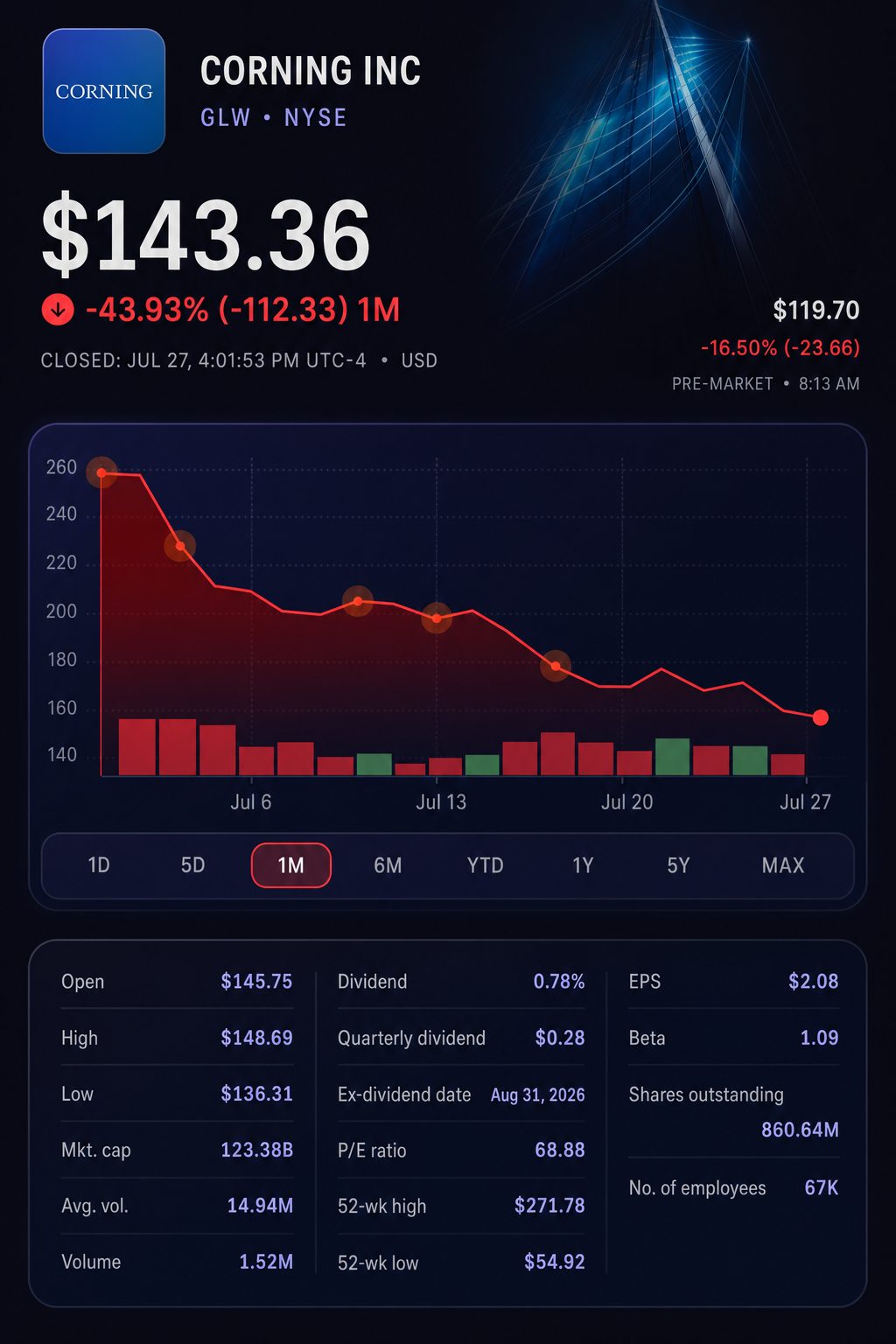
The stock was last trading close to $119 following the report, compared to Monday’s closing price of $143.36.
The Q3 midpoint suggests annualized core sales of $19.8 billion, which is 1% under Corning’s target for the end of the year.
Optical Communications accounted for 43.7% of core sales in the second quarter, a rise of five percentage points compared to the prior year.
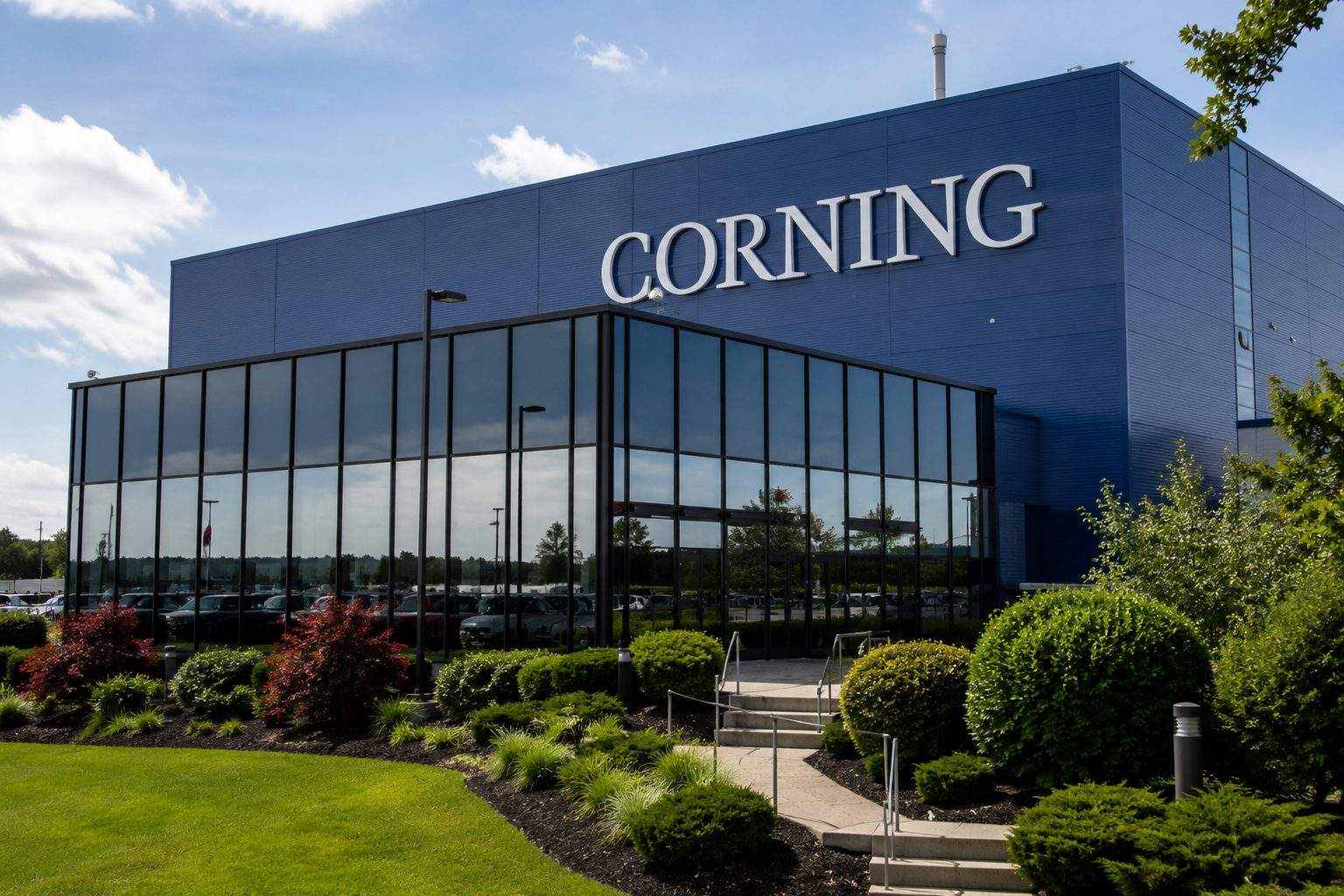
Shares of Corning Incorporated NYSE:GLW dropped roughly 17% in premarket trading on Tuesday. The stock was last seen around $119 after closing at $143.36 on Monday. If this loss holds, it would represent the company’s largest single-day decline since 2002.
The company surpassed expectations for second-quarter sales and earnings. However, the stock decline highlights increased skepticism over its AI-fiber growth prospects.
The company projected third-quarter core sales between $4.9 billion and $5 billion, with a midpoint of $4.95 billion, landing 0.8% lower than FactSet’s consensus estimate of $4.99 billion. Meanwhile, the midpoint of expected EPS exceeded forecasts by 2.4%.
The composition is important. Corning’s sales midpoint annualizes to $19.8 billion, just 1% off the company’s end-2026 target. The goal appears within reach. The upside surprise, however, was not expected.
Metric
Corning result or midpoint
Benchmark
Gap
Q2 core sales
$4.74 billion
$4.63 billion consensus
+2.4%
Q2 core EPS
$0.78
$0.76 consensus
+2.6%
Q3 core sales
$4.95 billion
$4.99 billion consensus
-0.8%
Q3 core EPS
$0.87
$0.85 consensus
+2.4%
Annualized Q3 sales pace
$19.8 billion
$20 billion 2026 goal
-1.0%
Core metrics exclude GAAP. Corning posted GAAP sales of $4.51 billion and earnings per share of $0.64. The table displays guidance midpoints alongside FactSet consensus projections.
The quarter delivered solid results. Core sales increased by 17%, and core EPS advanced 30%. Core operating margin gained 190 basis points, reaching 20.9%.
Cash conversion saw further gains. Adjusted free cash flow rose to $1.42 billion, surpassing three times the $451 million posted a year earlier.
The main driver was Optical Communications. Revenue surged 32% to $2.07 billion, while segment income climbed 77% to $438 million.
The segment accounted for 43.7% of Corning’s core sales, up from 38.7% the previous year, according to company data. Sales in Enterprise Networks jumped 65%, driven by generative-AI offerings.
Growth outside the optical segment showed weaker performance. Glass Innovations revenue increased by only 1%. Sales in Life Sciences and Emerging Growth Businesses fell 15%.
Solar revenue jumped 90% to $438 million, though the division reported a $7 million loss. Management anticipates improved profits in Q3 following maintenance work and equipment improvements.
Corning CEO Wendell Weeks said the company is “entering a new phase of accelerating growth.” Corning aims for $30 billion in annualized sales by 2028 and $40 billion by 2030. Business Wire
These objectives are supported by major customer agreements. Amazon.com NASDAQ:AMZN entered into a multiyear, multibillion-dollar supply pact. Corning additionally revealed a long-term collaboration with NVIDIA NASDAQ:NVDA.
The collaboration with NVIDIA targets a tenfold increase in U.S. connectivity manufacturing output. Corning intends to expand U.S. fiber production capacity by over 50%.
Investors had previously responded positively to that narrative. Corning’s shares were up 64% for the year as of Monday, though they had dropped 47% since peaking on June 30. The stock declined by 5.1% over the past week from Friday to Friday and slipped another 2.2% on Monday.
Shares in optical sector rivals also declined. Ciena Inc. NYSE:CIEN, Coherent Corp. NYSE:COHR and Lumentum Holdings NASDAQ:LITE dropped about 5% to 6% before the market opened.
Key updates are expected later this week. Corning will hold its earnings call at 8:30 a.m. ET. Meta Platforms NASDAQ:META, a significant buyer of Corning fiber, announces results on Wednesday, followed by Amazon on Thursday.
Risk concentration persists. AI-fiber demand may soften until additional capacity comes online. Demand from glass and life sciences stays subdued, and the solar segment has not reached profitability.
Corning is approaching its 2026 target, but has yet to meet market expectations. The difference—not performance in the second quarter—is the key signal for investors.
What is causing GLW shares to tumble even after reporting earnings above expectations?
Premarket pricing hovered around $118 to $121, representing a decline of about 16%-17%. The stock previously ended Monday’s session at $143.36. While core earnings exceeded forecasts, third-quarter guidance was roughly aligned with consensus. Shares were up 64% year-to-date and 160% over the past twelve months, so investors expected more than guidance merely in line with expectations.
Did Corning surpass analysts’ revenue expectations?
Corning posted core sales of $4.738 billion, reflecting a 17% increase from the prior year. GAAP sales were reported at $4.505 billion, also up 17%. Various media referenced consensus forecasts against core sales figures, describing results as a beat, while others measured against GAAP sales and labeled it a miss. In summary, core EPS results surpassed expectations, but revenue assessments vary depending on the metric used.
What was the performance of Corning's AI-based optical communications segment?
Sales in Optical Communications climbed 32% to $2.072 billion. Net income in the segment soared 77% to $438 million. Enterprise Networks sales saw a 65% jump, with Gen AI products posting even higher growth rates. Amazon agreed to a multiyear, multibillion-dollar supply deal during the quarter. NVIDIA’s collaboration will increase connectivity capacity tenfold and fiber capacity by more than 50%. Both announcements lack specific quarterly revenue breakdowns.
Does Corning’s outlook for the third quarter appear robust?
Corning projects core sales for Q3 in the range of $4.9 billion to $5.0 billion, and sees core EPS between $0.85 and $0.89, indicating an estimated 28% increase. FactSet consensus was for $4.99 billion in sales and $0.85 EPS. The sales guidance midpoint is 0.8% under consensus, and the EPS outlook is 2.4% higher. The results are firm but do not represent a significant revision upward.
Is Corning seeing better margins and higher cash flow?
Core gross margin climbed to 39.6%, up 120 basis points. Core operating margin increased 190 basis points to 20.9%. Core return on invested capital advanced 180 basis points, reaching 14.9%. Adjusted free cash flow totaled $1.42 billion, compared to $1.72 billion in operating cash flow. Quarterly cash flow may fluctuate with working capital, so projecting annual figures can be unreliable.
Is Corning's reliance on optical communications increasing too much?
Optical Communications accounted for about 44% of core sales in the second quarter. Sales from Glass Innovations edged up 1% to $1.463 billion. Automotive posted a 2% sales increase, while Life Sciences and Emerging businesses recorded a 15% drop. As a result, most incremental growth depends on optical communications and solar. The heavy concentration increases exposure to fluctuations in AI spending and the timing of large customer orders.
Can Corning’s solar segment emerge as a significant contributor to profits?
Solar revenue climbed 90% to $438 million, though the division reported a $7 million loss. In the same quarter of 2025, it posted a $2 million profit. Corning finalized its wafer plant closure and completed equipment modernization. Executives anticipate stronger Solar earnings in the third quarter. The division is scaling up toward over $3 billion in revenue. The company did not release specific timing details or a margin outlook.
To what extent are Corning's long-term Springboard targets ambitious?
Corning is aiming for annualized revenue of $20 billion by the end of 2026, increasing to $30 billion in 2028 and reaching $40 billion by 2030, according to its internal plan. The company has also identified $27 billion and $35 billion as high-confidence targets. For the third quarter, the midpoint annualizes to roughly $19.8 billion based on a simple four-quarter projection. The longer-term targets are described as execution goals and not formal financial guidance.
Does the premarket decline present an attractive valuation for GLW?
GLW is trading at $120.52, roughly 37.7 times projected 2026 earnings based on the most recent consensus forecast of $3.20 per share. The stock's price is about 28.3 times the 2027 earnings estimate of $4.26 per share. Estimates may be revised following today’s results and management’s remarks. The drop significantly reduces valuation, though strong growth expectations remain factored in.
What factors may impact GLW stock in the week ahead?
Corning will hold its earnings call at 8:30 a.m. ET on July 28. Key discussion topics are expected to include the timing of orders, customer-driven expansion efforts, and solar segment profitability. Investors will also watch commentary on free-cash-flow resilience and full-year earnings outlook. Immediate challenges identified are execution on capacity, foreign exchange, tariffs, and subdued demand for non-optical products. Revisions to price targets and estimates could influence trading activity in the coming week.
Khadija Saeed is a financial markets reporter at TS2.tech. Her coverage ranges from stocks and technology to emerging industries and developments across global markets. She studied economics and finance at the London School of Economics and worked in market research before becoming a financial journalist. Follow Khadija Saeed on Google News.
A figure above or below the 12.0 consensus could impact Treasury yields, the dollar, and cyclical stocks by influencing short-term growth outlooks.
#2
NAHB Housing Sentiment
A reading above or below 33 will influence expectations for housing demand, mortgage rate trends, and homebuilder stocks.
#3
Fabrinet After the Close
Investors are focusing on revenue, margins, and comments on datacom as key factors for companies involved in optical networking and AI infrastructure supply chains.