NEW YORK, July 28, 2026, 07:58 EDT — U.S. premarket trading.
- Adjusted EPS stood at $1.38, surpassing the consensus estimate of $1.28 by 7.8%.
- Payment volume climbed by 10%, while transaction margin dollars edged up by just 1%.
- The number of diluted shares dropped 9.7%, partly offsetting an adjusted net-income decrease of 11%.
PayPal shares were set to open 0.3% down at $56.07 on Tuesday. The company posted an earnings beat, but core profit drivers were more mixed.
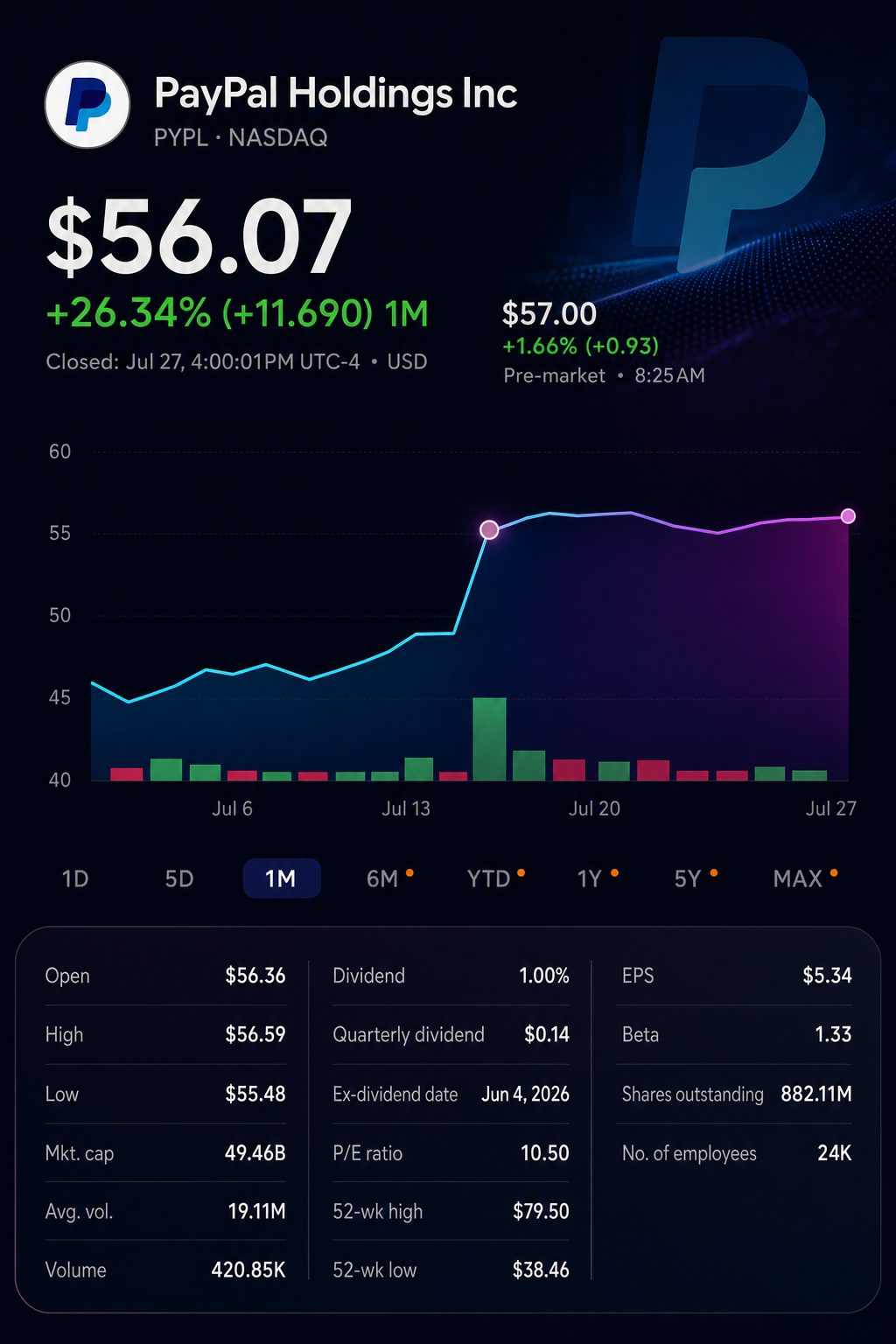
Adjusted net income declined to $1.22 billion compared with $1.37 billion. Weighted-average diluted shares decreased to 882 million from 977 million, which restricted the drop in adjusted EPS to 1%.
The company bought back approximately 33 million shares, spending $1.5 billion in the quarter. These rounded totals indicate an average repurchase price of about $45 per share. PayPal has repurchased close to 111 million shares over the past 12 months.
Those subsequent buybacks amounted to $6 billion, representing about 12% of PayPal’s existing market capitalization. The denominator is still a significant driver for earnings.
PayPal’s disclosed numbers highlight the growing gap between payment volume and profitability:
| Metric | Q2 2026 | Q2 2025 | Change |
|---|---|---|---|
| Revenue | $8.682 billion | $8.288 billion | +5% |
| Total payment volume | $486.448 billion | $443.547 billion | +10% |
| Transaction margin dollars | $3.900 billion | $3.844 billion | +1% |
| Adjusted operating margin | 17.4% | 19.8% | -248 basis points |
| Adjusted net income | $1.219 billion | $1.370 billion | -11% |
| Adjusted diluted shares | 882 million | 977 million | -9.7% |
| Adjusted EPS | $1.38 | $1.40 | -1% |
Based on figures provided by the company.
A straightforward look at yield highlights the difference. PayPal produced around $0.80 in transaction margin for every $100 handled, compared with approximately $0.87 during the same period last year.
Nonetheless, the main numbers beat projections. Revenue came in at $8.68 billion, surpassing the expected $8.47 billion. Adjusted EPS was ten cents higher than consensus.
PayPal increased its forecast for full-year adjusted EPS to approximately $5.38, signaling an estimated 1% rise from 2025. The company now projects annual transaction margin dollars at around $15.6 billion.
Chief Executive Enrique Lores said, “Our transformation is well underway.” PayPal aims to achieve $400 million in savings by the end of the year. The broader initiative plans total savings of $1.5 billion over a period of two to three years. Q4 Investor Relations
The breakdown by product showed mixed results. Branded checkout increased by 2%, consistent with growth seen in the first quarter. Debit and tap-to-pay transactions climbed over 60%.
Buy-now-pay-later transactions climbed by 26%. Monthly active users of Venmo debit saw an increase of over 50%. However, these quicker products have yet to drive faster growth in core checkout.
Account expansion remained modest. The number of active accounts hovered at close to 439 million, declining by 200,000 from the previous period. Total transactions increased by 8%, and transactions per active account went up by 3%.
Quarterly results were propelled by engagement rather than an increase in user numbers. While higher volume benefited, margins continued to rely largely on the product mix.
PayPal’s outlook for the third quarter is weaker, with the company projecting adjusted EPS will fall by a low-single-digit percentage. Analysts, based on LSEG data, had anticipated a 0.4% decline.
The gap accounts for the subdued reaction in premarket trading. Investors are now anticipating a recovery in margins rather than another boost to the denominator.
M&A continues to serve as a reference point for valuation. Reuters cited sources familiar with the situation who said Stripe and Advent made a $60.50-per-share proposal. No agreement has yet been confirmed.
The current bid is roughly 7.9% higher than Tuesday’s premarket signal. This gap signals not only some uncertainty regarding the transaction, but also anticipation for an increased bid.
Risks are still apparent. Margin challenges may extend beyond the current cost-cutting initiative. Apple NASDAQ:AAPL and Alphabet NASDAQ:GOOGL continue to grow built-in payment solutions. Weak consumer demand or an unsuccessful deal process could add further pressure.
Related articles: NASDAQ:PYPL