Alibaba (NYSE:BABA) rises 5% on Moonshot report highlighting AI-cloud synergy

Alibaba (NYSE:BABA) rises 5% on Moonshot report highlighting AI-cloud synergy

NEW YORK, July 31, 2026, 16:05 EDT — U.S. markets have ended trading.

  • Alibaba finished the session at $122.28, rising 5.1%, bringing its gain over five days to 9.0%.
  • An article connected Moonshot with the acquisition of approximately 20,000 chips via Alibaba. Reuters has not independently verified the deal.
  • The next macroeconomic focus is Monday’s private China factory survey, with economists predicting a modest loss of momentum.

Alibaba Group Holding Limited (NYSE:BABA; HKG:9988) ended Friday’s session up 5.1% at $122.28. The stock gained after a report connected its cloud infrastructure to Moonshot’s artificial intelligence models.
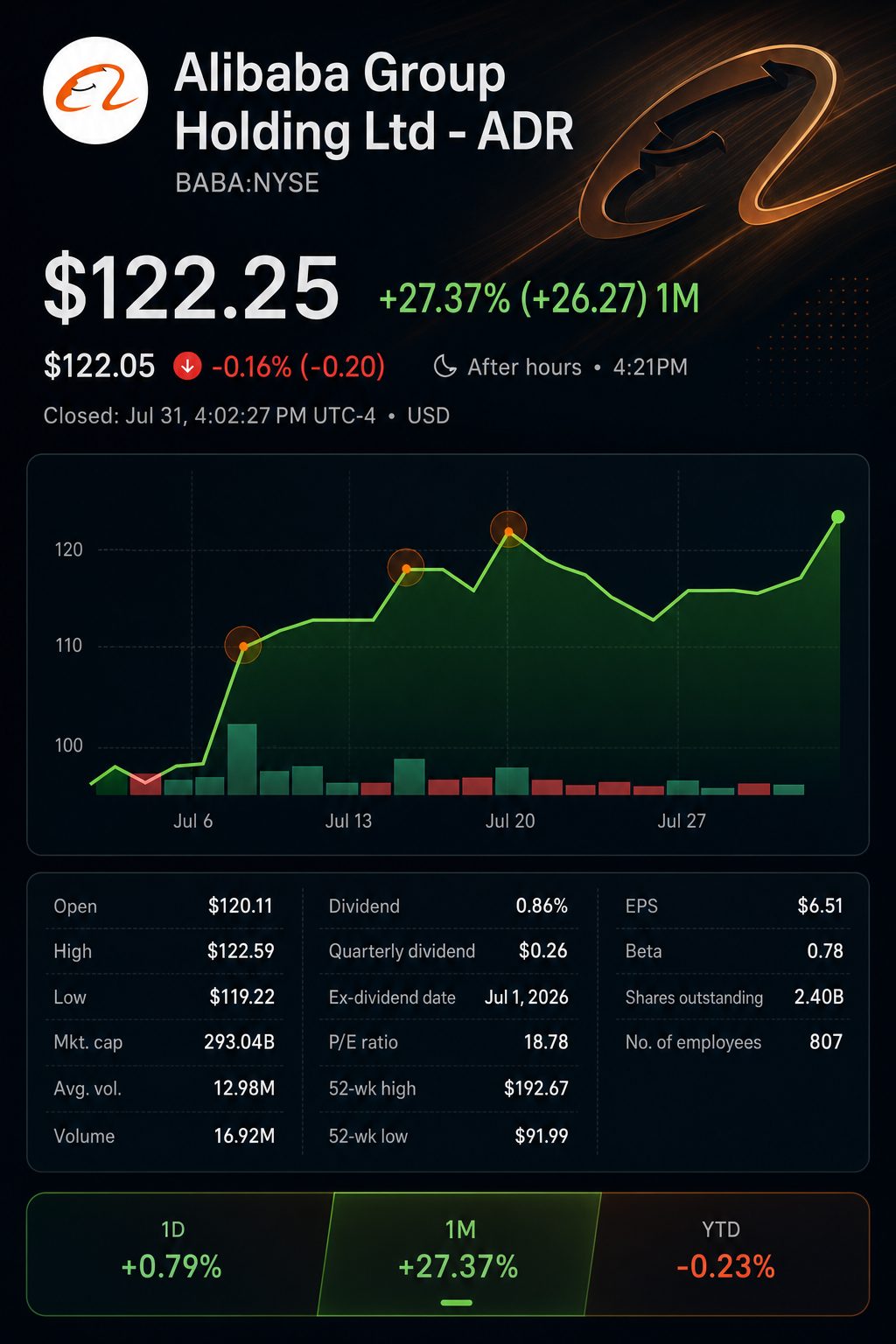
Stock chart for NYSE:BABA

The development is significant as Alibaba looks to spend more than 380 billion yuan on AI over three years. Sector outperformance indicates that investors responded positively to proof that deployed capacity is attracting users.

Alibaba outperformed the China-internet benchmark by roughly 3.7 percentage points, and surpassed e-commerce rivals JD.com Inc and PDD Holdings Inc . The margin suggests the presence of a stock-specific AI premium.

Friday closePriceDaily moveGap versus Alibaba
Alibaba ADR$122.28+5.12%
JD.com ADR$33.01+2.17%-2.95 points
PDD ADR$88.56+1.28%-3.84 points
KraneShares CSI China Internet ETF (NYSEARCA:KWEB)$28.47+1.46%-3.66 points

According to Bloomberg, Moonshot’s agreement with Alibaba involved around 20,000 Nvidia Corp chips. This chip cluster is said to have delivered significant computing resources for Moonshot’s Kimi models.

The report referenced prior Hopper-generation processors. In a statement, Alibaba denied providing H200 chips, labeling the allegation as “completely groundless.” Reuters was unable to confirm the computing agreement independently. Reuters

Moonshot does not operate as a fully independent customer trial. Alibaba ranks among its top investors and anticipates that portfolio firms will adopt its cloud. As a result, the report backs usage, though widespread external demand is still unproven.

Initial calculation: using Friday’s $5.96 increase on 2.28 billion shares suggests an additional $13.6 billion in market capitalization. Trading volume was approximately 16% higher than its 65-day average.

This week’s rally extended beyond Friday’s trigger. Alibaba’s ADR climbed 9.0%, with its Hong Kong-listed stock up 6.4%. KWEB increased approximately 8.3%.

SecurityJuly 24 closeJuly 31 closeWeekly move
Alibaba ADR$112.14$122.28up 9.0%
Alibaba Hong Kong sharesHK$110.00HK$117.00up 6.4%
KWEB$26.29$28.47up 8.3%

The ADR is still down 36.5% from its 52-week peak of $192.67. While Friday’s gains boosted some investor sentiment, the previous drop in valuation has not been recovered.

Alibaba’s recent cloud expansion is almost aligned with leading U.S. firms. Cloud Intelligence revenue climbed 38% in the March quarter. Amazon.com Inc posted 37% cloud growth, whereas Microsoft Corp saw Azure increase by 43%.

Cloud providerLatest reported growthMeasurable monetization signal
Alibaba Cloud+38%AI offerings contributed to 30% of external cloud sales
Amazon Web Services+37%Fastest expansion in over four years
Microsoft Azure+43%Cloud backlog climbed to $678 billion

The periods and reporting approaches vary, but Alibaba remains in a comparable growth range. The more challenging issue is whether this growth will translate into higher margins.

Bill Birmingham, the managing director of REX Financial, stated that investors are currently seeking “visible, near-term revenue and margin expansion.” While the Moonshot report deals with revenue clarity, it provides limited data on margins. Reuters

In May, Chief Executive Eddie Wu stated that Alibaba’s investments were “beginning to pay off commercially.” However, adjusted EBITA dropped 84%, and quarterly revenue came in below the LSEG consensus. Spending on AI infrastructure and quick-commerce accounted for most of the financial strain. Reuters

China’s official manufacturing Purchasing Managers’ Index declined to 49.2 in July, marking the lowest level in five months. The non-manufacturing index also slipped, reaching 49.0. Continuing sluggish domestic demand is weighing on Alibaba’s broader commerce segment.

Monday kicks off with the RatingDog manufacturing PMI release. Reuters’ poll projects a reading of 51.5, compared to June’s 51.7. Alibaba’s investor site does not show any scheduled corporate events for the week.

Risks are still significant. The Moonshot deal has not yet been confirmed. U.S. regulations limit access to advanced chips, and outlays on AI and quick-commerce could continue to weigh on margins. Sluggish demand from Chinese consumers may also counterbalance gains in cloud services.
TS2 TECH • EXTENDED COVERAGE

Further analysis

What drove Alibaba shares in the most recent session?
Alibaba’s U.S.-listed ADR ended Friday, July 31, at $122.28, a gain of 5.12%. Reports indicated Moonshot may have accessed roughly 20,000 Nvidia Hopper chips via Alibaba’s computing platforms. Alibaba denied providing H200 chips, with some elements of the reports remaining contested. Despite the rally, shares stayed 36.5% beneath their $192.67 high. Investing.com
What were the actual results in Alibaba’s most recent earnings report?
Alibaba posted a 3% increase in revenue for the March quarter, reaching RMB243.38 billion. Excluding the impact of the disposed Sun Art and Intime units, underlying revenue grew 11%. GAAP net profit climbed 96% to RMB23.50 billion, mainly due to investment returns. However, adjusted EBITA declined 84% to RMB5.10 billion, and non-GAAP net profit dropped sharply to RMB86 million. Business Wire
Are gains in cloud and AI robust enough to shift the narrative?
Alibaba’s cloud division remains its main growth driver. Cloud revenue for the March quarter climbed 38% to RMB41.63 billion. Revenue from external customers advanced 40%, with AI products accounting for 30% of this figure. Cloud-adjusted EBITA rose 57% to RMB3.80 billion. AI-related revenue recorded triple-digit gains for the eleventh straight quarter. Business Wire
What caused the sharp decline in operating profit?
Alibaba reported a loss of RMB848 million for the March quarter, after posting a profit of RMB28.47 billion a year earlier. Sales and marketing spending climbed to RMB53.42 billion compared to RMB36.18 billion. Product development expenses increased to RMB18.96 billion from RMB14.93 billion. The company attributed the cost pressures to quick commerce expansion, the Qwen acquisition, and investments in cloud infrastructure. Business Wire
Is performance strengthening in Alibaba's main commerce segment?
Core commerce saw minimal growth, whereas quick commerce posted significantly faster gains. E-commerce revenue declined by 1% to RMB96.29 billion for the March quarter. Customer management revenue increased 1%, or 8% on a comparable basis. Revenue from quick commerce surged 57%, reaching RMB19.99 billion. Despite this, China e-commerce adjusted EBITA slid 40% to RMB24.01 billion. Business Wire
How significant is the drop in free cash flow?
Alibaba’s immediate financial challenge is free cash flow. In the March quarter, the company reported an outflow of RMB17.30 billion, compared to an outflow of RMB3.74 billion in the same period a year earlier. For the full year, free cash flow shifted from a positive RMB73.87 billion to a negative RMB46.61 billion. Capital expenditure for fiscal 2026 totaled RMB126.06 billion. Business Wire
Is Alibaba able to finance its investment plan and dividend payments?
Alibaba maintains strong liquidity, with cash and liquid assets reaching RMB520.82 billion, or $75.50 billion. This is down from RMB597.13 billion the previous year. The fiscal 2026 dividend came in at $1.05 per ADR, for a total payout of roughly $2.5 billion. At a price of $122.28, the trailing yield stands at 0.86%. Business Wire
Is BABA considered inexpensive at around $122?
Alibaba appears to be trading at a low valuation on a GAAP basis, but looks pricier when considering adjusted earnings. The ADR, at $122.28, is valued at roughly 19.2 times projected GAAP EPS for fiscal 2026, while it is trading around 31.4 times non-GAAP EPS for the same period. GAAP results reflect significant investment gains, whereas adjusted figures factor in spending on growth. Shares remain down 36.5% from their 52-week peak, though this discounted price does not by itself suggest further upside. Business Wire
What are analysts expecting, and when is the upcoming catalyst?
Outlooks are positive, though estimates vary significantly. Two leading aggregators now show average price targets between $187 and $190, which signals a potential upside of 53% to 55% from Friday’s closing price. Targets from various sources range from approximately $92 up to $242. Alibaba has yet to officially confirm the date for its upcoming earnings report. External calendars indicate the announcement could fall between August 26 and August 28, but the exact date is still unconfirmed. MarketBeat
What factors might undermine the bullish outlook?
Policy risk has increased once more. In June, the Pentagon included Alibaba on its list of companies linked to the military. Alibaba responded with a lawsuit, arguing the designation was not supported by facts or law. Access to advanced chips also continues to be subject to shifting U.S. export controls. Alibaba’s annual report also notes VIE and Chinese regulatory uncertainties. Collectively, these factors could postpone a sustained improvement in valuation. Reuters

Iwona Majkowska is a financial markets journalist at TS2.tech, specializing in stocks, artificial intelligence and technology. A graduate of the Warsaw School of Economics, she previously worked in equity research and financial analysis before focusing on market reporting. Her daily coverage helps investors follow major developments across U.S. and global markets. Follow Iwona Majkowska on Google News.

AI PORTFOLIO

Top Stock Picks

Today’s highest-ranked model selections.

#1 STRONG BUY

Xylem

NYSE: XYL 94 / 100
#2 STRONG BUY

AerCap

NYSE: AER 92 / 100
#3 BUY ON WEAKNESS

Visa

NYSE: V 90 / 100
#4 BUY

Chevron

NYSE: CVX 86 / 100
#5 ACCUMULATE

UPS

NYSE: UPS 84 / 100
View full portfolio
Editorial model selection. Not personalised advice.
Linde plc (NASDAQ:LIN) Shares Fall 6% After Capex Boost Surpasses EPS Gain
Previous Story

Linde plc (NASDAQ:LIN) Shares Fall 6% After Capex Boost Surpasses EPS Gain

Next Story

U.S. stocks climb as AI-driven surge sidesteps small caps