NEW YORK, August 1, 2026, 11:10 EDT — U.S. markets have closed.
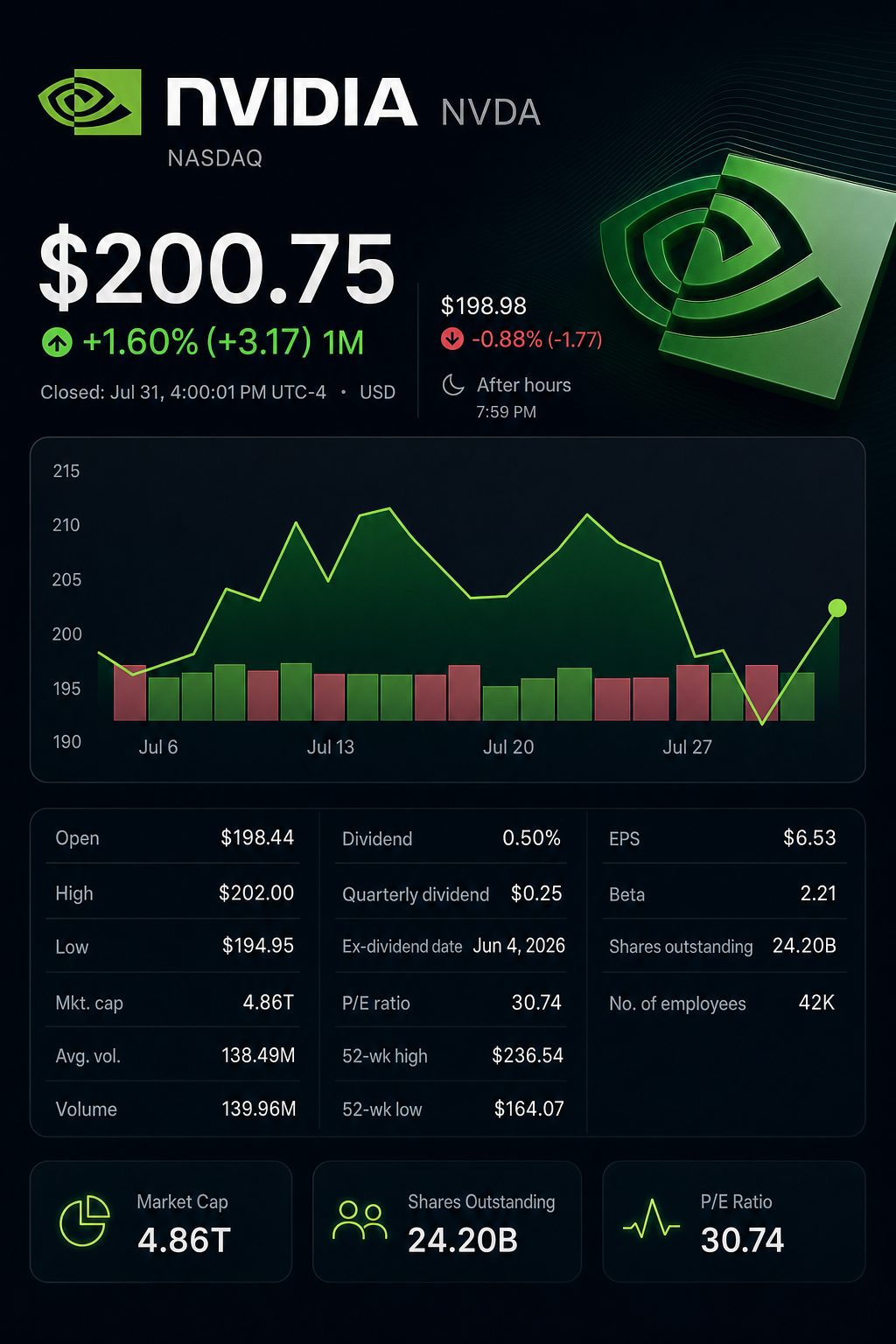
Nvidia finished Friday at $200.75, rising 2.9%, to reclaim the top global market-cap position. The company’s value, about $4.90 trillion, surpassed Apple NASDAQ:AAPL, which declined 7.1%.
Nvidia received a fresh boost from its clients. Amazon.com NASDAQ:AMZN increased its capital expenditure outlook for 2026 to $220 billion, following a 37% rise in AWS revenue.
The three major cloud purchasers disclosed $140.1 billion in capital expenditures for their most recent quarters. Although these totals are based on varying accounting standards, the combined figure stands 54% higher than Nvidia’s projected $91 billion in quarterly revenue. However, only a portion of this spending will benefit Nvidia.
| Cloud buyer | Reporting period | Reported capital outlay | Demand or spending detail |
|---|---|---|---|
| Amazon.com NASDAQ:AMZN | Q2 2026 | $54.2 billion | Spending on PP&E; total 2026 plan lifted to $220 billion |
| Alphabet NASDAQ:GOOGL | Q2 2026 | $44.9 billion | AI infrastructure accounted for most expenses; 60% of tech spend allocated to servers |
| Microsoft NASDAQ:MSFT | Fiscal Q4 2026 | $41.0 billion | Roughly two-thirds spent on short-term assets, primarily CPUs and GPUs |
| Combined | — | $140.1 billion | 1.54 times Nvidia’s Q2 revenue guide |
Data provided by the company. Definitions vary, and some expenditures are not linked to AI or are not areas Nvidia can target.
Amazon reported its cloud services backlog rose to $496 billion, up from $364 billion in the previous quarter. CEO Andy Jassy commented, “Even at that amount, we will still not have enough capacity.” Reuters
Nvidia does not hold exclusive access to this spending pool. Amazon reported that both its AI and chip operations have individually surpassed a $25 billion annual run rate. Meanwhile, Alphabet has started offering TPU systems directly to customers for installation in their own data centers.
Jensen Huang raised expectations in May. Nvidia’s chief executive told analysts, “We should be growing faster than hyperscale capex.” The company’s earnings release on August 26 will challenge that assertion. Reuters
| Company | Friday closing price | Change for the day | Market capitalization |
|---|---|---|---|
| Nvidia | $200.75 | +2.9% | $4.90 trillion |
| Apple | $308.91 | -7.1% | $4.55 trillion |
| Alphabet | $356.13 | +6.7% | $4.36 trillion |
| Microsoft | $464.72 | +3.0% | $3.46 trillion |
| Amazon | $271.58 | +15.3% | $2.95 trillion |
Market values shown are estimates.
Nvidia ended the week down 2.9% from July 24, despite a rebound on Friday, while the Nasdaq advanced 1.6%.
| Stock or index | Friday close | Weekly move |
|---|---|---|
| Nvidia | $200.75 | down 2.9% |
| Advanced Micro Devices NASDAQ:AMD | $476.15 | fell 8.8% |
| Taiwan Semiconductor Manufacturing NYSE:TSM | $404.25 | rose 0.2% |
| Nasdaq Composite | 25,373.85 | up 1.6% |
| S&P 500 | 7,489.72 | gained 1.0% |
Stock returns reflect closing values from July 24.
The trend points to an indication of consumer spending rather than a widespread surge in chip stocks. AMD shares fell 8.8% over the week, while TSM ended unchanged, backing up this view.
Nvidia started the quarter with significant momentum. Fiscal first-quarter revenue climbed 85%, reaching $81.6 billion. Data Center sales surged 92% to $75.2 billion. The company’s $91 billion forecast does not take into account any China Data Center compute revenue.
The spotlight turns to execution next week, moving away from budgets. AMD is scheduled to report after Tuesday’s market close, ahead of July payrolls data on Friday.
| Date and time, EDT | Event | Relevance for Nvidia investors |
|---|---|---|
| Monday, August 3, 10:00 | July ISM manufacturing PMI | Indicates overall demand trends, supply chain dynamics and possible inflation implications |
| Tuesday, August 4, after close | AMD fiscal Q2 results; call at 17:00 | Key check on server CPU and AI accelerator sales |
| Friday, August 7, 08:30 | July U.S. employment report | Could influence yields and how tech stocks are valued |
AMD projected second-quarter revenue at $11.2 billion, with a possible variance of $300 million either way. The midpoint figure indicates a 46% increase. Additional gains from accelerators could further underscore robust industry demand.
Risks: Purpose-built chips offer the potential to secure a larger share of each cloud-related dollar. Limitations imposed on China may decrease Nvidia’s total addressable market. Amazon’s free cash flow over the past year turned negative $7.6 billion as investment ramped up.
For Nvidia shareholders, the main issue is no longer if AI budgets are increasing, but if Nvidia can secure that expansion more quickly than clients bring chip development in-house. Only the first aspect was addressed on Friday.
Related articles: NASDAQ:AAPL