NEW YORK, August 2, 2026, 11:07 (EDT)
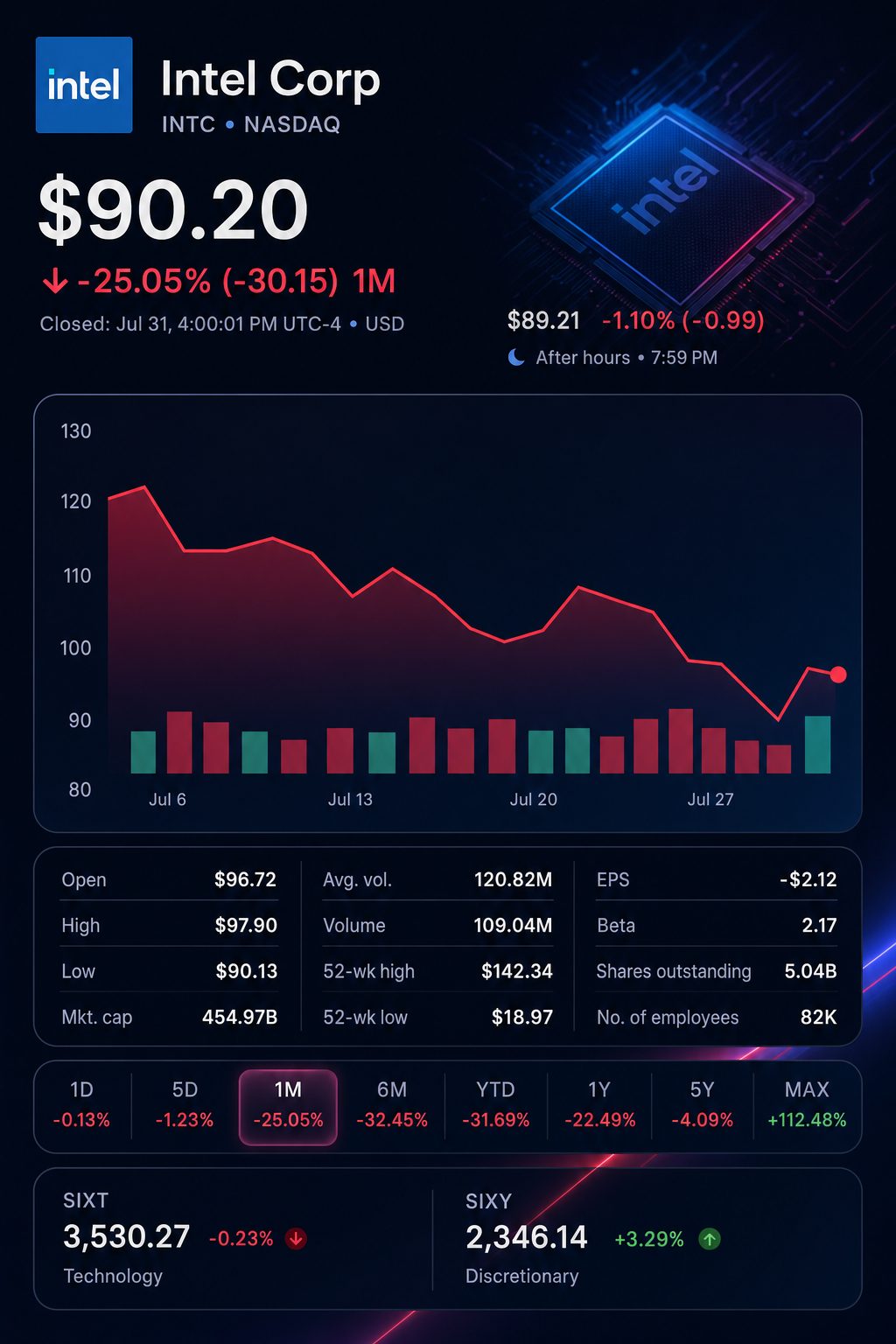
- Intel closed Friday at $90.20, down 2.3% from July 24.
- Server prices rose 48% in the second quarter. Unit shipments increased 9%.
- Advanced Micro Devices NASDAQ:AMD reports Tuesday after the market close.
Intel Corporation NASDAQ:INTC ended a volatile week lower, even after reporting 25% quarterly sales growth. The shares finished Friday at $90.20, down 2.3% from July 24. U.S. cash markets were closed Sunday.
The contrast puts growth quality at the center. Intel’s filing shows premium mix and pricing outpaced unit expansion.
Server average selling prices rose 48%, while units increased only 9%. Client prices climbed 27%, even as shipments fell 8%.
Friday-to-Friday moves show Intel beating AMD, but trailing the broad market. The stock returns below use July 24 and July 31 closes.
| Asset | Weekly change |
|---|---|
| Intel NASDAQ:INTC | -2.3% |
| Advanced Micro Devices NASDAQ:AMD | -8.8% |
| S&P 500 | +1.05% |
| Nasdaq Composite | +1.59% |
The tape remained unstable. Intel’s weekly low-to-high range reached 19.7%. It lagged Nasdaq by 3.9 percentage points.
Intel’s results beat pre-release consensus across revenue, earnings and margin. The gaps below are calculations from the reported figures.
| Q2 measure | Intel result | Pre-release estimate | Difference |
|---|---|---|---|
| Revenue | $16.13 billion | $14.42 billion | +11.9% |
| Adjusted EPS | $0.42 | $0.21 | +100% |
| Adjusted gross margin | 41.8% | 38.8% | +3.0 points |
Chief Executive Lip-Bu Tan called it Intel’s “strongest revenue growth in more than fifteen years.” Data-center and AI revenue reached $6.26 billion. Analysts had expected $5.37 billion. Intel Corporation
The regulatory filing gives a clearer view of that growth engine.
| Product business | Revenue evidence | Price change | Unit change |
|---|---|---|---|
| Client processors | $7.7 billion; up $1.1 billion | +27% | -8% |
| Server processors | Revenue up $2.0 billion | +48% | +9% |
Client revenue rose despite lower volume. Intel attributed most price gains to premium products. Demand-based increases played a smaller role.
Scarcity adds another edge. Intel expects client constraints to ease during the second half. Shortages of substrates, memory and other components may persist into 2027.
Foundry still lacked outside revenue at scale. External sales were $293 million, only 5.1% of segment revenue. They equaled 1.8% of Intel’s consolidated sales.
Foundry losses narrowed, though most revenue remained internal. The 2025 external figure below is derived from Intel’s reported increase.
| Foundry measure | Q2 2026 | Q2 2025 | Change |
|---|---|---|---|
| Segment revenue | $5.765 billion | $4.417 billion | +30.5% |
| External revenue | $293 million | $22 million | +$271 million |
| Operating loss | -$2.089 billion | -$3.168 billion | Narrowed 34.1% |
| Operating-loss margin | -36% | -72% | Improved 36 points |
Intel raised 2026 capital spending to $20 billion from $18 billion. Futurum Group strategist Shay Boloor tied further revaluation to one test. Intel must convert the shortage “into sustained revenue growth,” he said. Reuters
The third-quarter forecast sets a high near-term bar. Its midpoint stands well above pre-report consensus.
| Q3 measure | Intel forecast | Pre-report estimate | Forecast premium |
|---|---|---|---|
| Revenue | $15.8 billion-$16.8 billion | $15.1 billion | +7.9% at midpoint |
| Adjusted EPS | $0.38 | $0.27 | +40.7% |
Next week brings a direct industry check. AMD reports Tuesday after the close. Its prior guide called for $11.2 billion revenue and 56% adjusted gross margin.
The July jobs report follows Friday at 8:30 a.m. EDT. A preliminary Reuters poll estimate sees 83,000 jobs and 4.3% unemployment. The release could move yields and semiconductor valuations.
Risks: Shortages can delay shipments despite supporting prices. Faster relief could dilute premium mix and pressure margins. Foundry spending is rising before outside revenue becomes material.
AMD’s report will provide the next clean test of Intel’s pricing thesis.
Related articles: NASDAQ:AMD