NEW YORK, August 2, 2026, 12:00 (EDT) — U.S. cash markets have finished trading.
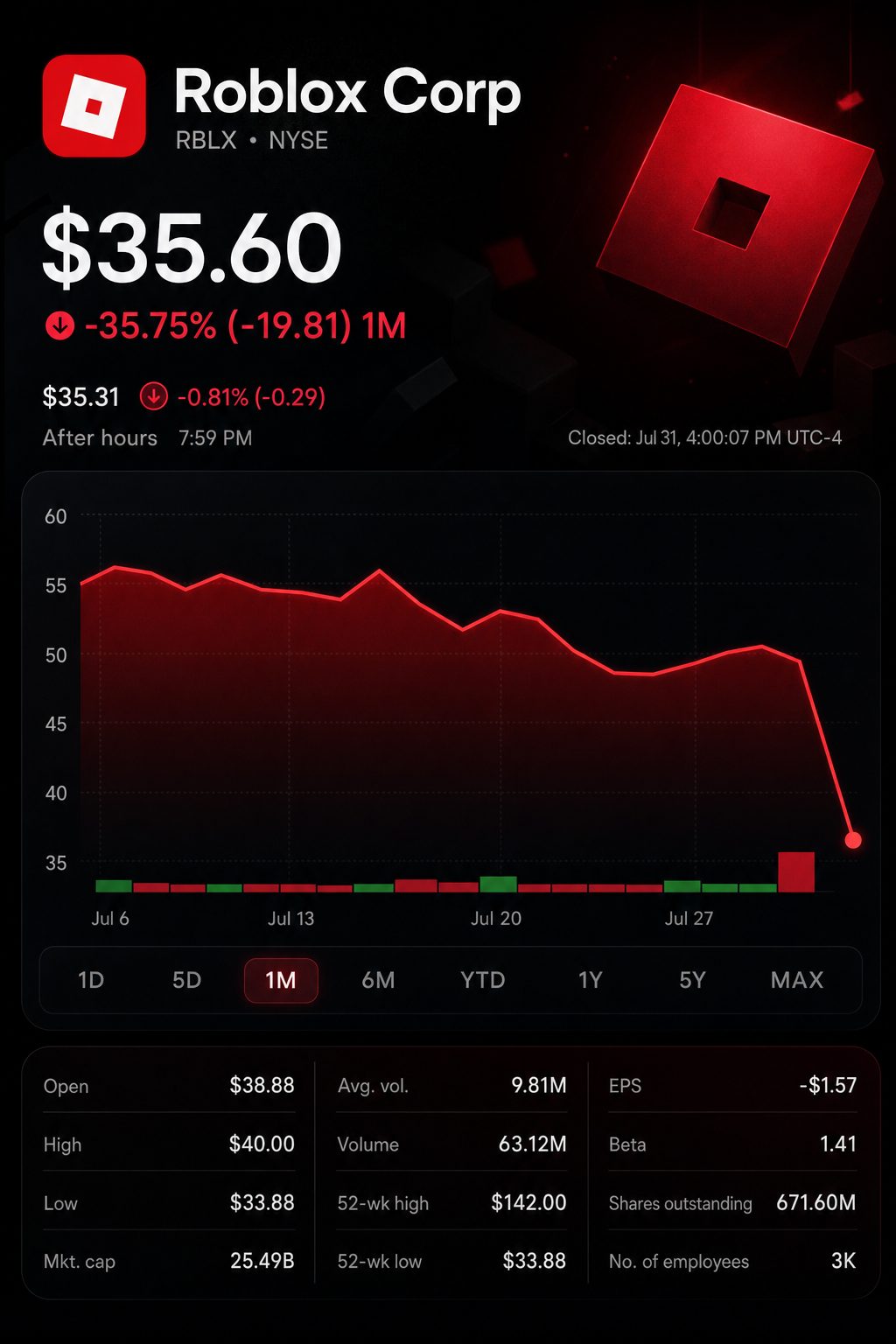
- Roblox ended Friday at $35.60, falling 26.9%. Shares dropped 25.1% for the week.
- At the midpoint of estimates, third-quarter bookings may decrease by 16.0%.
- Free cash flow may decrease by $470.5 million compared to the previous year.
Roblox shares recorded their steepest single-day drop on Friday after the company gave a disappointing bookings outlook. The stock ended the session at $35.60, falling 26.9%.
The key indicator for investors was not reported revenue, but rather the growing gap between current bookings and accounting revenue.
Roblox typically records the majority of its bookings throughout an average payer lifespan of 27 months. This allows previous spending to contribute to revenue even if present demand declines.
Friday saw a significantly deeper drop compared to other major peers in the gaming sector, while the wider market posted gains.
| Friday, July 31 | Close | Daily move | Market value |
|---|---|---|---|
| Roblox NYSE:RBLX | $35.60 | -26.9% | $25.5 billion |
| Unity Software NYSE:U | $31.71 | -4.9% | $13.8 billion |
| Take-Two Interactive Software NASDAQ:TTWO | $242.92 | -1.8% | $45.0 billion |
| S&P 500 | 7,489.72 | +0.7% | — |
Roblox shares dropped 25.1% over the week, while the S&P 500 rose 1.05%, indicating a repricing specific to the company.
Usage grew in the second quarter, but spending per user stayed flat.
| Second-quarter metric | Q2 2026 | Year-on-year change |
|---|---|---|
| Revenue | $1.469 billion | up 36% |
| Bookings | $1.557 billion | increased 8% |
| Daily active users | 123 million | rose 10% |
| Hours engaged | 29.0 billion | up 5% |
| Monthly unique payers | 27.0 million | gained 15% |
| Bookings per monthly payer | $19.25 | down 6% |
| Average bookings per DAU | $12.66 | fell 2% |
| Free cash flow | $294 million | jumped 66% |
The number of monthly payers increased by 15%, while bookings per payer declined by 6%. This reflects a wider base of participants, but with softer spending from each individual.
Management attributed the results to weaker monetization from younger users in the U.S. and Canada. The company was also impacted by a mix of lower-spending games and adjustments in discovery. Chief Financial Officer Naveen Chopra said: “Monetization weakness is likely to continue.” Q4 Stock Data
The outlook for the third quarter highlights the extent of that pressure. The midpoint adjustments shown below are derived from the company’s provided ranges.
| Metric | Q3 2025 | Q3 2026 company guide | Calculated midpoint change |
|---|---|---|---|
| Revenue | $1.360 billion | $1.413 billion-$1.490 billion | Increase of 6.7% |
| Bookings | $1.922 billion | $1.576 billion-$1.653 billion | Falls 16.0% |
| Operating cash flow | $546 million | $110 million-$175 million | Down 73.9% |
| Free cash flow | $443 million | -$60 million to +$5 million | Decline of $470.5 million |
The midpoint for bookings is roughly 8.8% under the $1.77 billion estimate from LSEG. Cash flow is declining at a pace that outstrips the decrease in revenue.
Roblox has discontinued its full-year guidance. As a result, investors must now rely on quarterly updates to determine if spending has levelled off.
Adult users provide the most significant opportunity for offset. In the U.S., those 18 and older generate more than 50% higher monetization rates than younger users. Their daily active user number increased by 32%.
Yet, adults made up just 27% of daily users who completed age verification. This group needs to grow further before it can compensate for reduced spending among younger users.
Benchmark’s Mike Hickey cut his rating on Roblox to Sell, noting the platform “may be entering lifecycle decline.” Roblox executives highlight potential for further growth among adults, as well as in advertising and commerce. Barron’s
Sector updates are due later this week. Unity will release its results on Thursday ahead of the market open, and Take-Two is scheduled to report on Friday.
Risks: Improved discovery features or accelerated adult user conversion may render the guidance cautious. Risks on the downside involve softer youth spending and increased expenses related to safety. Fines in the U.K. could total up to 10% of last year’s worldwide revenue in the event of violations.
Related articles: NYSE:RBLX