NEW YORK, August 3, 2026, 19:08 EDT — U.S. main trading session ended; after-hours trading remains active.
- Whirlpool is required to produce at least $1.408 billion in free cash flow during the second half.
- Whirlpool reported a 69% decrease in ongoing EBIT for the second quarter, with ongoing EPS turning to a loss of $0.21.
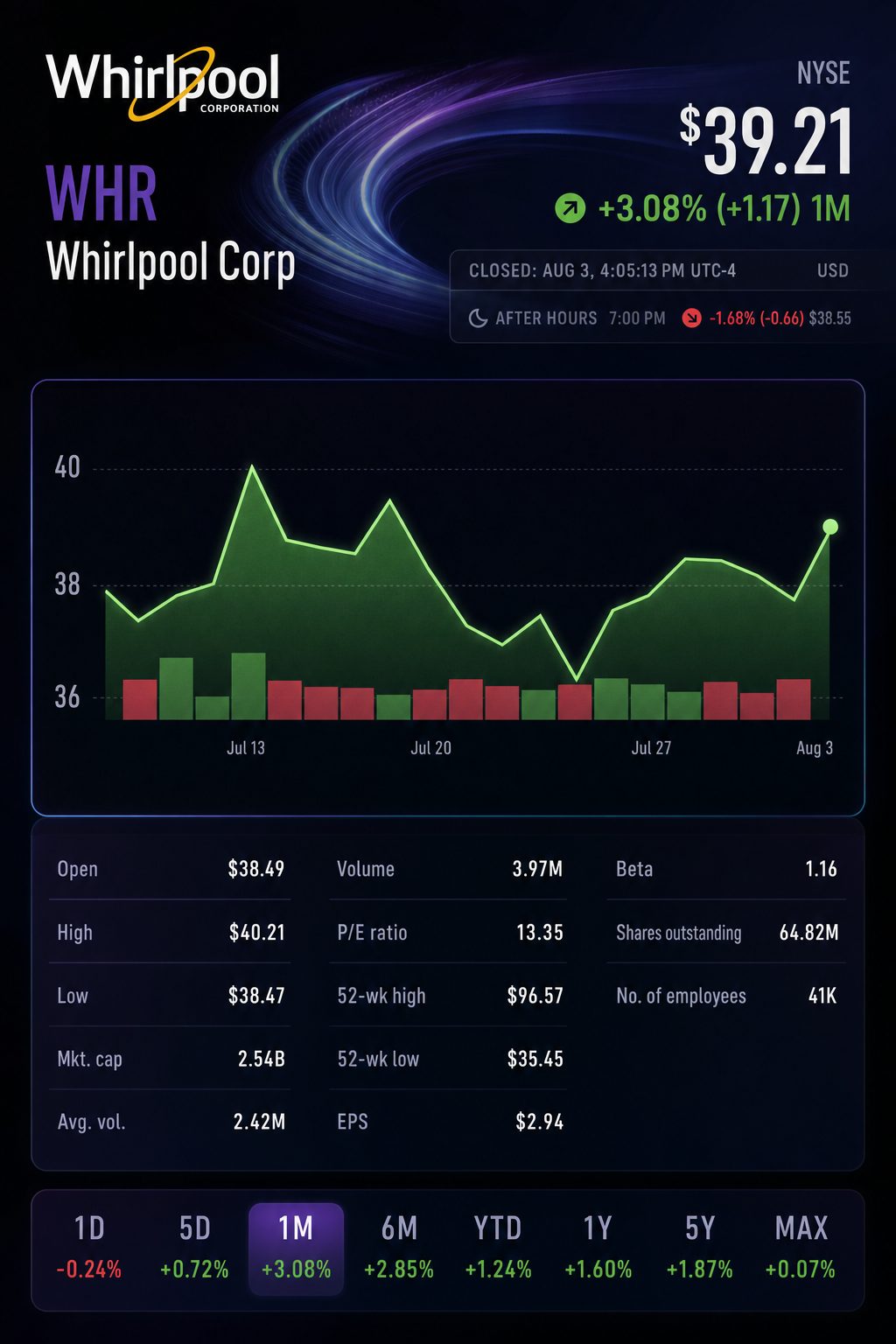
- The stock gained 4.6% on Monday, before falling 1.7% in after-hours trading.
Whirlpool Corporation NYSE:WHR is set to undergo a $1.4 billion cash challenge in the second half. Meeting its 2026 goal demands over $1.408 billion after June. The latest forecast also signals second-half ongoing EBIT near $524 million.
That earnings target is nearly fivefold the EBIT reported in the first half. The necessary ongoing margin for the second half stands at roughly 6.4%, compared with 1.6% up to June. This is the key point for investors.
| Preliminary execution bridge | H1 2026 actual | H2 2026 implied | Required change |
|---|---|---|---|
| Net sales | $6.790 billion | Roughly $8.210 billion | +20.9% |
| Ongoing EBIT | $106 million | Roughly $524 million | +394% |
| Ongoing EBIT margin | 1.6% | Nearly 6.4% | +4.8 points |
| Free cash flow | -$1.108 billion | Above $1.408 billion | Shift over $2.516 billion |
Initial estimates are based on Whirlpool’s sales forecast of about $15 billion, an ongoing EBIT reconciliation near $630 million and a free-cash-flow aim above $300 million, minus year-to-date actuals. Totals have been rounded and may not add up precisely.
The previous year’s results provide limited backing. Whirlpool produced $937 million in reported free cash flow during the latter half of the year. The latest target is over 50% above that level. The figure for 2025 factored in India, making direct comparison incomplete.
After the U.S. market closed, Whirlpool finished Monday up 4.6% at $39.21, but by 7 p.m. EDT, shares had slipped to $38.54 in after-hours trade, a decline of 1.7%. The stock had risen 0.6% the previous week.
The quarter was soft below the surface. Sales dropped 6.8%, and organic sales slipped 1.7%. Ongoing EBIT was down 69%.
| Second-quarter results | Q2 2026 | Q2 2025 | Change |
|---|---|---|---|
| Net sales | $3.517 billion | $3.773 billion | -6.8% |
| Organic net sales | $3.437 billion | $3.496 billion | -1.7% |
| GAAP net income | $75 million | $65 million | +14.2% |
| Ongoing EBIT | $62 million | $200 million | -69.1% |
| GAAP diluted EPS | $1.15 | $1.17 | -1.7% |
| Ongoing diluted EPS | -$0.21 | $1.34 | Not applicable |
| Ongoing EBIT margin | 1.8% | 5.3% | -3.5 percentage points |
Whirlpool identifies ongoing EBIT and ongoing EPS as non-GAAP metrics.
GAAP earnings showed a more positive picture. Net income increased by 14% to $75 million. Still, Whirlpool’s reconciliation excludes $133 million tied to M&A gains. The adjusted figure showed a loss of $0.21 per share.
Chief Executive Marc Bitzer stated he was “encouraged by the sequential margin expansion achieved in Q2.” North American margin rose by 240 basis points compared to the previous quarter, but declined by 320 basis points year over year. Whirlpool Investor Relations
All reported divisions posted lower margins compared with a year ago. Sales in Latin America rose by 7.8%, while EBIT dropped 46%. The strongest margin remained with small appliances.
| Whirlpool segment | Sales change | Q2 2026 EBIT margin | Q2 2025 EBIT margin | Margin change |
|---|---|---|---|---|
| Major appliances, North America | down 1.5% | 2.7% | 5.9% | decrease of 3.2 points |
| Major appliances, Latin America | up 7.8% | 3.0% | 6.0% | down 3.0 points |
| Small appliances, global | rose 0.5% | 11.9% | 17.3% | lower by 5.4 points |
Whirlpool’s profitability also trailed behind peers. AB Electrolux (STO:ELUX-B) posted a 3.8% operating margin before non-recurring items, while LG Electronics Inc. KRX:066570 achieved roughly 9.7% in its home appliances segment.
| Company or business | Q2 operating measure | Margin | Main qualifier |
|---|---|---|---|
| Whirlpool | Ongoing EBIT | 1.8% | Dropped 3.5 points from previous year |
| Electrolux Group | Operating income excluding non-recurring items | 3.8% | Tariff and retiree-plan benefit gains included |
| LG home appliances | Segment operating profit | About 9.7% | Accounted for tariff refunds, greater share of premium models |
LG’s margin is based on KRW686 billion in operating profit and KRW7.08 trillion in revenue. These three figures are not entirely comparable.
The comparison is constrained. Each company received U.S. tariff refunds and their business structures vary. Electrolux additionally reported a U.S. retiree-plan gain. Nevertheless, the gap highlights the scale of recovery underpinning Whirlpool’s target.
Management maintained its sales and margin outlook. However, it lowered both EPS forecasts due to higher interest costs.
| 2026 forecast | May 6 estimate | August 3 estimate | Difference |
|---|---|---|---|
| Net sales | About $15 billion | About $15 billion | No change |
| Ongoing EBIT margin | About 4.0% | About 4.0% | No change |
| GAAP diluted EPS | $2.45–$2.95 | $2.25–$2.75 | Midpoint fell 7.4% |
| Ongoing diluted EPS | $3.00–$3.50 | $2.50–$3.00 | Midpoint down 15.4% |
| Interest expense | About $300 million | About $350 million | +16.7% |
| Free cash flow | More than $300 million | More than $300 million | No change |
Figures for midpoint and percentage movement are initial estimates.
The $50 million rise in interest amounts to roughly 8% of the $630 million continuous EBIT reconciliation. The recent financing addressed short-term maturity risk, but did not relieve pressure on earnings. Whirlpool secured a $2 billion asset-backed line and sold $2 billion in secured notes. CFO Roxanne Warner stated the transactions had “extended our debt maturity profile.” Whirlpool Investor Relations
Whirlpool is set for its next test Tuesday, with its earnings call scheduled to begin at 8 a.m. EDT. Investors are expected to concentrate on working capital, price realization, and the trajectory toward the company’s 6.4% second-half margin.
Risks: The forecast hinges on significant working-capital release and stable pricing. Lower volume, tariffs, metals, fuel costs, or retailer destocking could offset margin progress. Failing to meet targets would hinder efforts to cut debt.